Anniversary after Death

Anniversaries are different after a loved one’s death. And there are more of them than there were before.

My first wedding anniversary after my husband died was/would have been our 25th. (Note my confused tense. Since he was gone, did I still count each new year as an anniversary? Or did the numbers freeze at 24, the last we spent together?)

Ten months into widowhood, I was “still” in shock. I remember only two things about my first widowed wedding anniversary:

  1. It hurt too much for “happy anniversary” greetings to be welcome.
  2. It hurt worse not having it acknowledged at all.

The kindest contacts let me know they were thinking of me — and of my loss. I read my friends’ support in texts, emails, Facebook messages, handwritten notes, and cards. Others left phone messages I heard later (because I didn’t feel inclined to answering the phone that day).

If you’re wondering whether (or how) to mention your friends’ wedding anniversaries after they’ve lost their spouses, here are some tips:

  • Say something before the anniversary if you can. For many bereaved, the days leading up to are as hard as (if not harder than) the day of. Even a belated acknowledgment is better than none.
  • Avoid cheery, cliché greeting-card greetings.
    Don’t say, “Happy Anniversary” as if this year is no different (even though you do wish them happiness).
    Don’t say, “Have a wonderful anniversary” (because without their beloved spouse that’s not likely).
  • Acknowledge the loss. Anniversaries after death are inextricably interwoven with that loss. Phrases like these are helpful:
    • I’m thinking of you as your anniversary approaches.”
    • You’re on my mind this week. I know this anniversary will be different.”
    •  “I know you’re missing your sweetheart.”
    • You’re in my thoughts and prayers.”

At the start of the post, I mentioned there are more anniversaries after a death than there were before. Death marks a family’s calendar with its own darkly circled dates.

All the “typical” commemorations are there — holidays and birthdays and, yes, wedding anniversaries.

But for anyone who has lost a loved one (parent, child, spouse, sibling, best friend …) the death-added days are there, too — the death date, the funeral date, the day the death certificate finally arrived, the day the cemetery marker was installed, and (in cases where death was expected due to illness) the dates of first symptoms, first diagnosis, hospice care, etc.  All are anniversaries of their own sorts.

Even when death was expected (and perhaps welcomed) at the end of a long, productive life (ultimately impeded by a painful, protracted illness), such “sadiversaries” or “angelversaries” carry pain for the survivors as much as they bring remembered relief for the release of the sufferers.

(A quick side note here: As “happy” as I was for my 54-year-old mother’s release from the cancer that entrapped her body, and as “grateful” as I was that my 47-year-old husband was no longer imprisoned by the premature deterioration of his mind, I was — and still am — neither happy nor grateful that either of them died so young. I’d have much preferred decades more together. So, please. Please don’t tell me — or anyone mourning — why we should be glad or thankful for our loved ones’ deaths. Grieving is not compatible with Pollyanna’s “glad game.”)

I’d say all such dates are difficult to get through during the first year, but that would do a disservice to everyone who has lost someone close to them. Love has no time limits. Neither does grief. I mentioned not remembering much about my first widowed anniversary, but I don’t remember the second one, either. The shock of widowed fog (and other grief) can — and often does — blur more than a single year’s worth of seasons. 

We will always mourn those we’ve loved, but we won’t always be consumed by that bereavement. Given time and encouragement, we learn to live with the grief. We learn to live in spite of it. We learn to live forward again.

But as anniversaries approach — even years later — we can always use expressions of loving help and caring encouragement from our friends.

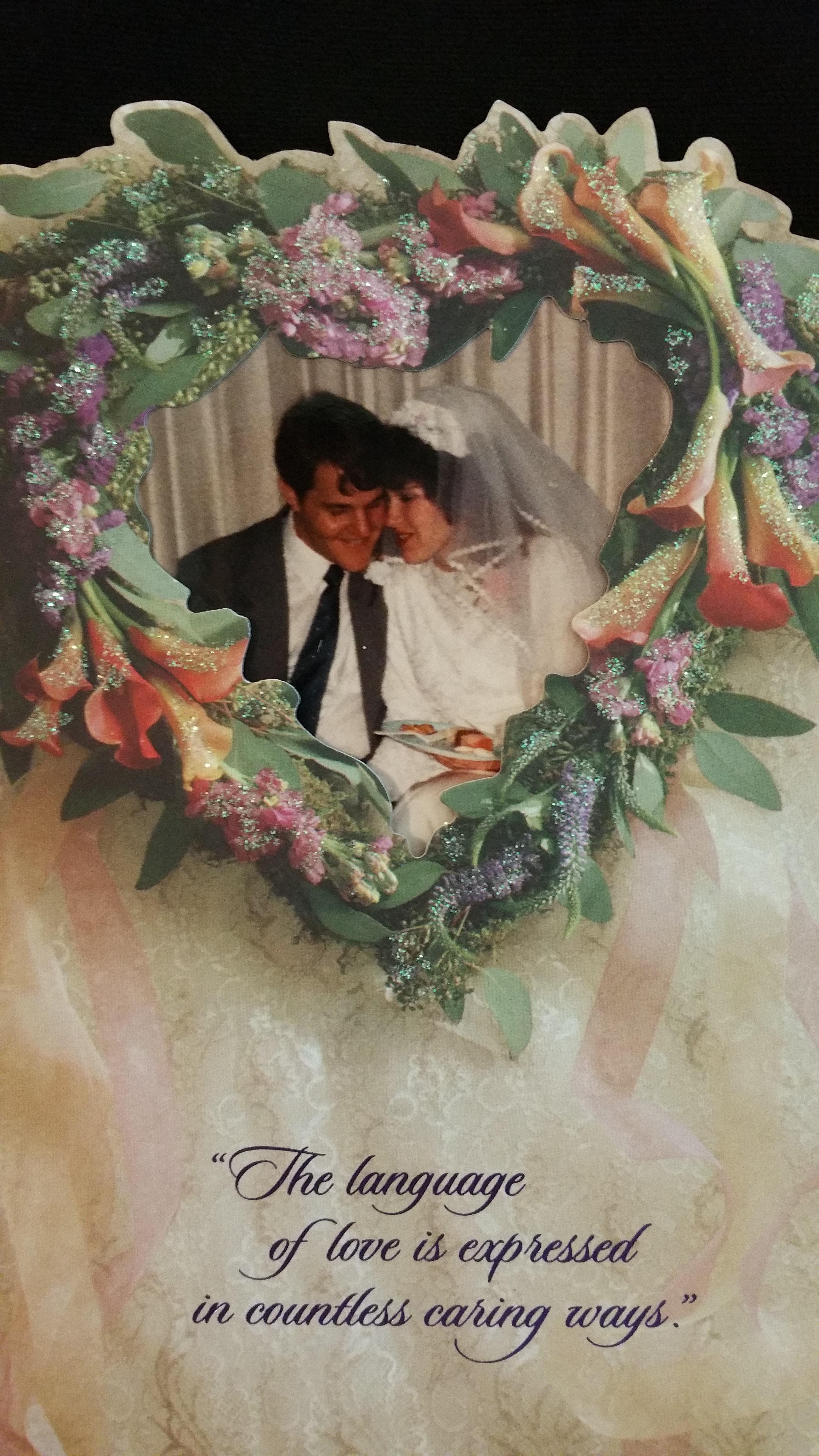
"The language of love is expressed in countless caring ways."

Snapshot taken by Mom, tucked in a Hallmark card from my late husband. Teresa TL Bruce, TealAshes.com


Putting the Widowed in a Box

I went for a checkup yesterday. I hadn’t been to that provider since the year my husband died, so I had to fill out a new medical history. How difficult filling out such forms used to be (and sometimes “still” is)! If you own or manage a business that requires personal information of its clients, make sure your paperwork and/or website includes “widowed” as a category.

At least this form offered me the option of "Other" where I could write in my own category: widowed.

At least this form offered me the option of “Other” where I could write in my own category: widowed.

I can’t count the number of times I sobbed through inadequate, limited options during the first year and a half after his death. (I do remember specific waiting rooms where people were leery enough of the crying woman to move to the other side of the room, sending not-so-furtive glances my way.)

When I was newly widowed,  EVERYTHING reminded me of my loss. It was hard enough coping with grief on a daily (sometimes hourly) basis. I hated having to acknowledge my husband’s death in clinical black and white on the many forms I had to fill out — and there were a LOT of forms. It was excruciating to complete paperwork that ignored the existence of my life-altered status.

  • I was not “single.” (I’d been married for 24 years and hadn’t done anything that changed or negated that. Neither had my husband — except for his dying.)
  • I was not “divorced.” (See above.)
  • I was not “married.” (Even though both of the above still applied, my spouse was no longer there — he was NEVER coming home.)
  • I was “widowed.” (Still am.)

Too often, company  (and government) forms offer no appropriate box for widows and widowers to check under “marital status.” On paper I write in my own category, even when there isn’t an option (or enough space) to do so. But online forms can incite scream-inducing, option-lacking frustration.

(And yes, during that first year or so, I sat at my computer and screamed at such websites — and at whatever offices or organizations had sent me to them — even though I had never been a person who screamed. But I’d never been widowed before, either.)

It has been nearly five years since my husband died. Socially, I’ve come to see myself as single again — most days, anyway.  But legally, “widowed” still feels like a better fit.

I still check the “Mrs.” box (rather than the ones for Ms. or Miss).* Online, that often opens a dialog box for my husband’s contact information. (Good luck trying to reach him, I think.) If I leave blank his current address and phone number, or type “deceased” (or, when I’m in a snarky mood, if I enter the word “cemetery”), such sites red-line my responses with please submit a valid phone number and street address. (Sometimes that makes me want to scream again.)

I don’t appreciate paperwork forcing me back to the start, forcing me to redefine myself according to its guidelines.

As a widow, I’ve had to do enough starting over — and redefining — for myself.

___

*If you don’t know what a widow prefers to be called (Mrs., Ms. or Miss), ask her. She won’t bite, and she’ll appreciate that you respect her enough to want to heed her preference.

Speak the Names of the Dead

what to say when someone dies

Speak the Names of the Dead (word cloud created on WordItOut.com)

People often mistakenly worry they’ll “make” grieving survivors feel sad by mentioning or alluding to their friends’ deceased loved ones. They’re afraid speaking up will remind them of the loss. There are two reasons this isn’t so:

  • You can’t “remind” a person of something they cannot (and should not and don’t want to) forget. Grief is rooted in love, and that love doesn’t die with the deceased. For the one grieving, no matter the relationship — bereaved parent, sibling, child, grandparent, best friend, spouse, aunt, uncle, niece, cousin, in-law, or other loving mourner — the loss is never forgotten. With time — more time than you can possibly imagine unless you’ve mourned a similar loss — the sadness will thin from a suffocating deluge to a gentle mist that moistens but no longer threatens drowning. It may at times seem imperceptible, but it never evaporates completely.
  • Most people who mourn loved ones fear that others will forget them. They may feel they have to hold tighter to the memories of their dear dead ones — because if they don’t, who will remember? Hearing others speak their dear ones’ names acknowledges they aren’t — and won’t be — forgotten. It frees them to mourn without fear of losing their memories.

Yes, your friends’ eyes may glisten (or pour) when you speak their loved ones’ names, but that’s not a bad thing. Sometimes grief fills a mourner full to bursting — and tears act as a pressure release valve.

It’s been nearly five years since my husband’s death and nearly twenty years since my mom’s. My life is rich and full (sometimes too full) and I’ve learned to live with the grief I still — yes, still — feel for them. (Thank heaven I’m way past the awful days, er, months when I blurted out variations of “My husband died” to everyone I encountered.)

But there are days when grief gets ugly again, not just for me, but for everyone who has lost someone dear. It sneaks up behind us and whispers cruel doubts about whether anyone else still cares they’re gone, about our ability to keep on keeping on, about the disloyalty of moving forward in our lives without them.

Those are some of the days when we most need to hear others speak their names. Tell us stories of what they did — good or bad.* If you knew them, tell us you miss them, too (no matter how long it’s been). If you didn’t know them, tell us you remember (and understand) that missing them goes on . . . long after they have.

___

*I realized after writing this that part of my thinking (and post title) draws on echoes of Orson Scott Card’s Speaker for the Dead. Its title character cautions survivors that he will speak the truth — the full truth — about the dead they wish memorialized.

Another Father’s Day–DANG IT!

Father’s Day, like so many special events, is “still” nearly as hard to face this fifth year as it was in the first years after my husband died. His absence (especially on days like these) still hurts me, but it cuts doubly for my children’s pain as they miss him, too.

I’m a person who draws great strength from my faith, but I’ve learned that on Father’s Day Sunday my worship is more focused from within the privacy of my home. (As much as I love the camaraderie of fellow worshipers, I cannot abide hearing the little kids’ adorable annual rendition of “I’m So Glad When Daddy Comes Home” and other sweet songs my children used to sing to their dad.)

TealAshes (Teresa TL Bruce)'s avatarWhat to Say When Someone Dies

Father’s Day. For three weeks I’ve written, revised, and discarded post after post, trying to decide what to say. It’s the night before, and I still don’t know …

I’m blessed and grateful that my dad is still here. He lives nearby and continues to be a rock of solid reliability. I can’t remember him ever directing an unkind gesture or a loud word my way (though when he spoke my full name in a certain tone I knew I’d crossed the line).

When I was a young, naive newlywed I remember my mother once telling me she hoped I appreciated how lucky we both were to have such good, kind men in our lives. I thought at the time that I did fully appreciate it.

Looking back now, I see how clueless I was, how little I understood. Since then I’ve seen glimpses, peeks at the hardships inflicted on many women and children because…

View original post 430 more words

Grieving Lost Minds: Go Purple for Alzheimer’s and Brain Awareness Month

Have you lost your mind?” For most it’s a rhetorical question, but for 47 million people, the answer is a tragic yes.

I’m not talking about “losing your mind” in heated moments when stress clutters thinking or when you’ve reacted rashly during a brief lapse in judgement.

I’m also not talking about the fog of grief that messes with your mind after loved ones die (although as a new widow I felt I had lost it).

I’m talking about dementia, a general term for impaired thinking caused by brain damage — dead brain cells. Whether dementia patients suffer because of injury, illness or age, they have literally lost parts of their minds. And that loss inflicts a unique grief.

I’ve written and rewritten this post for two weeks because, as much as I wanted to put the information out there, the topic is too close to home for me.  (More on that later.)

According to the Alzheimer’s Association, June is “Alzheimer’s and Brain Awareness Month,” and purple is its color.  You can find more information, including facts and ways you can help, by visiting their website here:
http://alz.org/abam/

Global facts and national statistics are important, but the devastation of dementia  is personal. It erodes people of every age, and it damages the health and well-being of patients’ families, too.

The grief and frustration of dementia come from living with two (or more) symptoms of life-impeding mental deterioration:

  • short- or long-term memory loss
  • illogical thinking or diminished reasoning
  • skewed sensory perception
  • unfocused attention
  • mangled communication

In many cases, patients recognize their own decline and grieve what they know they’ve lost. Let them know you recognize areas of cognition they still have.

Let them know you will “be there” to step in with them in whatever areas they need help in.

Let them know they can count on your friendship.

Other sufferers don’t recognize their own impairment and may resent the necessity of being cared for by others.  Caretakers need as much support as the patients.

I did.

My familiarity with “brain awareness” stems from other dementias which afflicted beloved, once-functional minds in my family.

I cared for Mom when breast cancer metastasized into her brain, and I catered to (and placated) her father when age dulled and bent his once razor-sharp mind. I listened as relatives on the other side of the country tended to spouses with mental deterioration from specific illnesses. I worked alongside family (and a wonderful home health aid) in dealing with my almost 95-year-old great-aunt’s diminished mental capacity.

And I endured the 24/7 stresses of my barely middle-aged husband’s mental deterioration.

He was 45 when symptoms appeared. At first, I didn’t realize my hubby’s occasional absent-minded lapses were evolving into debilitating short-term memory loss. One month he was “distracted” while paying bills,  and he mailed checks to company A (in amounts for company B’s invoices) inside envelopes addressed to company C. He returned from work or short errands with our car displaying an increasing number of dings, scrapes, and dents. (I later learned his spatial processing was amiss. More than once he “emptied” large, full trash cans “into” smaller, already full wastebaskets. Not successfully.)

By the time his boss called to express concern, things were worse. If asked to perform simple, familiar tasks in their necessary 1-2-3-4 sequence, my husband would dig right in — beginning with four, but completing it poorly. On good days he might then remember to do the first step (now out-of-order), but items two and three? — not at all.

A few months after that call, my husband began what we both hoped would be temporary medical leave as we sought answers and treatment for these (and other) increasingly bizarre symptoms he displayed. He was 46 when a neurologist, one of many doctors we’d seen, made a casual remark including the phrase, “… aside from your husband’s obvious dementia …”

(If my life had a soundtrack, this is where the record needle would SCREECH.) The voice in my head screamed, WHAT?!

I didn’t hear the rest of the neurologist’s sentence. I had to ask him to repeat it. 

Dementia?! That’s for old people, I’d always thought.

I had a lot to learn, and the school of experience was a harsh teacher.

Here’s what I wish I’d known then about how to support people who do or don’t recognize their own dementia — and how to support their exhausted, emotionally drained caretakers:

  • Give them a break. When one person cares for another round the clock, it gets to be too much. TOO MUCH. A change of face can give a boost to both the patient and the caretaker. Even if the patient is confused by the change in routine, even a brief respite can make a world of difference. Offer to sit with the patient (and show up) so the caretaker can get out and about. Or if health permits, take the patient to the store or out for a walk so the caretaker can tend to self-care or other tasks difficult to do with the patient.
  • Don’t take “no” at face value. Your help is needed, whether it’s asked for or not. I don’t mean for you to bully your friend into accepting the above offers, but be persistent and creative in finding ways to help that your friend can live with. If they won’t let you bring in dinner, send them a gift card (or even just a note of encouragement) in the mail. Do something.
  • It’s not worth fighting over. Patients with brain impairment see the world in illogical ways. Their warped perceptions are as vivid and real to them as yours are to you. Arguing to “make” them see reality is both pointless and cruel; it further upsets and agitates everyone, including those with already confused minds. Humor them whenever possible.

Here’s an oversimplified example I’ve fictionalized (by altering details) from one true situation. The father in this scenario, a retired teacher, is anxious and fidgety. “I don’t want to be late. They’re waiting for me.”

His adult children ask, “Who’s waiting, Dad?”

“I have parent conferences today. I need my students’ files so I can get their grades out.”

Each time the son says, “Dad, you retired ten years ago. You don’t have any students. You don’t have to go anywhere,” his father becomes more agitated.

When the daughter says, “Dad, it’s great that you don’t want to keep anyone waiting. You’re always on time. The parent-teacher conferences are done now. You turned in all the paperwork and grades before break started,” Dad (hopefully) is appeased, at least temporarily.

  • Safety first. Having said what I did about humoring the dementia patient, help the caretaker ensure safe practices. Enlist a doctor, home health aid, trusted friend, or neighbor to take away car keys when judgement or reflexes make driving unsafe. Install safety locks and/or alarms on doors and windows for patients prone to wander at 2:00 a.m. Remove the knobs on the stove in homes where a burner might not be turned off again. Lock up prescriptions for those who may think it’s a new day every time they doze off and take a week’s worth of morning medicines before afternoon.
  • Listen up, and let the tears flow. Crying can offer a healthy release of emotion for both patient and caretaker. The loss of mental function creates ripples of grief as caretakers mourn a myriad of associated losses. Future dreams are abandoned when a loved one’s personality dies bit by bit, changing their dear one into a helpless or demanding “stranger.”
  • Repeat. Whatever support you can offer will be appreciated and will make a difference, but as their loved ones’ ongoing deterioration chisels increasing degrees of independence and personality from them, your friends will need your help again.

And again.

Till death does them part.

Then the caretakers will need your understanding — again — as the permanence of new grief kicks in.

When that happens, don’t tell them how happy they should be their loved one no longer suffers.

Don’t ask if they’re relieved their responsibility is finally done.

No one should be made to express or justify grieving emotions until (or unless) they feel ready to do so. Just be with them in the meanwhile.

#ENDALZ #GOPURPLE

___

Each summer solstice, the Alzheimer’s Association sponsors The Longest Day to raise awareness (and funds). For information on this year’s team-oriented event (June 21), visit
http://act.alz.org/site/TR?fr_id=6650&pg=informational&sid=20684