Grief after Shooting in Orlando

Early Sunday morning, people were slaughtered in Orlando, my hometown. Forty-nine victims died on-site at Pulse Nightclub; more than 50 were hospitalized due to serious injuries inflicted in the attack; countless others’ lives are forever altered — traumatized survivors, witnesses, first responders, and their families. All of them. All of us.

It is tragedy. It is horror. It is pain.

vigil.2.061316

My first, panicked thoughts were for of one of my daughter’s dear friends, a young adult who has not come out to blood family but who (like many of my children’s friends over decades) has called me a second mom for years. My fingers shook as I texted, “Are you okay?”

I’m grateful — so grateful — this friend of ours replied immediately, was not at Pulse at that time, is physically okay. But this adult kid who calls me Mom … this young soul’s roommates lost many friends.

Being “okay” will never be the same again.

In the aftermath of most tragedy, we witness the best and the worst of humanity. At church hours after this happened, everyone I encountered spoke with tears in their eyes, with broken voices (and hearts), with compassion and pain for those impacted. Congregants were vocal in prayer for the victims and their families, of course, but even more vocal about the need to reach out in tangible help — to give blood, to be of support, to offer healing help and comfort. To love our neighbors.

I was proud, too, of the statement Orlando Mayor Buddy Dyer emailed to residents:
“Despite the fact that this crime will have a lasting effect on our city and country, Orlando is a strong community. We will be grieving together in the upcoming days, weeks and months. We need to support each other and love each other. This tragedy will not define us, but will bring us together.”  Well said, Mayor Dyer. Well said.

But I was appalled by other reactions — as if the hateful, terrorist acts of murder and mayhem weren’t appalling enough.

As I scrolled through social media after church — searching (like everyone else in and/or with ties to Orlando) for assurance regarding those I know — I couldn’t believe what I saw:

People were politicizing these lost and shattered lives.

I’m a proponent of free speech, and there’s a time and a place for most forms and reforms, but immediately after a tragedy —within hours, or even days! — is not the time or the place. Death does not invite discussion about dogma. Murder does not mean it’s time to moralize. Loss is not linked to knee-jerk legislation.

Loss should be only about loving the bereaved, mourning the missing, healing the hurt. Period.

Unless you are in the inner ring of mourning, it is not your place to voice your political or moral views on those who have been injured or who have lost loved ones. Significant others, immediate family, closest friends — these are the people who have the right to state (or not state) their views from within the LGBTQ community targeted by the shooter. These are the souls whose lives have been altered by the killer’s evil actions, who have the right to state (or not state) their positions on gun laws and ISIS and every other blame-relevant topic.

For everyone else, everyone not directly impacted, it is our place — and time — to offer love and support and help and presence while listening. (The time to legislate and protest and reform will come … but not at the cost of depersonalizing individual loss into broader causes. Not yet.)

People are mourning. Reach out to them. They will need your love and support not just now but in the weeks, months, and years to come. (In the meantime, if you can’t say something nice, don’t say anything at all.)

photos on this post provided by and with permission of harmonyebee


April Fool’s Day, Grief, and Humor — To Joke or Not to Joke

A woman gets into a car and snaps her fingers as she says to the driver, “I hear your husband died — just like that. Are you kidding me?”

As if I were the kind of person who would joke or kid about a loved one’s death.

The punchline in this true tale is that I didn’t punch her. (I tend to keep both hands on the wheel at 55 mph.) “Umm … no, I’m not kidding, and I really don’t want to talk about it right now” (what with concentrating on the doings of other I-4 drivers and not wanting to obscure my vision by crying).

She honored my wishes — sort of — for a full mile (which, at highway speed, wasn’t long enough) before opening her mouth to address the sudden death of someone else. “I had a friend whose husband keeled over without warning,” she said, sounding more thoughtful than she was being. “It really tore her up for a long time. She was never the same after that.”

Compared to her conversation, I-4 traffic seemed calming. My heart pounded as I gripped the wheel tighter and said, “I really, really don’t want to talk about this right now.” All of a month into widowhood, my very nerve endings were raw with emotion.

This time she stayed quiet nearly half a mile before opening her mouth again. “Your poor girls must be devastated. Weren’t they close to their father?”

“Be quiet,” I said too quietly. 

She continued, asking how on earth I was going to handle being a single mom.

“Stop. Talking!” I said. Louder.

She returned to the topic of how awful it was for her friend who never recovered after her husband’s death.

“BE QUIET!” I bellowed as loud as I could, far too loud for the confines of my car. “I DON’T WANT YOU TO SAY ANOTHER WORD — NO! NOT! ANOTHER! WORD!” The last part came as she began protesting. “DO NOT SPEAK AGAIN unless you want me so upset I drive this thing RIGHT OFF THE ROAD because I can’t see!” (Whether from rage or tears, I didn’t clarify.)

I’m not a screamer or a yeller. Never have been (except when cheering for my children and their teammates). But that day … I don’t think I’d ever been so angry at another human being , not counting the hospital orderly who asked, “How’re ya doin’?” while handing me the phone with the medical examiner’s office on the other end … But, no, he was at least doing his job — albeit horribly — while this woman just prattled on and on and on against my repeated requests otherwise.

I pulled off the highway and found our destination, bristling even at inane comments about the weather and the route.  I parked, found the hostess who’d invited us, and, car keys still in hand, pulled her aside. Without explanation, I said, “I’m sorry, but you need to find someone else to take her home.” I inclined my head toward the woman I’d given a ride. “I’m leaving.”

I had to take back roads to my house, not trusting myself to the interstate again.

To this day, the phrase “are you kidding me” screeches like sound system feedback against my psyche.

There really is no time or place or circumstance for anyone but the bereaved to be “kidding” or “joking around” about whether a loved one is dead or dying.

___

A sense of humor in a grieving heart is a beautiful but delicate thing. Photo by Teresa TL Bruce, TealAshes.com

A sense of humor in a grieving heart is, like a spiderweb, a beautiful but delicate thing. (Photo by Teresa TL Bruce, TealAshes.com)

Gentle, harmless April Fool’s Day pranks can be fun, but think twice — and then think twice again — before planning pranks on someone who is grieving. Humor is important and essential, but weaving humor into mourning requires intricate knowledge of the bereaved and delicate application. New, raw grief can make a person’s beautiful sense of humor into a fragile construction, as easily damaged as a spider’s web.

Before my husband died, I pulled April Fool’s Day pranks on my family every year. We’d also invite young missionaries from church to our house for dinner every April 1 and feed them foods that weren’t what they seemed. It was a fun tradition we all looked forward to.

I’ve only done it once as a widow. It seemed like too much trouble for a few laughs over a meal. This year, work deadlines and other projects mean I’m not likely inviting anyone over, but I may arrange a couple of small surprises for a few close people … (Shh … don’t tell …) 😉

___

Grief hurts. It’s sad and sorrowful and all-consuming. It’s easy to be swallowed by it, so when the bereaved have a chance to laugh and breathe the healing air of humor, it usually helps.

Laughter over funny things the deceased said or did can be especially healing. Most mourners yearn for a connection between their loved ones and those around them. If laughter turns to tears, that’s not a bad thing. When bereaved emotions are all-consuming, releasing one often releases another.

Mad Libs became a part of our family's humor culture that we continue to enjoy.

Mad Libs became a part of our family’s humor culture that we continue to enjoy.

Don’t be afraid to laugh with your grieving friends. Invite them to a funny movie or to play together a ridiculous party game at your house like Curses or  Mad Libs.*

Do tread lightly with grief-related humor. It’s one thing for a pair of widows to share a joke about the “joy” of not waking to anyone’s snores; it’s altogether different for someone outside that degree of grief to make light of what is yet another aspect of forced change.

Above all, LISTEN to what your friends say and honor their requests.

___

*Mad Libs are a registered trademark of Penguin Random House LLC. (As of this writing, I have no affiliation with Penguin Random House.) I’ve enjoyed these fill-in stories since I was a kid (and often wrote up my own versions); my husband and I introduced them to our kids when they were little, and they remain a family staple of road trips. And I have to say, my kids and I treasure the pages of our Mad Libs books with my late husband’s handwriting.

Regarding the game Curses, I’m not sure who came up with it, but the times I’ve played, I’ve laughed hard enough to cry — in a good way.

“Be Strong” Is Wrong (for Grieving Friends)

When someone dies, don’t tell survivors how strong they are. Tell them you’ll be strong beside them so they don’t have to — and follow through.

The first times people called me strong after my husband died, I had no idea how to respond. Their expressions and tones made it clear they’d intended to compliment me, but I couldn’t accept their words. I’d look at them, thinking, How can I say the expected “thank you” to such a blatant lie? 

I was as fragile as dandelion fluff.

Mourning made my feelings as fragile as overripe dandelion fluff. (photo by Teresa TL Bruce, TealAshes.com)

The truth was, I was broken, shattered into a million loosely gathered shards. The softest puff of sympathy or the least gust of gruffness might send my fragmented psyche as irretrievably into the wind as overripe dandelions in the hands (and breath) of enthused toddlers.

I was not strong. And it puzzled me that anyone might think I was.

I cried all the time. All. The. Time.

Everyday chores I’d mastered years earlier now confused me.

New tasks (including seemingly endless death-related business matters) overwhelmed me.

The sudden, sole responsibilities of single parenting had my knees buckling.

Strong, I was not. But that’s what was expected (and even demanded) of me. “Don’t cry,” some said. “You have to be strong for your daughters.”

Such words (though intended as encouragement) deeply shamed me. Being anyone else’s rock is a heavy burden when you’re scarcely able to hold onto yourself. 

Didn’t they realize how much strength seeped from me in getting out of bed each morning? Didn’t they know how much energy I exerted just remembering to breathe? Had they no idea how sucked away my strength felt after days and weeks and months of only sparse, grief- and nightmare-riddled, interrupted naps instead of genuine sleep?

Telling me how strong I was didn’t feel like a compliment. It felt like being told I could and should be able to handle everything on my own.

But I couldn’t.

Telling me I was strong didn’t make me feel capable. It made me feel like I wasn’t worthy of asking for help.

So I didn’t.

Sorrow saps strength. Grieving grinds it away. Bereavement burdens and bruises the body. Mourning makes mincemeat of memory.

So step in.

How can you offer your strength to grieving friends?

  • Help your mourning friends with physical tasks like mowing the lawn or shoveling snow or washing the car or doing the dishes and laundry. (*See important note about this below!)
  • Go along on emotionally charged errands (like changing car titles, account names, or banking business into the survivors’ names). Don’t make general offers like “call me if you want me to go” — they won’t. Instead, be specific: “Can I take you to the auto tag office Thursday afternoon to help you transfer the title into your name?” or “Would Tuesday or Wednesday be better for me to drive you to the Social Security office to submit the claim for the kids’ benefits?” or “The minute the funeral home says you can pick up the death certificates, call me. I want to help.”
  • Look out for your bereaved friends’ health. Bring a healthy meal, invite your friends on nature walks, share your favorite sleep soundtrack, take them for a massage, mention you need your own six-month dental cleaning and ask if they need you to call their dentist to schedule theirs …
  • Make a list. Mourning makes remembering anything a challenge. Write down tasks your friend might mention in passing. Offer reminders of appointments. Write down memories of their deceased loved one. Write down all the kindnesses other friends extend to your grieving mutual friend.
  • Be present. The loneliness of mourning a person missing from your life is difficult to describe. Acknowledge your awareness your friend is hurting. Sometimes the bereaved need reminders they (the deceased and the bereaved) aren’t forgotten and that they are valued for themselves — not just for who they used to be in relation to the ones no longer living. If you live nearby, sitting in silence alongside your friends will strengthen them just by your willingness to witness their sorrow. If you live far from them, you can still be “present” with phone calls, texts, instant messages, and even old-fashioned snail mail.

Here’s the irony:

Now, five-plus years later, I can honestly say, I’ve become strong. I’ve had to.  I’ve become stronger than my pre-widowed self could have imagined. The bones of my broken soul reknit into a construction of titanium lace.

But it took being broken — and much, much longer than six to eight weeks — to grow that strength.

(Sometimes, I also admit, the holes in that titanium knit lace soul of mine still feel more jagged than smooth, more broken than whole. Grieving, like living, is a process.)

___

*Please note: ALWAYS, Always, always ask before washing or putting away or cleaning up after the deceased person’s clothing, dishes, or even apparent trash! (Mourners may need and want to handle those newly sacred, last-touched items themselves.)

Grief Talk: Blurting Nonstop about a Loved One’s Death

I blurted “my husband died” to every stranger I encountered in the earliest weeks after it happened. No matter the setting — church, the frozen foods aisle, in the pharmacy checkout line … No matter where I was, I had to say it. I hated saying it. I hated hearing it. But I had to.

It wasn’t as if I walked into any business thinking, “I’m going to announce to the world I’m a widow.” Most of my grief blurted out in unbidden bursts prompted by the piercing pressure of dull-looking (yet deceptively sharp) questions like “How are you?”*

I am grieving, that’s how I am, thank you very much. Whether a person meant the question or said it as a greeting synonymous with hello, if I was asked, I would tell. And even if I wasn’t asked, my body had to express its inexpressible sadness in tears, shallow breathing, gut-wrenching anxiety at the sight of products my husband used — no, used to use — and sometimes in words, inadequate as they were.

Perhaps my pattern of blurting was set from the first moments after the hospital doctor delivered his pronouncement, when an orderly leaned inside the doorway of the tiny waiting room. “‘Scuse me,” he said to the doctor, “the medical examiner’s office is on the phone.” He crossed the room in three steps and while extending the cordless phone toward my hand said, “How ya doin’?”

I regret to say I raised my voice at the man. “My husband just died. How do you THINK I’m doing!?” (I can only hope my outburst did some good in the long run; I hope he never, ever addressed a grieving family in that way again.)

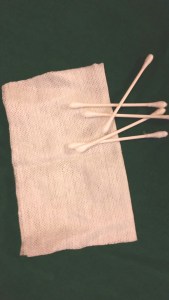
The gentle gauze of acknowledgement will better slow verbal grieving than the poky prodding of a cotton swab. (photo by Teresa TL Bruce, TealAshes.com)

The gentle gauze of acknowledgement will better slow verbal grieving than the poky prodding of a cotton-tipped swab. (photo by Teresa TL Bruce, TealAshes.com)

Sometimes the people I blurted to were sympathetic. “I’m sorry,” they’d say while looking me over carefully. (One asked, “Are you okay to drive? Do you need me to call someone for you?”) I appreciated the kindness of their sympathy and felt slightly better for the interaction. Their gentle acknowledgement acted like an embracing gauze to hold my wounded soul together.

Often people appeared embarrassed, averting their eyes as if I’d bared too much skin rather than too much of my soul. “Oh,” they’d say (if they said that much) before altogether turning away or, in the case of cashiers locked into position, turning their full attention back to the buttons at their fingertips. I left such encounters feeling the kind of social embarrassment I hadn’t experienced since my children were tiny and bled or threw up (or worse) in public places. In this case there were no surfaces to clean up and nothing to apologize for, but it felt much the same.

The harshest, most damaging interchanges happened when strangers (or much worse, people I knew) chastened me for speaking (or crying) about my husband’s death. “Stop crying,” they’d say, or “You already told me,” or “But that was last month, so why are you still crying about it?” or “Everyone has troubles, so you need to get over it and move on.” I walked away from such encounters feeling deep shame for my feelings and my inability to keep them to myself, as if I’d just offered a messy, inappropriate blood sacrifice in someone’s all-white living room.

In hindsight, with five-plus years behind me, I can forgive myself for committing such “offenses” against those whose own insecurities prompted their harsh or embarrassed responses. Looking back on the way I felt when newly bereaved, I can see how my wounded, lacerated soul and psyche bled orally. Applying pointed pressure to stanch the flow of grieving words was no more effective than holding a Q-tip to a deep cut.**

It was about a year before I managed not to blurt, “My husband died,” long after his death faded to “old news.”

For our family, though, every day we lived with the new, unwelcome reality of “firsts” without him. Time had to thicken and slow the verbal and emotional bleeding. Gentle acknowledgement of loss had to wrap around me and take hold. The raw edges of my wounded psyche had to begin their healing.

If your mourning friends seem never to stop talking about the death of their loved ones, don’t shove a poky cotton-tipped swab into their wounds. Wrap them with the consoling gauze of your acknowledgement and absorb the mess of their blurting with your acceptance and understanding.

___

Feel free to share ways you blurted — or listened.

___

*Please see these suggestions for Better Questions to Ask than “How Are You?”

**I don’t have any affiliation with (or aversion to) the Q-tip brand of cotton-tipped swabs.


Valentine Loss — A Love Story

Donna and Owen were school sweethearts, but she wanted to be a missionary before she’d settle down to marry him.

Grandpa Owen and Grandma Donna married on Valentine's Day (Teresa TL Bruce/TealAshes.com)

Grandpa Owen and Grandma Donna married on Valentine’s Day (family photo, ca. 1930, Teresa TL Bruce/TealAshes.com)

As a young woman, she left her small-town Utah home to teach (and preach) as a volunteer for The Church of Jesus Christ of Latter-day Saints. She traveled 2,000-plus miles to North Carolina, a state where few Mormons then lived. While serving the people there, Donna roomed in a home with three daughters near her age: Lala, Gertie, and Leone. At the end of her time in the South, Donna and her “Carolina sisters” half-joked that someday they’d introduce their future children to each other — and have them marry so they could become “real” family.

Donna went home and married Owen on Valentine’s Day.*

They built and ran a business together — an auto service center and motel — and brought three beloved children into the world. When their little ones were seven, five, and three, Owen went hunting in the mountains with friends and cousins for food for their families. An out-of-season blizzard stranded them. Only one returned.

Widowed Donna went back to school so she could earn a living to support her children. She taught elementary school and raised her sons and daughter. She became a principal and also worked for educational publisher Allyn & Bacon.

When her kids were grown, she taught English in Japan.

Eventually, Donna dated and married Wally, a widower with a young son — the bonus son whom she delighted in raising and claiming as her own. She later became the first woman to sit (and vote!) on her city council.

When Donna’s second son met Leone’s daughter at college, everyone later agreed it never would have worked if “the Carolina sisters” had orchestrated it as they once planned. (I’m glad it worked out for them, since Donna’s son and Leone’s daughter became my parents!)

I never knew my dad’s father, Grandpa Owen, but I liked the way Grandpa Wally spoke of him, though he never met Owen, either.

Donna and Wally had an unusual second marriage. They each had a sense of responsibility and accountability to the other’s long-dead love. They spoke of taking care of one another for the one who was absent — and also playfully “blamed” them for household mishaps (“Donna, Owen must have mislaid my book…” “Wally, Bertha must have let your dinner burn…”).

For the rest of their lives, Donna and Wally celebrated three wedding anniversaries every year: Donna and Wally’s, Wally’s and Bertha’s, and — on Valentine’s Day — Donna and Owen’s.

From her decades-later hindsight, she didn’t tell me about the hardship of losing her husband when their children were so young. She didn’t describe the loneliness of losing her mother (hit by a drunk driver) within a short time of becoming a widow. But I’d heard the stories.

In college I lived near Grandma Donna and Grandpa Wally. Whenever I mentioned going on a date, Grandma worried. “Don’t get serious with anyone until you have a way to earn your own living. You never know what’s going to happen.” However, the first time I mentioned my future husband’s name, she changed her script. “When are you bringing him to meet us?”

Whoa, I thought. Our courtship was still in early days; it gave me pause that instead of reminding me to keep my distance, Grandma Donna wanted to meet him.

Fast forward two and a half decades.

In my early days of widowhood, I yearned to ask Grandma the important things I needed to know:

Grandma, how did you get through it?

When your heart was ripped in half, how did you become the optimistic, faith-filled, compassionate person I knew and loved?

How did you raise your children to be that way, too?

Grandma, how can I get through it?

Valentine’s Day isn’t easy on anyone who has lost a loved one — to death or otherwise. Hearts ache over severed connections. When all the world (in the media, anyway) seems paired up in love, it can be easy to rename February 14 as Single Awareness Day or Sorrowing After Death Day; it can be a very SAD day.

The first few Valentine’s Days after my husband’s death hurt horribly. I did what I could to serve others who I knew were also sorrowing, but it didn’t alleviate my own sadness.

This is my sixth widowed Valentine’s Day, and I’m trying to view it more as my Grandma Donna’s wedding anniversary than as a day without my own husband.

Grandma Donna survived — and thrived — after widowhood.

Valentine's Day balloons (photo by Teresa TL Bruce, TealAshes.com)

Valentine’s Day balloons (photo by Teresa TL Bruce, TealAshes.com)

So will I.

(But I still wish I could ask how she did it.)

*For ways to help your grieving friends through this holiday (and others), please see Valentine Greetings for the Grieving.