Typhoons, Tornadoes, and Other Disasters Wreak Havoc on Individuals

Typhoons. Tornadoes. Terrorism. Turmoil. Large-scale disasters all, impacting dozens, hundreds, thousands of souls.

Life-shattering, publicly viewed, world-watched tragedies, displaying agonies of individuals: children, wives, husbands, parents, siblings, relatives, friends.

Fragmented sentences, fragmented lives.

I admit, I seldom watch the news. Not anymore. Not since my husband’s death.

It’s not that I don’t want to be informed. I do. But I’m now expertly informed in the one area the glowing rectangle cannot convey, no matter how eloquent its writers, nor inspired its photographers, nor supernal its composers, nor gifted its news gatherers and broadcasters may be:

I know how grief feels.

And when I see the shocked, huddled faces of survivors’ physical pain and discomfort …

And when I see the decimated rubble  of one-time homes, hospitals, and houses of worship…

And when I see the eyes of those whose loved ones are no more…

…I see their grief, their public grief,
and I feel a degree of it.
I remember the excruciating feel of
my own, private anguish.

Large-scale grief-events require large-scale generosity and cooperation (to rebuild community infrastructure and provide day-to-day resources for residents to live on). They also require one-on-one generosity and compassion (to refashion–not rebuild–individual survivors’ lives).

Please, as much as you are able, help.

Image from the Children's Grief Awareness Day Facebook page (https://www.facebook.com/photo.php?fbid=346620602055569&set=a.121173784600253.18290.121173094600322&type=1&theater)

Blue butterfly image from the Children’s Grief Awareness Day Facebook page

Donate time, money, or expertise. Give a little or give a lot, but please also give from your heart. Though emergencies have an impact on everyone, with Children’s Grief Awareness Day coming this week, please consider the affected children’s needs, too. Already grieving children (and parents) not directly touched by today’s tragedies will nevertheless feel for–and with–those who are.

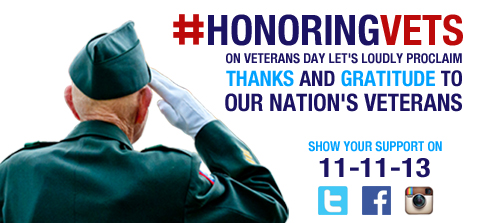
Veterans Day Thanks

Say THANK YOU to veterans--and their families.

Say THANK YOU to veterans–and their families.

What is the purpose of Veterans Day? “A celebration to honor America’s veterans for their patriotism, love of country, and willingness to serve and sacrifice for the common good.” *

One of the best ways to honor those who have served is to say “thank you” to them — and to their families — acknowledging awareness of their service and sacrifice on behalf of their nation.

I was raised in a patriotic home by parents whose reverence for and “allegiance to the flag of the United States” was founded in acknowledgement of all the souls who perished — from the Revolutionary War to the present — in paying the price for the freedoms that bless my life. (Most patriotic songs have brought tears to my eyes since I was old enough to understand their lyrics.)

As a widow, however, my appreciation for veterans has multiplied a hundred-fold. I have a better grasp of the fragility of the time we spend with (and away from) our loved ones. I’m grateful to those whose service cost them precious days away from home and whose service-related health issues continue exacting a price.

And now, because I know the pain of losing a spouse and have met many military widows (and a few military widowers), I view the sacrifices of the fallen in a more personal way than I did before.

THANK YOU, Veterans, for leaving home and hearth to serve your country. And thank you to the loved ones who wished you well as you did so.

*quoted from “History of Veterans Day,” U.S. Department of Veterans Affairs (http://www.va.gov/opa/vetsday/vetdayhistory.asp)

I’ve Added a Resource Page

I’ve created a page of “Helpful Grief Resources” with examples of what to say when someone dies (and what not to say).  I’ll add new sources as I encounter them, so check back from time to time.

  • Have you found useful sites, books, articles–even songs–that helped you interact with the bereaved?
  • If you’ve suffered a significant loss in your life, what comments or gestures from friends were most (or least) helpful to you?

Please share your experiences in the comments below or you can contact me via

email: writeTealAshes@gmail.com

Twitter: @TealAshesTBruce

Facebook: https://www.facebook.com/TealAshesbyTeresaBruce/

Together we can ease the anxieties of those who wish to help their grieving friends — and thereby help the mourners, too.

To reach (or share) the “Helpful Grief Resources” page, click on the menu above or go directly to:

Helpful Grief Resources

Avoid Saying “At Least” When Consoling the Bereaved

If you begin forming the words “at least” — STOP!

Stop using "at least" to talk about grief. Console. Stop sign. TealAshes.com

Stop saying “at least” when consoling mourners. (photo by Teresa TL Bruce, TealAshes.com)

Do not, do not, do NOT let that phrase pass your lips (or fingertips)! If you think uttering (or writing) “at least” to console anyone who is grieving, I advise this:

Bite a hole in your tongue (or slam your fingers in a door) to  prevent yourself from saying “at least.”
(Can you tell I feel strongly about this?)

Here’s why:

“At least,” by definition, shrinks and plays down a thing, reducing it to its smallest component. It minimizes. It downplays and lessens importance. It diminishes and disparages, and when applied to grief it belittles the perceived importance of the loss.

Any intended consolation beginning with “At least you …” will not console. Instead, it isolates mourners, proclaiming their devastating loss to be less calamitous to others than if feels to them.

Examples of “at least” statements (and how they come across to the bereaved) and why they’re so hurtful:

  • “At least you didn’t have any children” (so you won’t have to “deal with” them or their grief and you can just pick up and go on).
    What if the couple privately, desperately wanted children? What if they planned to conceive or adopt within the next year or two? What if one was already pregnant at the time of (her own or her partner’s) death?
  • “At least you (can) have more children” (so you shouldn’t be upset over losing this one).
    One child’s presence cannot “replace” another. The loss of a child (at any age) is a grief unlike any other. Never diminish it. Never assume “replacement fertility” is possible, either — because it may not be, and even if it were, “replacing” one who is lost is not possible.
  • “At least the children are young enough they won’t miss their [parent, grandparent, sibling…]” (so it really won’t be that hard on them).
    Grieving families need to know loved ones won’t be forgotten. Children who’ve lost loved ones, even at very young ages, are impacted in ways only families in similar situations can comprehend.
  • “At least your kids are all grown up” (so you won’t have to raise them alone; also implies adult kids will be “okay” with the loss).
    The surviving parent is now left alone to weather the years-long, unrelenting upheavals of grief by him- or herself. The adult children are burdened with their own grief as well as their concerns for their surviving parent.
  • “At least you weren’t married very long” (so you can’t miss your spouse that much).
    The loss of future, anticipated experiences runs as deep as the loss of familiar comfort and companionship. Those widowed after fewer years together often feel deeply “cheated” by the timing.
  • “At least you had [however many] years together” (so you had more than your share and shouldn’t complain it came to an end).
    A lifetime shared is irrevocably altered by the shearing of one’s “better half.” In A Grief Observed C.S. Lewis compared the loss of a spouse to the loss of a limb which, even when healed, leaves the amputee forever changed.

If you’re cringing now because you remember saying “at least” in past attempts to console, remember that you meant well — at least you tried. (Now that you know, you’ll do better next time.)

Better Questions than “How Are You?” Part 2–What to Ask When Grief Is “New”

For at least the first year after a death, avoid casually asking “How are you?” It’s too broad, and because it’s routinely used in place of “hello,” it can seem insincere.

Instead, ask one or two specific questions that acknowledge life has changed:

  • Are you remembering to breathe?
    If you’ve never been blindsided by grief, this may seem odd. (After all, who forgets to breathe?!) More than a month after my husband’s death, another widow first asked about my breathing. I thought the question strange–until I inhaled. All at once I realized I couldn’t remember the last time I’d fully filled my lungs. The difference felt amazing, even luxurious! Still, over the next year, I found myself failing to do so again and again.
  • Do you need a drink of water? Are you drinking enough water?
    Your friend has shed incalculable streams of tears. You may (or may not) have witnessed them, but I guarantee more are shed unseen. Those tears, along with the other myriad physical and emotional stressors and distractions of grief, can lead to dehydration.
  • Can I make calls for you?
    Notifying others of my husband’s death was excruciating. It had to be done, but I  dreaded every personal and business call.
  • Would you like to talk?
    This helps, but be sure to listen! Your job is to L-I-S-T-E-N–not to evaluate, judge, or redirect. Let the conversation wander wherever your bereaved friend needs it to go.
  • Would you like to talk about [name the loss]?
    Grieving loved ones need to share feelings and memories about the deceased.
  • Can I bring you [name a specific food, whether homemade or take-out] at [#] o’clock on ___-day?
    Menu planning? Hah! I felt like a five-star chef if I managed to serve cold cereal or popcorn. Sometimes I forgot to eat or to stop eating. Grief disrupts digestion as ruthlessly as it sabotages sleep.
  • May I help you with [name a chore (*see below)]?
    Name one or two, because often the bereaved struggles to recall even simple tasks. I knew I wasn’t handling everything that needed doing, but I couldn’t figure out what was undone until someone offered to help with it. (I appreciated those thoughtful folks!)

    [*Consider offering to take on: errands, paperwork, transporting kids, yard work, washing the car, sweeping, laundry, polishing shoes, buying milk or fruit, house cleaning, etc.]

Questions like these show you care in practical ways. Even if the answer to all is “no,” your interest will be appreciated. (If your offers are rebuffed, please, please try again in a week or so. Consistency counts.)

If you’ve suffered such a loss, please add a comment sharing what helpful things others asked–and did–for you.