To Comfort the Bereaved, Give Hugs–But Ask First!

Offer hugs, but ASK before embracing.

In the first year after my husband died, sometimes I needed — but sometimes I couldn’t stand — hugs. The one person I most wanted to hug me was no longer around — and never would be again. I didn’t want “substitutes.”

There were times our daughters didn’t “feel like” hugs, either, and although my arms ached to offer them a mother’s comforting embrace, I learned they each needed to grieve their father on their own terms and in their own ways.

Most days, though, I accepted and found strength in other women’s hugs, especially from widows. (Their silent squeezes conveyed I understand better than words.) I found solace in my male relatives’ hugs, too. We’ve always been a “huggy” family on both sides, so sharing their (often wordless, occasionally bear-like) embraces felt familiar and comforting.

However, I did not, repeat, did not enjoy hugs from male friends and acquaintances, not even a little bit in the first year … or two. Maybe I was overly sensitive. Maybe not. For me, when I made my marriage vows 24 years earlier, I took the “forsake all others” portion to heart, hands, and arms. My husband was the man I hugged — the only man I hugged — other than kin (and a very few close-as-kin-to-us-both friends), because that was what I chose. That was one way I honored him — and our vows.

I wasn’t in the habit of hugging other men when my husband stepped from the room or went away on a trip. Why, after death took him “away,” would I suddenly do so? I still felt the same connection and commitment to him — and to our vows. To me, hugging other men after he died felt as “wrong”  as it would have felt while he lived.

However, for many widowed friends, hugs from friends of the opposite sex helped! Such hugs made them feel better connected to their late spouses. The hugs that disconcerted me brought them a semblance of peace.

These days, three years into widowhood, I’m no longer raw with the shock and newness of my loss. I willingly accept and return (almost all) embraces.

I even initiate hugs — but I ask first, unless I’m offering virtual (((hugs))) like these.

(((Hugs))) to you for reaching out to your grieving friends, coworkers, and family members.

Typhoons, Tornadoes, and Other Disasters Wreak Havoc on Individuals

Typhoons. Tornadoes. Terrorism. Turmoil. Large-scale disasters all, impacting dozens, hundreds, thousands of souls.

Life-shattering, publicly viewed, world-watched tragedies, displaying agonies of individuals: children, wives, husbands, parents, siblings, relatives, friends.

Fragmented sentences, fragmented lives.

I admit, I seldom watch the news. Not anymore. Not since my husband’s death.

It’s not that I don’t want to be informed. I do. But I’m now expertly informed in the one area the glowing rectangle cannot convey, no matter how eloquent its writers, nor inspired its photographers, nor supernal its composers, nor gifted its news gatherers and broadcasters may be:

I know how grief feels.

And when I see the shocked, huddled faces of survivors’ physical pain and discomfort …

And when I see the decimated rubble  of one-time homes, hospitals, and houses of worship…

And when I see the eyes of those whose loved ones are no more…

…I see their grief, their public grief,
and I feel a degree of it.
I remember the excruciating feel of
my own, private anguish.

Large-scale grief-events require large-scale generosity and cooperation (to rebuild community infrastructure and provide day-to-day resources for residents to live on). They also require one-on-one generosity and compassion (to refashion–not rebuild–individual survivors’ lives).

Please, as much as you are able, help.

Image from the Children's Grief Awareness Day Facebook page (https://www.facebook.com/photo.php?fbid=346620602055569&set=a.121173784600253.18290.121173094600322&type=1&theater)

Blue butterfly image from the Children’s Grief Awareness Day Facebook page

Donate time, money, or expertise. Give a little or give a lot, but please also give from your heart. Though emergencies have an impact on everyone, with Children’s Grief Awareness Day coming this week, please consider the affected children’s needs, too. Already grieving children (and parents) not directly touched by today’s tragedies will nevertheless feel for–and with–those who are.

Better Questions than “How Are You?” Part 3 — What to Keep Asking

After the initial shock of my loss lessened, I began adjusting to life as a widow. Far from being “over” my grief, I faced ongoing challenges.

These are questions I found particularly helpful as time went by.

  • How are you sleeping?
    Grief wreaks havoc with sleep cycles, causing some to sleep much longer than “normal” and others — like me — much, much, much less. (Would another “much” be too repetitive?) Asking won’t restore the mourner’s pre-grief sleep, but it will show you’re aware of the struggle. In grieving families with young children, ask if you can take the kids for a few hours so the parent(s) can rest.
  • Do you need help with [be specific in naming possible errands] that you’ve been afraid or reluctant to ask for?
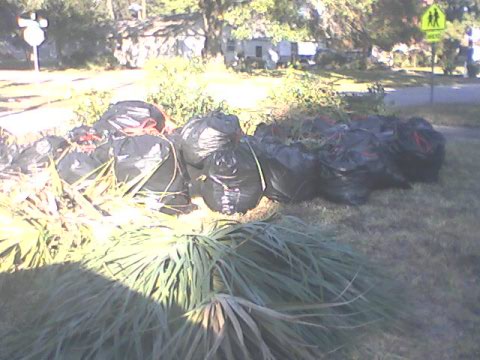
    This is only a portion of the debris cleared away by the men from church that day. The "bushes" behind the trash bags are piled limbs hauled out to the street. (Sorry for the poor lighting!)

    This is a portion of debris cleared by the men from church that day. “Bushes” behind the yard bags are actually piles of limbs they hauled to the street. The poor photo quality reflects my scattered state of mind at the time! (photo — such as it is — by Teresa TL Bruce, TealAshes.com)

    I had trouble figuring out what I’d left undone until friends offered help with specific tasks. I needed (but too seldom sought) help transporting my daughter, remembering car maintenance, washing doggie (an ordeal requiring a minimum of five human hands), cleaning …

    One Saturday, men and boys from church gathered in my yard and hauled more than 15 Hefty bags of debris — and a huge pile of limbs — out to to the curb. I was flabbergasted. Until I saw the tremendous difference their efforts made, I hadn’t noticed the overgrown undergrowth!  (I still get teary-eyed over their labors — and the thoughtfulness behind them.)

  • What sounds appetizing? Which day can I bring you [the “appetizing” dish or another item of your suggestion], or would you rather to come to my place?
    Grief scrambles appetite as ferociously as sleep. On “bad” days, pouring cereal and milk into the same bowl felt like an accomplishment. On “good days,” removing plastic wrap from frozen pizza before heating (or not burning boxed macaroni and cheese) felt like I’d done “real” cooking again.
  • Will you come [for a walk, to the store, to the mall, to a movie, to lunch, etc.] with me [name a specific day and time]?
    Again, invitations to specific activities and times are less threatening to the bereaved than general ones.  When well-meaning friends and acquaintances invited me to “do something” in the earliest weeks after the funeral, I wasn’t ready. Overwhelmed, I asked them to check back later. (Two actually did.) I needed time and space to grieve and to focus on my daughters before I worked up courage to return to “social” activities.

Questions (and actions!) such as these acknowledge you haven’t forgotten that your friend is still grieving — “even” after months have passed.

Better Questions than “How Are you?” Part 1–Why

“How are you?” is almost impossible to answer if you’re newly bereaved (within 13 months of a loss).

When grief shakes your world, tips it end over end, and dumps it in the middle of life’s ten-lane freeway during rush hour, you find yourself smashed into  3.4 bazillion pieces (give or take a handful).

Even if you could yell “STOP!” and every commuter and freight driver pulled over to help gather the detritus that was your life Before… Even if magical glue could mend you more seamlessly than Humpty Dumpty… You’ve lost bits and pieces of yourself, blown away by the breezes of cleanup or embedded in the tires of already faraway cars.

So how would you reply to the question, “How are you?” while you’re still smeared and strewn and fragmented and incomplete?

Picture this:

I answer the doctor’s questions about my hubby’s medical history. Doctor utters impossible to comprehend, life-shattering words: “I’m sorry to inform you …”

Everything shifts.

Somehow my brain processes the meaning of the doctor’s ongoing words, though my ears hear only wuh-WUH-wuh-wuh vocalizations like adults in Charlie Brown TV specials. My vision zooms onto my daughter’s shocked face as I watch comprehension and disbelief drawing battle lines across her lovely, distorted features. In the same moment, as if I have more than one set of eyes, I notice the way light plays differently in the corners of the ceiling above and behind the doctor’s droning and I squint at the glare of his bald spot. Out of nowhere, a wrecking ball tugs from the base of my skull, its weighted chain confined within my spine, its globe of destruction swinging wildly through my abdomen. I am helpless to console my child, because this cannot be real and it cannot be undone–and how, oh how can I call her sisters 2,000 miles away to tell them–over the phone–they’ll never see their father again?  “So this is what it feels like,” the writer’s voice in my head intrudes, “when you lose your spouse.”

A bit of time passes. Seconds? Minutes? Hours? Impossible to say, but the doctor is still here, saying I don’t know what anymore.

In walks a hospital employee, portable phone in hand. (Soon I’ll learn he’s on the line with someone from the medical examiner’s office to question me.) As his eyes fix on mine, he says, “How’re you doin’?”

I admit my response was impolite.

(Part 2, Better Questions than “How Are You?” —  What to Ask When Grief Is New, will offer alternative questions that show you care.)

Do NOT Tell the Bereaved “Life Goes On.”

Never tell a newly grieving person that “life goes on.”  Don’t.

The first time I heard that after my husband’s death, my breath whooshed away like when a fifth-grade bully punched me in the stomach. If my lungs hadn’t been empty I’d have screamed, “That’s not true!”

It wasn’t — not for my husband. His life did NOT go on.

It wasn’t true for our family, either. Death ended the life we had together. His/Our/My life did NOT “go on” physically, emotionally, financially, legally, socially. It screeched down a slope, plunged over a cliff, and shattered into flying shards.

“Life goes on?” Straightforward, everyday chores nearly undid me! When I entered the grocery store as a new widow, Halloween decorations mocked from everywhere. My heart pounded faster than my thoughts raced. “How can there still be holidays? How can people put up decorations? How dare they depict death and decay and graveyards as fun?”

I took as much offense at the onslaught of every season throughout that year of “first” annual events. Each birthday, anniversary, and holiday that “went on” without my husband scratched nails across the now excruciating chalkboard of occasions by which we had once marked our shared passage through each calendar page.

That life could “go on” normally — for everyone else — seemed cruel.

During those first shocked, raw months, I felt bruised and fettered by day-to-day evidence that — for others — “life went on” around me.

Gradually, as I worked through the motions of “going on,” I felt a brief loosening of those fetters. Sometimes they tightened again, protesting my returns toward living my own life as I faced “new firsts” without him. When I opened my first “Congratulations! Your story has been selected …” notice, I squealed and waved my arms and shouted (just a bit excited, you understand!) and then — and then I wanted to tell my husband … and my mom.

Ouch, again.

But each time I stepped forward, those fetters stretched a little more, and with each new “first” I found their restrictions looser, briefer. Eventually they began resembling bracelets more than manacles, accessories to my life story more than markings of “The End.”

I’ve learned that life does, indeed, go on, that it can be beautiful again. I, however, like every other grieving soul, had to discover it for myself — when I was ready.