Grief after Shooting in Orlando

Early Sunday morning, people were slaughtered in Orlando, my hometown. Forty-nine victims died on-site at Pulse Nightclub; more than 50 were hospitalized due to serious injuries inflicted in the attack; countless others’ lives are forever altered — traumatized survivors, witnesses, first responders, and their families. All of them. All of us.

It is tragedy. It is horror. It is pain.

vigil.2.061316

My first, panicked thoughts were for of one of my daughter’s dear friends, a young adult who has not come out to blood family but who (like many of my children’s friends over decades) has called me a second mom for years. My fingers shook as I texted, “Are you okay?”

I’m grateful — so grateful — this friend of ours replied immediately, was not at Pulse at that time, is physically okay. But this adult kid who calls me Mom … this young soul’s roommates lost many friends.

Being “okay” will never be the same again.

In the aftermath of most tragedy, we witness the best and the worst of humanity. At church hours after this happened, everyone I encountered spoke with tears in their eyes, with broken voices (and hearts), with compassion and pain for those impacted. Congregants were vocal in prayer for the victims and their families, of course, but even more vocal about the need to reach out in tangible help — to give blood, to be of support, to offer healing help and comfort. To love our neighbors.

I was proud, too, of the statement Orlando Mayor Buddy Dyer emailed to residents:
“Despite the fact that this crime will have a lasting effect on our city and country, Orlando is a strong community. We will be grieving together in the upcoming days, weeks and months. We need to support each other and love each other. This tragedy will not define us, but will bring us together.”  Well said, Mayor Dyer. Well said.

But I was appalled by other reactions — as if the hateful, terrorist acts of murder and mayhem weren’t appalling enough.

As I scrolled through social media after church — searching (like everyone else in and/or with ties to Orlando) for assurance regarding those I know — I couldn’t believe what I saw:

People were politicizing these lost and shattered lives.

I’m a proponent of free speech, and there’s a time and a place for most forms and reforms, but immediately after a tragedy —within hours, or even days! — is not the time or the place. Death does not invite discussion about dogma. Murder does not mean it’s time to moralize. Loss is not linked to knee-jerk legislation.

Loss should be only about loving the bereaved, mourning the missing, healing the hurt. Period.

Unless you are in the inner ring of mourning, it is not your place to voice your political or moral views on those who have been injured or who have lost loved ones. Significant others, immediate family, closest friends — these are the people who have the right to state (or not state) their views from within the LGBTQ community targeted by the shooter. These are the souls whose lives have been altered by the killer’s evil actions, who have the right to state (or not state) their positions on gun laws and ISIS and every other blame-relevant topic.

For everyone else, everyone not directly impacted, it is our place — and time — to offer love and support and help and presence while listening. (The time to legislate and protest and reform will come … but not at the cost of depersonalizing individual loss into broader causes. Not yet.)

People are mourning. Reach out to them. They will need your love and support not just now but in the weeks, months, and years to come. (In the meantime, if you can’t say something nice, don’t say anything at all.)

photos on this post provided by and with permission of harmonyebee


Friends and Grief

“Your address book will change,” another widow told me.

Will you write yourself into or fade away from your grieving friends' address books? (photo by Teresa TL Bruce/TealAshes.com)

Will you write yourself into or fade away from your grieving friends’ address books?
(photo by Teresa TL Bruce/TealAshes.com)

“What do you mean?”

“Some of the people you thought would always be there for you … won’t. They’ll disappear.”

My mind replayed one of the most-heard phrases at and after the funeral: “Call if you need anything.” I’d known the people saying it meant the sentiment (or at least thought they did). But while I nodded acknowledgement of their intention, I also knew — really knew — I wouldn’t call. I couldn’t.

“It’s not their fault,” I told my widow friend. “They’d be here if I asked.”

As if she read my mind, she said, “And how many have you asked?”

My silence answered.

“I get it,” she said. “As much as you need people around you, it’s physically and emotionally impossible to reach out to gather them to you. It takes every bit of energy just to muster the have-to calls for paying the bills and tending to all the business-of-death matters.”

“You mean it’s not just me?” I’d thought I was especially weak and inept at dealing with the aftermath of my husband’s death.

“Teresa, it’s hard for everybody,” she said, “but this is still early for you.  I don’t know anybody who could call people back if they needed anything so soon. It took me a couple of years. You’re only a couple months out, still in shock.”

Two months, one week, and three days, I corrected in my head, incapable of turning off the infernal count ticking off the time since he died. “It seems like it’s been forever, but it also feels like it just happened.”

“Have any of your friends tried to make you feel like you should be ‘over it’ by now?”

Frustrating memories surfaced: The first time (a whole 36 hours after he died) when someone said, “Don’t worry about anything. You’re young enough to remarry.” The people who (the day of the funeral) pressed to know what my immediate, short-term, and long-term future plans were now. The woman who (about six weeks after he died) insisted, “I wish you wouldn’t cry anymore. I makes me feel sad to see your tears.” (To her credit, she apologized soon after.)

“After the funeral,” my widow friend continued, “your friends’  lives went back to normal. But yours will never be the way it was before. They can’t understand, not unless they’ve also lost someone as much a part of your life as your husband was to you. They’re not trying to shut you out. They’re just … getting on with their lives.”

I nodded. I’d learned to scroll past friends’ status updates about sweet marital bliss — or stupid squabbles — that sliced and salted my grief. How unfair. Don’t they know they should be grateful for what they still have? But it still hurt to see illustrations that “life went on” for them when it hadn’t for me. (Side note: Never say “life goes on” to anyone grieving. Just don’t.)

“And then there are the ones who step away because they’re too uncomfortable around your pain.”

I let out a brief, one-syllable bark-laugh, thinking of the neighbor who instead of waving hello now turned away at the sight of me.

“But you’re going to make some amazing new friends, too. And there will be people you didn’t know well who will reach out with compassion that makes up for the others’ neglect.”

“You’re right.” I smiled and nodded at thoughts of those who’d reached out, people I’d known only casually before: A note card in the mail. Text check-ins. Dinners (or desserts) dropped off. Emails. His angelversary date acknowledged. 

I’ve reflected on that conversation many times since. It reminded me of a song round I learned as a Girl Scout:

Make new friends, but keep the old. One is silver and the other gold.

Dear new friends have shown up and written themselves into my life’s address book in gold and silver inks during the five-plus years since my husband died. My life now is richer for knowing them.

Among my friends who mourn, I understand why some have erased entries from their contacts. Rejection and neglect are painful at any stage of life, but they are brutal while grieving. If a trusted friend criticizes or ignores your bereavement, why continue to rely on them?

For my part, I didn’t trust my own grief-shrouded judgement enough to erase the time-worn entries from my contacts. Even when I was too wounded to reach out to them. Meanwhile, those who didn’t ink themselves into my widowed life have faded: gold to silver to ink to pencil.

In future, who knows? Maybe one of those barely legible names will tell me a story of my husband or let one of my kids know they remember their dad. If so, the faded lines will become traced over, easier to distinguish.

Even if they don’t ink themselves back into my treasured contacts, I’ll keep them written there.  If I could rewrite the world to exclude grief, I would. But I can’t. So I’ll try to remember when faded contacts’ time comes to join the ranks of those who “get” grief.

I’ll try to reach out, because there’s no such thing as too many friends — even faded, friendly acquaintances — when you’re grieving.


April Fool’s Day, Grief, and Humor — To Joke or Not to Joke

A woman gets into a car and snaps her fingers as she says to the driver, “I hear your husband died — just like that. Are you kidding me?”

As if I were the kind of person who would joke or kid about a loved one’s death.

The punchline in this true tale is that I didn’t punch her. (I tend to keep both hands on the wheel at 55 mph.) “Umm … no, I’m not kidding, and I really don’t want to talk about it right now” (what with concentrating on the doings of other I-4 drivers and not wanting to obscure my vision by crying).

She honored my wishes — sort of — for a full mile (which, at highway speed, wasn’t long enough) before opening her mouth to address the sudden death of someone else. “I had a friend whose husband keeled over without warning,” she said, sounding more thoughtful than she was being. “It really tore her up for a long time. She was never the same after that.”

Compared to her conversation, I-4 traffic seemed calming. My heart pounded as I gripped the wheel tighter and said, “I really, really don’t want to talk about this right now.” All of a month into widowhood, my very nerve endings were raw with emotion.

This time she stayed quiet nearly half a mile before opening her mouth again. “Your poor girls must be devastated. Weren’t they close to their father?”

“Be quiet,” I said too quietly. 

She continued, asking how on earth I was going to handle being a single mom.

“Stop. Talking!” I said. Louder.

She returned to the topic of how awful it was for her friend who never recovered after her husband’s death.

“BE QUIET!” I bellowed as loud as I could, far too loud for the confines of my car. “I DON’T WANT YOU TO SAY ANOTHER WORD — NO! NOT! ANOTHER! WORD!” The last part came as she began protesting. “DO NOT SPEAK AGAIN unless you want me so upset I drive this thing RIGHT OFF THE ROAD because I can’t see!” (Whether from rage or tears, I didn’t clarify.)

I’m not a screamer or a yeller. Never have been (except when cheering for my children and their teammates). But that day … I don’t think I’d ever been so angry at another human being , not counting the hospital orderly who asked, “How’re ya doin’?” while handing me the phone with the medical examiner’s office on the other end … But, no, he was at least doing his job — albeit horribly — while this woman just prattled on and on and on against my repeated requests otherwise.

I pulled off the highway and found our destination, bristling even at inane comments about the weather and the route.  I parked, found the hostess who’d invited us, and, car keys still in hand, pulled her aside. Without explanation, I said, “I’m sorry, but you need to find someone else to take her home.” I inclined my head toward the woman I’d given a ride. “I’m leaving.”

I had to take back roads to my house, not trusting myself to the interstate again.

To this day, the phrase “are you kidding me” screeches like sound system feedback against my psyche.

There really is no time or place or circumstance for anyone but the bereaved to be “kidding” or “joking around” about whether a loved one is dead or dying.

___

A sense of humor in a grieving heart is a beautiful but delicate thing. Photo by Teresa TL Bruce, TealAshes.com

A sense of humor in a grieving heart is, like a spiderweb, a beautiful but delicate thing. (Photo by Teresa TL Bruce, TealAshes.com)

Gentle, harmless April Fool’s Day pranks can be fun, but think twice — and then think twice again — before planning pranks on someone who is grieving. Humor is important and essential, but weaving humor into mourning requires intricate knowledge of the bereaved and delicate application. New, raw grief can make a person’s beautiful sense of humor into a fragile construction, as easily damaged as a spider’s web.

Before my husband died, I pulled April Fool’s Day pranks on my family every year. We’d also invite young missionaries from church to our house for dinner every April 1 and feed them foods that weren’t what they seemed. It was a fun tradition we all looked forward to.

I’ve only done it once as a widow. It seemed like too much trouble for a few laughs over a meal. This year, work deadlines and other projects mean I’m not likely inviting anyone over, but I may arrange a couple of small surprises for a few close people … (Shh … don’t tell …) 😉

___

Grief hurts. It’s sad and sorrowful and all-consuming. It’s easy to be swallowed by it, so when the bereaved have a chance to laugh and breathe the healing air of humor, it usually helps.

Laughter over funny things the deceased said or did can be especially healing. Most mourners yearn for a connection between their loved ones and those around them. If laughter turns to tears, that’s not a bad thing. When bereaved emotions are all-consuming, releasing one often releases another.

Mad Libs became a part of our family's humor culture that we continue to enjoy.

Mad Libs became a part of our family’s humor culture that we continue to enjoy.

Don’t be afraid to laugh with your grieving friends. Invite them to a funny movie or to play together a ridiculous party game at your house like Curses or  Mad Libs.*

Do tread lightly with grief-related humor. It’s one thing for a pair of widows to share a joke about the “joy” of not waking to anyone’s snores; it’s altogether different for someone outside that degree of grief to make light of what is yet another aspect of forced change.

Above all, LISTEN to what your friends say and honor their requests.

___

*Mad Libs are a registered trademark of Penguin Random House LLC. (As of this writing, I have no affiliation with Penguin Random House.) I’ve enjoyed these fill-in stories since I was a kid (and often wrote up my own versions); my husband and I introduced them to our kids when they were little, and they remain a family staple of road trips. And I have to say, my kids and I treasure the pages of our Mad Libs books with my late husband’s handwriting.

Regarding the game Curses, I’m not sure who came up with it, but the times I’ve played, I’ve laughed hard enough to cry — in a good way.

St. Patrick and the Green Grief Monster

Celebrating St. Patrick’s Day (or not) isn’t the same when you’re grieving. Nothing is. The day itself commemorates the death of Ireland’s patron saint — originally it was a religious observation. But in recent years its solemnity appears all but forgotten as popular culture makes it into a day for people to celebrate their Irish heritage (whether real or adapted for the day).

In my family, with Irish ancestors on both my side and my late husband’s side, our St. Patrick’s Days were all about the green. When our kids were little, I’d add green food coloring into milk, pancakes, cookie dough — whatever I could think of — just to infuse the day with a bit more color.

Green milk and other green-dyed foods were a staple of our St. Patrick's Days.

Green milk and other green-dyed foods were a staple of our St. Patrick’s Days. (Photo by Teresa TL Bruce/TealAshes.com)

We wore green, of course, because nobody wanted to get pinched.

I made corned beef, cabbage, and potatoes for dinner. A few times I made Irish brown bread from a magazine or cookbook recipe.

And that was it — St. Patrick’s Day at our house.

After my husband died, memory and timekeeping did an agonizing push-pull dance.  For more than a year, I knew exactly how many days, weeks, and months had passed since his death. The awareness wasn’t something I tried to keep track of — it just was.

I also knew when holidays loomed ahead of me, but I backpedaled from them, dragging my feet as the calendar funneled me toward them. Maybe I thought if I didn’t acknowledge them, didn’t prepare for them, didn’t commemorate them … Maybe by ignoring those yearly occasions, I could avoid the pain of experiencing them without my husband.

I also felt guilty for the unwilling resentment I felt toward couples I saw enjoying such days together. I wanted to walk up to them and say, “Whatever you do, don’t take each other for granted. You’re together. Not everyone has that.”

I’d felt similar pangs of green-eyed jealousy after my mom died when I’d see grown daughters with their mothers. It was especially difficult at church, watching women I grew up with visiting home and spending that time with their moms. Of course I was happy for them, but it hurt that they had what I no longer did.

More than a few times, when I overheard women (of various ages) griping about their moms or snapping at them with harsh words at the store or a restaurant, I butted in — completely unbidden. “Excuse me,” I’d say. “You don’t know how long you get to have her in your life. When she’s gone you are going to regret acting like this.” Then I’d walk away. (I’ve tried to keep my own words in mind when interacting with my grown daughters. Every day together is precious.)

It hurt to remember my husband and my mother during holidays. It hurt worse when others didn’t acknowledge their absence during those same days.

Although it wasn’t my intention to walk around under a cloud of doom, I couldn’t help resenting well-intended “Happy St. Patrick’s Day” greetings, along with every other “happy this” or “happy that” greeting in the first couple of years after each new loss. Sure, I wanted to be happy, but I was mourning. And grief is not a  happy process.

The best support friends gave me during holidays, on anniversaries, and on other tender dates was to acknowledge my loss.

It may seem contradictory, but speaking of the deceased loved one can offer better cheer than saying “Have a happy [whatever] day.” Instead, tell your grieving friend something like, “I’m sure you’re missing [SAY the name!] today. I’m thinking of you.”

This is my sixth widowed St. Patrick’s Day. There’s no corned beef and cabbage on the menu, but I’ve made green milk and cookies again, and I no longer scowl when wished a “happy St. Patrick’s Day.” For now, that’s enough.


Grief Talk: Blurting Nonstop about a Loved One’s Death

I blurted “my husband died” to every stranger I encountered in the earliest weeks after it happened. No matter the setting — church, the frozen foods aisle, in the pharmacy checkout line … No matter where I was, I had to say it. I hated saying it. I hated hearing it. But I had to.

It wasn’t as if I walked into any business thinking, “I’m going to announce to the world I’m a widow.” Most of my grief blurted out in unbidden bursts prompted by the piercing pressure of dull-looking (yet deceptively sharp) questions like “How are you?”*

I am grieving, that’s how I am, thank you very much. Whether a person meant the question or said it as a greeting synonymous with hello, if I was asked, I would tell. And even if I wasn’t asked, my body had to express its inexpressible sadness in tears, shallow breathing, gut-wrenching anxiety at the sight of products my husband used — no, used to use — and sometimes in words, inadequate as they were.

Perhaps my pattern of blurting was set from the first moments after the hospital doctor delivered his pronouncement, when an orderly leaned inside the doorway of the tiny waiting room. “‘Scuse me,” he said to the doctor, “the medical examiner’s office is on the phone.” He crossed the room in three steps and while extending the cordless phone toward my hand said, “How ya doin’?”

I regret to say I raised my voice at the man. “My husband just died. How do you THINK I’m doing!?” (I can only hope my outburst did some good in the long run; I hope he never, ever addressed a grieving family in that way again.)

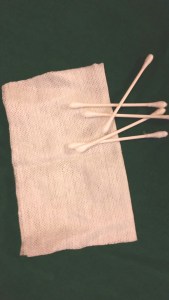
The gentle gauze of acknowledgement will better slow verbal grieving than the poky prodding of a cotton swab. (photo by Teresa TL Bruce, TealAshes.com)

The gentle gauze of acknowledgement will better slow verbal grieving than the poky prodding of a cotton-tipped swab. (photo by Teresa TL Bruce, TealAshes.com)

Sometimes the people I blurted to were sympathetic. “I’m sorry,” they’d say while looking me over carefully. (One asked, “Are you okay to drive? Do you need me to call someone for you?”) I appreciated the kindness of their sympathy and felt slightly better for the interaction. Their gentle acknowledgement acted like an embracing gauze to hold my wounded soul together.

Often people appeared embarrassed, averting their eyes as if I’d bared too much skin rather than too much of my soul. “Oh,” they’d say (if they said that much) before altogether turning away or, in the case of cashiers locked into position, turning their full attention back to the buttons at their fingertips. I left such encounters feeling the kind of social embarrassment I hadn’t experienced since my children were tiny and bled or threw up (or worse) in public places. In this case there were no surfaces to clean up and nothing to apologize for, but it felt much the same.

The harshest, most damaging interchanges happened when strangers (or much worse, people I knew) chastened me for speaking (or crying) about my husband’s death. “Stop crying,” they’d say, or “You already told me,” or “But that was last month, so why are you still crying about it?” or “Everyone has troubles, so you need to get over it and move on.” I walked away from such encounters feeling deep shame for my feelings and my inability to keep them to myself, as if I’d just offered a messy, inappropriate blood sacrifice in someone’s all-white living room.

In hindsight, with five-plus years behind me, I can forgive myself for committing such “offenses” against those whose own insecurities prompted their harsh or embarrassed responses. Looking back on the way I felt when newly bereaved, I can see how my wounded, lacerated soul and psyche bled orally. Applying pointed pressure to stanch the flow of grieving words was no more effective than holding a Q-tip to a deep cut.**

It was about a year before I managed not to blurt, “My husband died,” long after his death faded to “old news.”

For our family, though, every day we lived with the new, unwelcome reality of “firsts” without him. Time had to thicken and slow the verbal and emotional bleeding. Gentle acknowledgement of loss had to wrap around me and take hold. The raw edges of my wounded psyche had to begin their healing.

If your mourning friends seem never to stop talking about the death of their loved ones, don’t shove a poky cotton-tipped swab into their wounds. Wrap them with the consoling gauze of your acknowledgement and absorb the mess of their blurting with your acceptance and understanding.

___

Feel free to share ways you blurted — or listened.

___

*Please see these suggestions for Better Questions to Ask than “How Are You?”

**I don’t have any affiliation with (or aversion to) the Q-tip brand of cotton-tipped swabs.