The Pulse of Grief, Six Months Later

Half a year ago, 49 people died without warning in an evil attack at Orlando’s Pulse Nightclub. For six months, these victims’ loved ones — parents and partners, siblings and children, other family and friends — have privately and publicly mourned their beloved ones.  Just (or should I say already?) 26 weeks ago our city — and with television and Internet coverage, the world — ground to a halt in emergency response, physical recovery, and remembering.

In the 180-some days since those horrible, early morning hours, Orlando’s outward pace has accelerated almost back to normal in a deceptive echo of the trite, insensitive dismissal — “life goes on” — some shove at the bereaved.

"You Mattered" Pulse Birds (photo by Teresa TL Bruce, TealAshes.com)

“You Mattered” Pulse Birds painted outside an Orlando business (photo by Teresa TL Bruce, TealAshes.com)

I have hope, though, that many hearts better understand the open-ended nature of grieving. Murals, T-shirts, store marquees, and hashtags all around town (#OrlandoStrong and #OrlandoUnited) display the love and pride my city’s citizens express in memory of the victims and in support of their loved ones. Surely, with such vivid visual reminders, we will keep these loved ones’ lost lives present in ways that will help their families rather than harm them.

I’m grateful for the media coverage focusing on the coming-together of disparate parts of our community. People who didn’t know any of those who were slain actively reach out to show their support for the people grieving them.

It’s important to remember, though, that most people mourning loved ones don’t have national or even local media reminding everyone of grief milestones — such as the six or twelve or eighteen or twenty-four months — since their loved ones died.

For many who grieve, such commemorations pass in lonely, heartbroken silence.  Death anniversaries — even “monthiversaries” — can be difficult. So please, reach out to those you know who have lost someone recently.


Grief Talk: Blurting Nonstop about a Loved One’s Death

I blurted “my husband died” to every stranger I encountered in the earliest weeks after it happened. No matter the setting — church, the frozen foods aisle, in the pharmacy checkout line … No matter where I was, I had to say it. I hated saying it. I hated hearing it. But I had to.

It wasn’t as if I walked into any business thinking, “I’m going to announce to the world I’m a widow.” Most of my grief blurted out in unbidden bursts prompted by the piercing pressure of dull-looking (yet deceptively sharp) questions like “How are you?”*

I am grieving, that’s how I am, thank you very much. Whether a person meant the question or said it as a greeting synonymous with hello, if I was asked, I would tell. And even if I wasn’t asked, my body had to express its inexpressible sadness in tears, shallow breathing, gut-wrenching anxiety at the sight of products my husband used — no, used to use — and sometimes in words, inadequate as they were.

Perhaps my pattern of blurting was set from the first moments after the hospital doctor delivered his pronouncement, when an orderly leaned inside the doorway of the tiny waiting room. “‘Scuse me,” he said to the doctor, “the medical examiner’s office is on the phone.” He crossed the room in three steps and while extending the cordless phone toward my hand said, “How ya doin’?”

I regret to say I raised my voice at the man. “My husband just died. How do you THINK I’m doing!?” (I can only hope my outburst did some good in the long run; I hope he never, ever addressed a grieving family in that way again.)

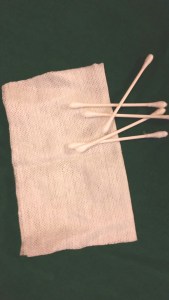
The gentle gauze of acknowledgement will better slow verbal grieving than the poky prodding of a cotton swab. (photo by Teresa TL Bruce, TealAshes.com)

The gentle gauze of acknowledgement will better slow verbal grieving than the poky prodding of a cotton-tipped swab. (photo by Teresa TL Bruce, TealAshes.com)

Sometimes the people I blurted to were sympathetic. “I’m sorry,” they’d say while looking me over carefully. (One asked, “Are you okay to drive? Do you need me to call someone for you?”) I appreciated the kindness of their sympathy and felt slightly better for the interaction. Their gentle acknowledgement acted like an embracing gauze to hold my wounded soul together.

Often people appeared embarrassed, averting their eyes as if I’d bared too much skin rather than too much of my soul. “Oh,” they’d say (if they said that much) before altogether turning away or, in the case of cashiers locked into position, turning their full attention back to the buttons at their fingertips. I left such encounters feeling the kind of social embarrassment I hadn’t experienced since my children were tiny and bled or threw up (or worse) in public places. In this case there were no surfaces to clean up and nothing to apologize for, but it felt much the same.

The harshest, most damaging interchanges happened when strangers (or much worse, people I knew) chastened me for speaking (or crying) about my husband’s death. “Stop crying,” they’d say, or “You already told me,” or “But that was last month, so why are you still crying about it?” or “Everyone has troubles, so you need to get over it and move on.” I walked away from such encounters feeling deep shame for my feelings and my inability to keep them to myself, as if I’d just offered a messy, inappropriate blood sacrifice in someone’s all-white living room.

In hindsight, with five-plus years behind me, I can forgive myself for committing such “offenses” against those whose own insecurities prompted their harsh or embarrassed responses. Looking back on the way I felt when newly bereaved, I can see how my wounded, lacerated soul and psyche bled orally. Applying pointed pressure to stanch the flow of grieving words was no more effective than holding a Q-tip to a deep cut.**

It was about a year before I managed not to blurt, “My husband died,” long after his death faded to “old news.”

For our family, though, every day we lived with the new, unwelcome reality of “firsts” without him. Time had to thicken and slow the verbal and emotional bleeding. Gentle acknowledgement of loss had to wrap around me and take hold. The raw edges of my wounded psyche had to begin their healing.

If your mourning friends seem never to stop talking about the death of their loved ones, don’t shove a poky cotton-tipped swab into their wounds. Wrap them with the consoling gauze of your acknowledgement and absorb the mess of their blurting with your acceptance and understanding.

___

Feel free to share ways you blurted — or listened.

___

*Please see these suggestions for Better Questions to Ask than “How Are You?”

**I don’t have any affiliation with (or aversion to) the Q-tip brand of cotton-tipped swabs.


Grief Therapy and a Friend’s Counsel

A  few weeks after my husband’s death, a woman I hadn’t seen in years suggested I meet with a grief therapist. “My mom went to counseling after her husband died,” my friend told me, “and it made a world of difference for her. Counseling helped her cope.”

My friend’s sincere concern (and attempted consolation) touched me. I felt the kindness of her intention, but her words scraped at already raw emotions. I balked.

I may have nodded as she spoke, but I stepped back, putting a wider space between us while my inner voice screamed over her advice:

I don’t need a therapist, thank you very much, and this sadness isn’t something I need to fix. I don’t want counseling — I want my husband back. I want my kids’ father back! How dare you — who still have your husband — tell me someone can fix my mental health? He’s only been dead a month — am I supposed to be okay with that?

My husband was dead. Talking it out with a stranger wouldn’t return him to life. It wouldn’t return me from my new, unwelcome status as a single parent to my familiar role as a married, stay-at-home mom.

But before I could put words to that inner indignation, another old acquaintance approached who’d not yet heard THE news. “Hi, Teresa. How’s your husband doing? Where is he today?”

I opened my mouth to answer, not knowing what I’d say.

Sometimes, back then, when grief was new and raw and all-consuming, I couldn’t allow myself to utter the horrible words, “He’s dead.”

Other times, I couldn’t stop myself from blurting, “My husband died.” (Looking back, I pity the poor store clerks, fellow shoppers, and service professionals I encountered.)

So how did I answer the second woman’s innocent, caring question that day — on the heels of hearing another’s advice?

A wordless sob.  I spun and — sobbing louder — ran as fast as I could.*

I ran from the idea of counseling as much as I ran from the need to escape before really making a scene.

For more than a year after that day, my friend’s suggestion rattled around in the back of my mind, usually associated with feelings of flight. Meanwhile, I met and networked with many, many fellow widows and widowers and began networking with others who’d lost loved ones as well. From time to time, these peers mentioned grief counseling, and how glad they were they’d participated.  I always thought, “Good for them … but not for me.”

Counseling reframes grief, but it doesn't remove it.

Counseling reframes grief, but it doesn’t remove it. (Photo by Teresa TL Bruce, TealAshes.com)

Yet my friend’s words echoed: Counseling helped her cope … Counseling helped her … Counseling helped …

When I was ready, I realized it might do me some good. Even then, it took a couple of months more (and several dialed hang ups) to schedule myself an appointment.

It did help. It didn’t take away or diminish my loss, but it empowered me with tools to reframe my life’s “new normal.”

(Thank you again, my friend, for the gentle suggestion you gave me that day more than five years ago. I remain grateful for it!)

Before you gently suggest grief counseling or therapy for bereaved friends, keep in mind:

  • Grieving is harder than it looks, so avoid criticism or commentary that implies your friends are mourning and/or coping the “wrong” way. (Of course, if they are doing or about to do something harmful to themselves or others, stepping in is essential — just as it would be for any of your friends who aren’t grieving!)
  • Grieving takes much, much longer than you think. (Hint: Year two is often more difficult than the first 365 days after a death.) Please, remember they are still in mourning long after the funeral — and reach out to them.
  • Sometimes it helps to enlist a professional, but until mourners are ready, counseling won’t help.**  If you think it would benefit your friends, gently mention the idea once. Wait a couple of months before you bring it up again. Then wait another couple of months.
  • Remember: Grief is an emotional state born of love and triggered by loss, but it has real, physical components, too. Grief can’t be cured or fixed or treated any more than you can cure or fix the love at its roots. But coping tools can (eventually) assist in adjusting to it.
  • Like anything new, it takes time to become proficient. Never, ever, ever imply to a griever they should be (or get) “over it by now.” Don’t say that. Ever. No, never. (Can you tell how strongly I feel about this?)

In the meantime, let your friends know that whether or not they seek a professional’s help in learning to manage their grief, you’ll stand by them — no matter what.

___

*I ran as fast as a woman with nerve damage in her ankle could “run” away while clomping along with a cane. (But that’s a whole different story of life back then…)

**See the Mayo Clinic’s page on Complicated Grief for information on warning signs that your friend may need professional help adjusting after a loss. The symptoms listed are normal for grievers (and even to be expected) during the first six months, according to that website, but may also last much longer. However, if they do not diminish of if they intensify over time, enlisting professional help may be necessary.

New Year after Death

Illustration of running the gauntlet from "Spiessgasse" (Pike-alley) from the Frundsberger Kriegsbuch (war-book) of Jost Ammann, 1525. (This image is in the public domain.) Source: https://commons.wikimedia.org/wiki/File:Spiessgasse_Frundsberger_Kriegsbuch_Jost_Ammann_1525.JPG

Illustration of running the gauntlet from “Spiessgasse” (Pike-alley) from the Frundsberger Kriegsbuch (war-book) of Jost Ammann, 1525.
(This image is in the public domain.)
Source: https://commons.wikimedia.org/wiki/File:Spiessgasse_Frundsberger_Kriegsbuch_Jost_Ammann_1525.JPG

‘Twas the week after Christmas and ‘fore the New Year,
When partyers gathered to prolong good cheer.
But for mourners it marked yet another milestone
(without absent loved ones) of being alone.
— Teresa  TL Bruce

The holidays are hard for the newly bereaved. (They’re not so easy for the not-so-newly bereaved, either.) Since early fall (in the U.S.), we’ve run the grieving gauntlet of celebrations — Halloween, Veterans Day, Thanksgiving, Hanukkah, Christmas — and now we’re facing New Year’s Eve and New Year’s Day. [Please see New Year, New Grief for specifics on grief, the end of one year, and the beginning of the next.]

Sometimes, the cumulative effects of getting through event after event without deceased loved ones can seem like too much to bear. Sometimes mourners become overwhelmed with breathing — with being — in a world whose traditions and commemorations keep going while their lost loves do not.

For weeks now I’ve been reflecting on something I saw on the news the week before Thanksgiving. Former NFL New England Patriot quarterback Doug Flutie’s parents died of natural causes within hours of one another. His father had a fatal heart attack, and then his mother did, too.

It’s been said she died of a broken heart. I believe it.

My sympathies and condolences go to the Fluties’ children, grandchildren, and other extended family this holiday season and as they begin the new year without them. Losing a parent is agonizing. (I know how I felt when my mother died.) Losing a grandparent is painful and life-changing, too. (I miss all of my grandparents.)

I cannot imagine the sorrow and ache of losing both parents (or two grandparents) in a single day.

For their immediate and extended family’s sake, I am sorry. Their pain and mourning will last beyond the initial swells of sympathy and kindness they no doubt received from their friends (and from the public).

But for the sake of the couple themselves, who died within hours of each other …

Losing a spouse is heart-breaking. Literally. It wasn’t until my husband’s death that I understood how physically broken a heart could feel. But it wasn’t just my heart. I had grafted my life to my husband’s — joined in mind, heart, body, and soul. His death ripped, tore at, axed, smashed, and severed our joined mind, heart, body, and soul — my mind, my heart, my body, my soul.

We were one. And when one is halved, the fraction remaining is not whole. The surviving spouse is an off-kilter, walking wound, more a jagged hole than a functioning human.

I remember how awful the first days felt. (First weeks, months, years …) I resented rare couples, like the Fluties, who passed from this life into the next together by peaceful, natural causes.

For the sakes of that late husband and his briefly widowed wife (whose family now doubly grieves their dual absence), I reluctantly admit I held a sliver of envy. (Amid the widowed community, I know I’m not alone in this.)

I’m not the only widowed one who, on hearing of one spouse shortly following the other into death, feels … (I don’t like admitting this) … jealous.

Now, lest any of my friends, family, or readers misunderstand me, let me be very, very clear before we go on from here:  I did not ever, I do not now, and I will not ever contemplate taking any action to hasten “joining” my late husband. No. NOT gonna happen.*

But there were times I would have welcomed a passive exit of my own. There were times when grief was so ever-present, so debilitating, so excruciating, so overwhelming, so lonely … I went to bed hoping not to wake up. 

It wasn’t that I didn’t want to live, because I had three amazing daughters who needed me. I had other family and friends I needed and loved, too. But I didn’t know how to keep going One. More. Hour. — let alone another DAY — in that much pain.

Waking up to a new day was as awful as going to bed alone. (Sometimes.)

Among the newly widowed, dying together can seem preferable to surviving a spouse. (At least for a while.) Over and over I heard others say, “Why did I have to stay behind? Why do I have to keep going? How can I endure hurting this badly?”

There’s nothing you can do to remove their pain, but you can make sure they don’t endure it alone. Include them. Be with them. Validate their loss by acknowledging and accepting their sorrow.

Let them know you’ll be by their side — and not just on New Year’s Eve, but in the unbearably long 365 days that follow.

___

*If you (or anyone you know) feel so overburdened by grief or loss (or any other reason) that “not living” seems like an option, please, please seek professional help. Do it now. If not for your own sake, then for the sakes of those around you, get help now.
Visit http://www.suicidepreventionlifeline.org/ or call 1-800-273-TALK (8255) in the U.S.; outside the U.S. you may find resources listed at http://www.suicide.org/international-suicide-hotlines.html.


Lost, Found, and Lost Again–Goodbye, YWBB

Several weeks after my husband died, a friend of a friend suggested I visit a website for young widows. Like me, she’d been widowed not long before, and she’d found it a balm for her wounded, bereaved soul. When our mutual friend mentioned it to me, I balked. How could I — why would I — ever consider putting my most raw, vulnerable feelings “out there” under a made-up user name to converse with strangers in a forum that anyone in the world could read?

(Says the woman whose blog now does just that, but in her own name …)

I resisted the invitation to check out the website, but my friend persisted, insisting it had helped her friend and that it could help me, too. After fending off several promptings from her, I finally typed in the site address. (I figured I’d give it a quick glance so I could tell her I’d done it — so she’d stop asking.)

What I didn’t know then, but quickly learned upon my first look at the site, was that it was FILLED with others who’d suffered their own similar, devastating losses. I believe there were about 17,000 registered users at the time — a staggering number considering I was the only young widow I knew then.  It was one thing for friends and family to reassure me, “You’ll be okay, Teresa. You’ll get through this.” Their words were positive and encouraging and appreciated and … emotionally unbelievable.

How could any of the people in my “real life” know what it meant to suddenly, unexpectedly be “relieved” of 24/7 soul mate caretaking? How could they relate to the weight of being the sole, surviving parent of college and high school students? How could they assure me that things would “be okay” for my kids (and me) while life as we knew it tumbled apart and away in grief and loneliness and shock and a thousand other irrevocable daily changes…

Within seconds — yes, seconds — of my first glance at the Young Widows Bulletin Board (YWBB), I felt the weight of “aloneness” slip from my shoulders. These people were my people, from all walks of life, from just about every corner of the globe. All knew the self-severing pain of losing their other halves. All wore the wounds of widowhood.

They assured me it was okay to cry whenever (and wherever) I needed to. They reminded me I needed to breathe deeply and drink more water to cope with the physical stresses of bereavement. They understood why I couldn’t remember to prepare meals (or eat them), why I got lost driving within my neighborhood, and why simple errands left me sobbing. They shared the same physical cravings for their companions.

With these, my new peers, I was home.

They didn’t tell me to “be happy” for his lack of ongoing suffering or to “be glad” it was quick. They didn’t tell me when I “should” feel this way or that. They didn’t reassure me he was “in a better place,” even when they believed it as firmly as I did. They didn’t minimize his absence by “consolation” that I was “young enough” to marry again.

They acknowledged, and therefore validated, my pain.

In the years since I took that first glance, I grew to know and care about many of “the regulars” and before long I found myself in the role of nurturer for the newly widowed. I’ve met with many of my friends from the site and formed lifelong bonds. In time, I leaned on the YWBB less frequently as I grew and healed and found other sources of solace and support.

But it was always there as an emotional backup.

Until today.

The site recently announced it would forever close as of March 20, 2015. Over the last couple of weeks, I’ve frantically poured spare minutes into the painstaking, time consuming process of copying and pasting my archived posts into my personal journal. I’d made a lot of comments over the years, so the process took HOURS. I had about 60 comments to go (out of more than 1300) when at midnight this message appeared:

Young Widows Bulletin Board signs off

It is gone. I knew it was coming, and yet … I mourn anew at its passing.

Worse, far worse, early this morning — between the time I began drafting this post and the time I finished it — a friend joined the ranks of the young widowed. She’s a woman of great faith; please offer a prayer (or two or more) in behalf of my friend and her family. My heart hurts for her (and for her children) and I want to — I wish I could — walk her gently to the place of my now-missing lifeline. 

There are other sites available now, and I’m sure they will offer complete camaraderie and sustaining support, too. But they won’t be the same.

___
(By the way, Cynthia and Eileen, thanks again for your kind, well-aimed nudges toward what became a source of strength and encouragement when I so badly needed it.)