Typhoons, Tornadoes, and Other Disasters Wreak Havoc on Individuals

Typhoons. Tornadoes. Terrorism. Turmoil. Large-scale disasters all, impacting dozens, hundreds, thousands of souls.

Life-shattering, publicly viewed, world-watched tragedies, displaying agonies of individuals: children, wives, husbands, parents, siblings, relatives, friends.

Fragmented sentences, fragmented lives.

I admit, I seldom watch the news. Not anymore. Not since my husband’s death.

It’s not that I don’t want to be informed. I do. But I’m now expertly informed in the one area the glowing rectangle cannot convey, no matter how eloquent its writers, nor inspired its photographers, nor supernal its composers, nor gifted its news gatherers and broadcasters may be:

I know how grief feels.

And when I see the shocked, huddled faces of survivors’ physical pain and discomfort …

And when I see the decimated rubble  of one-time homes, hospitals, and houses of worship…

And when I see the eyes of those whose loved ones are no more…

…I see their grief, their public grief,
and I feel a degree of it.
I remember the excruciating feel of
my own, private anguish.

Large-scale grief-events require large-scale generosity and cooperation (to rebuild community infrastructure and provide day-to-day resources for residents to live on). They also require one-on-one generosity and compassion (to refashion–not rebuild–individual survivors’ lives).

Please, as much as you are able, help.

Image from the Children's Grief Awareness Day Facebook page (https://www.facebook.com/photo.php?fbid=346620602055569&set=a.121173784600253.18290.121173094600322&type=1&theater)

Blue butterfly image from the Children’s Grief Awareness Day Facebook page

Donate time, money, or expertise. Give a little or give a lot, but please also give from your heart. Though emergencies have an impact on everyone, with Children’s Grief Awareness Day coming this week, please consider the affected children’s needs, too. Already grieving children (and parents) not directly touched by today’s tragedies will nevertheless feel for–and with–those who are.

You Shouldn’t Say “You Should”

When you want to  help someone whose friend, relative, or coworker has died, avoid saying “you should” or “you shouldn’t.”

Grieving is some of the hardest work people ever undertake — perhaps the hardest. When the loss is new and raw, when bereaved parents  or widowed spouses or parentless children face the realities of never seeing loved ones again, the pain is beyond description. In the grief-laden, foggy-minded months after my husband’s death, someone told me the human brain doesn’t have the capacity to imagine that kind of pain. Though I still can’t remember the context (whether written or spoken) nor who said it, the accuracy of the assertion burned itself into my core.

Grief doesn’t affect mourners 24/7; it lurks 48 hours a day, 14 days per week. (Whether “the math” agrees or not, that is how it feels.) Grief doesn’t visit the homes or workplaces of those who have lost; without permission it becomes an unwelcome squatter inside the cells and hearts of the bereaved. It tosses beloved furnishings out onto rainy streets while arranging its own dark goods in every corner of memory and thought.

Already facing such life-altering changes, the bereaved don’t deserve to be told they “should” or “shouldn’t” … anything.

Don’t say, “You should be…” or “You shouldn’t be…”
Don’t say, “You should feel” or “You shouldn’t feel…”
Don’t say, “You should already…” or “You shouldn’t yet…”
Don’t say, “You should have…” or “You shouldn’t have…”

Instead of helping, these and other shoulds and shouldn’ts send the bereaved the message they are not grieving the “right” way, that their best efforts are inadequate, that those best efforts fall short.

Telling the bereaved what they should or shouldn’t do (unless you’re a professional whose advice they are seeking) is like whipping a horse with a broken leg because it refuses to run — pointless and cruel.

Acknowledge Birthdays and Anniversaries

After Mom died I hesitated over whether to acknowledge her birthday — or their anniversary — to Dad. I say “hesitated,” but that’s too mild a word.

I was afraid.

What if … he didn’t remember their anniversary ?
What if … he didn’t remember it was her birthday?
What if … he’d forgotten his sadness … and I reminded him?

What if I made him feel worse?

I didn’t know then, even though I missed her terribly, too, that my widower Dad missed her so much more. He was already sad — of course he was — already grieving her absence.

The week of her birthday felt awful, though my husband did his best to help me through it. Then one of Mom’s friends brought me a loaf of homemade bread. She knew it was Mom’s birthday, and she told me about a time when my mother took some to her.

Knowing someone else remembered my mother meant everything!

Even so, I still hesitated to bring up special Mom-related occasions around Dad because, again I thought, What if I make him feel sad by mentioning her?

After my husband died, I realized how ridiculous my thinking had been. Even though I’d wanted and needed acknowledgment of others’ ongoing thoughts of Mom, I’d assumed Dad could “forget” the timing of significant dates. I’d assumed that by mentioning those special occasions I’d “make” him feel more sorrow and longing for her than he already did.

As a widow it felt even more important and helpful to have people remember — and acknowledge — my husband’s birthday than my mom’s, though I still wanted that, too. Before hubby’s death, he was the one who helped me get through Mom’s birthday, the day after his.

Their birthdays fell in the fourth month after his death. Shock had begun to lift, but I was still, frankly, a mess. In that first year, one of my best friends flew 2,000 miles to spend that difficult week with me. She returned again for the week of the anniversary of his death. Her presence made a world of difference!

Another thoughtful woman gave me a card a few days before that same first “angelversary,” as some call it. (Some also call it the “sadiversary.” When my grief was still raw I called it the latter; now tempered by a few years, I think of it as the former.) In her sweet note she acknowledged awareness that it was a difficult time of year for me. Until then I’d known her only as a friendly acquaintance, but we’d not been particularly close. Her thoughtfulness marked the beginning of a now solid friendship.

Don’t be afraid to “say something” to your coworkers, friends, classmates, or relatives who’ve suffered a loss. Even if your kind acknowledgment elicits a tear or two (or an entire stream), you won’t “cause” the bereaved to feel sad — their losses did that! — but you will have demonstrated you care by showing you remember their lost loved ones.

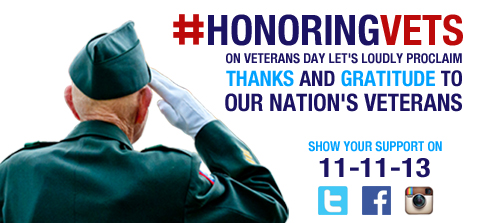
Veterans Day Thanks

Say THANK YOU to veterans--and their families.

Say THANK YOU to veterans–and their families.

What is the purpose of Veterans Day? “A celebration to honor America’s veterans for their patriotism, love of country, and willingness to serve and sacrifice for the common good.” *

One of the best ways to honor those who have served is to say “thank you” to them — and to their families — acknowledging awareness of their service and sacrifice on behalf of their nation.

I was raised in a patriotic home by parents whose reverence for and “allegiance to the flag of the United States” was founded in acknowledgement of all the souls who perished — from the Revolutionary War to the present — in paying the price for the freedoms that bless my life. (Most patriotic songs have brought tears to my eyes since I was old enough to understand their lyrics.)

As a widow, however, my appreciation for veterans has multiplied a hundred-fold. I have a better grasp of the fragility of the time we spend with (and away from) our loved ones. I’m grateful to those whose service cost them precious days away from home and whose service-related health issues continue exacting a price.

And now, because I know the pain of losing a spouse and have met many military widows (and a few military widowers), I view the sacrifices of the fallen in a more personal way than I did before.

THANK YOU, Veterans, for leaving home and hearth to serve your country. And thank you to the loved ones who wished you well as you did so.

*quoted from “History of Veterans Day,” U.S. Department of Veterans Affairs (http://www.va.gov/opa/vetsday/vetdayhistory.asp)

Remember Your Own Pain

These flowers may not look like much, but they meant the world to me when a neighbor who'd just heard "the news" brought them from her house. Her kind gesture was incredibly helpful.

These flowers may not look like much, but they meant the world to me when a neighbor who’d just heard “the news” brought them from her house. Her kind gesture was incredibly helpful.

Grief isn’t limited to the death of a loved one, nor is its impact felt the same at each stage of our lives. If you’re old enough to read this, you’re old enough to have experienced your own loss(es) by now. Remember how you felt as you reach out to console your friends who have lost loved ones. Even if you can’t understand the depth of their pain, you can empathize by silently recalling your own — while never verbally comparing your grief to theirs).

Here are a few levels or degrees of personal grief that continue to temper my understanding as I interact with those I know:

As a kindergartner, my grief over the moving-day mishap of losing my toy kitchen felt devastating — for a while.

As an older child and teenager, my grief over the loss of each beloved pet (whether goldfish or guinea pig or dog) was devastating — for quite a while.

As a young woman in high school and college, my grief over each broken heart felt like the end of my world — for the foreseeable future.

As a young mother (not yet in my thirties), my grief over the loss of Mom was life-altering — forever. I was motherless while anticipating the renewal of my own motherhood, with our third child due in three more months. This baby would not know my wonderful mom! I leaned heavily on my husband’s strength and support at the time.

One crying-on-his-shoulder conversation stands out. He didn’t urge me to stop crying, nor did he tell me everything would be okay. He cried with me, sharing his love and grief, too. Even after Mom’s initial breast cancer diagnosis three years earlier, and even after it metastasized to her brain and spinal column, he’d assumed his much older parents would “go” before either of mine. As I thanked him for holding and hearing me, he hugged me tighter and asked that I do the same for him when the time came.

His death at 47 left me unable to reciprocate.

As a young widow (not yet midway through my forties), my grief over my husband’s death was life-shattering. It was unlike any previous experiences.

As you draw upon your own painful experiences, let them remind you of what helped — and what did not help — in similar circumstances. You may find the best help of all is to quietly “be there” beside your friend.

___

Note: For more on widowhood’s devastation, see If You Really Want to Know What Widowhood Means where I share the anonymous “Letter to a Friend” mentioned on my Helpful Grief Resources page.