St. Patrick and the Green Grief Monster

Celebrating St. Patrick’s Day (or not) isn’t the same when you’re grieving. Nothing is. The day itself commemorates the death of Ireland’s patron saint — originally it was a religious observation. But in recent years its solemnity appears all but forgotten as popular culture makes it into a day for people to celebrate their Irish heritage (whether real or adapted for the day).

In my family, with Irish ancestors on both my side and my late husband’s side, our St. Patrick’s Days were all about the green. When our kids were little, I’d add green food coloring into milk, pancakes, cookie dough — whatever I could think of — just to infuse the day with a bit more color.

Green milk and other green-dyed foods were a staple of our St. Patrick's Days.

Green milk and other green-dyed foods were a staple of our St. Patrick’s Days. (Photo by Teresa TL Bruce/TealAshes.com)

We wore green, of course, because nobody wanted to get pinched.

I made corned beef, cabbage, and potatoes for dinner. A few times I made Irish brown bread from a magazine or cookbook recipe.

And that was it — St. Patrick’s Day at our house.

After my husband died, memory and timekeeping did an agonizing push-pull dance.  For more than a year, I knew exactly how many days, weeks, and months had passed since his death. The awareness wasn’t something I tried to keep track of — it just was.

I also knew when holidays loomed ahead of me, but I backpedaled from them, dragging my feet as the calendar funneled me toward them. Maybe I thought if I didn’t acknowledge them, didn’t prepare for them, didn’t commemorate them … Maybe by ignoring those yearly occasions, I could avoid the pain of experiencing them without my husband.

I also felt guilty for the unwilling resentment I felt toward couples I saw enjoying such days together. I wanted to walk up to them and say, “Whatever you do, don’t take each other for granted. You’re together. Not everyone has that.”

I’d felt similar pangs of green-eyed jealousy after my mom died when I’d see grown daughters with their mothers. It was especially difficult at church, watching women I grew up with visiting home and spending that time with their moms. Of course I was happy for them, but it hurt that they had what I no longer did.

More than a few times, when I overheard women (of various ages) griping about their moms or snapping at them with harsh words at the store or a restaurant, I butted in — completely unbidden. “Excuse me,” I’d say. “You don’t know how long you get to have her in your life. When she’s gone you are going to regret acting like this.” Then I’d walk away. (I’ve tried to keep my own words in mind when interacting with my grown daughters. Every day together is precious.)

It hurt to remember my husband and my mother during holidays. It hurt worse when others didn’t acknowledge their absence during those same days.

Although it wasn’t my intention to walk around under a cloud of doom, I couldn’t help resenting well-intended “Happy St. Patrick’s Day” greetings, along with every other “happy this” or “happy that” greeting in the first couple of years after each new loss. Sure, I wanted to be happy, but I was mourning. And grief is not a  happy process.

The best support friends gave me during holidays, on anniversaries, and on other tender dates was to acknowledge my loss.

It may seem contradictory, but speaking of the deceased loved one can offer better cheer than saying “Have a happy [whatever] day.” Instead, tell your grieving friend something like, “I’m sure you’re missing [SAY the name!] today. I’m thinking of you.”

This is my sixth widowed St. Patrick’s Day. There’s no corned beef and cabbage on the menu, but I’ve made green milk and cookies again, and I no longer scowl when wished a “happy St. Patrick’s Day.” For now, that’s enough.




“Be Strong” Is Wrong (for Grieving Friends)

When someone dies, don’t tell survivors how strong they are. Tell them you’ll be strong beside them so they don’t have to — and follow through.

The first times people called me strong after my husband died, I had no idea how to respond. Their expressions and tones made it clear they’d intended to compliment me, but I couldn’t accept their words. I’d look at them, thinking, How can I say the expected “thank you” to such a blatant lie? 

I was as fragile as dandelion fluff.

Mourning made my feelings as fragile as overripe dandelion fluff. (photo by Teresa TL Bruce, TealAshes.com)

The truth was, I was broken, shattered into a million loosely gathered shards. The softest puff of sympathy or the least gust of gruffness might send my fragmented psyche as irretrievably into the wind as overripe dandelions in the hands (and breath) of enthused toddlers.

I was not strong. And it puzzled me that anyone might think I was.

I cried all the time. All. The. Time.

Everyday chores I’d mastered years earlier now confused me.

New tasks (including seemingly endless death-related business matters) overwhelmed me.

The sudden, sole responsibilities of single parenting had my knees buckling.

Strong, I was not. But that’s what was expected (and even demanded) of me. “Don’t cry,” some said. “You have to be strong for your daughters.”

Such words (though intended as encouragement) deeply shamed me. Being anyone else’s rock is a heavy burden when you’re scarcely able to hold onto yourself. 

Didn’t they realize how much strength seeped from me in getting out of bed each morning? Didn’t they know how much energy I exerted just remembering to breathe? Had they no idea how sucked away my strength felt after days and weeks and months of only sparse, grief- and nightmare-riddled, interrupted naps instead of genuine sleep?

Telling me how strong I was didn’t feel like a compliment. It felt like being told I could and should be able to handle everything on my own.

But I couldn’t.

Telling me I was strong didn’t make me feel capable. It made me feel like I wasn’t worthy of asking for help.

So I didn’t.

Sorrow saps strength. Grieving grinds it away. Bereavement burdens and bruises the body. Mourning makes mincemeat of memory.

So step in.

How can you offer your strength to grieving friends?

  • Help your mourning friends with physical tasks like mowing the lawn or shoveling snow or washing the car or doing the dishes and laundry. (*See important note about this below!)
  • Go along on emotionally charged errands (like changing car titles, account names, or banking business into the survivors’ names). Don’t make general offers like “call me if you want me to go” — they won’t. Instead, be specific: “Can I take you to the auto tag office Thursday afternoon to help you transfer the title into your name?” or “Would Tuesday or Wednesday be better for me to drive you to the Social Security office to submit the claim for the kids’ benefits?” or “The minute the funeral home says you can pick up the death certificates, call me. I want to help.”
  • Look out for your bereaved friends’ health. Bring a healthy meal, invite your friends on nature walks, share your favorite sleep soundtrack, take them for a massage, mention you need your own six-month dental cleaning and ask if they need you to call their dentist to schedule theirs …
  • Make a list. Mourning makes remembering anything a challenge. Write down tasks your friend might mention in passing. Offer reminders of appointments. Write down memories of their deceased loved one. Write down all the kindnesses other friends extend to your grieving mutual friend.
  • Be present. The loneliness of mourning a person missing from your life is difficult to describe. Acknowledge your awareness your friend is hurting. Sometimes the bereaved need reminders they (the deceased and the bereaved) aren’t forgotten and that they are valued for themselves — not just for who they used to be in relation to the ones no longer living. If you live nearby, sitting in silence alongside your friends will strengthen them just by your willingness to witness their sorrow. If you live far from them, you can still be “present” with phone calls, texts, instant messages, and even old-fashioned snail mail.

Here’s the irony:

Now, five-plus years later, I can honestly say, I’ve become strong. I’ve had to.  I’ve become stronger than my pre-widowed self could have imagined. The bones of my broken soul reknit into a construction of titanium lace.

But it took being broken — and much, much longer than six to eight weeks — to grow that strength.

(Sometimes, I also admit, the holes in that titanium knit lace soul of mine still feel more jagged than smooth, more broken than whole. Grieving, like living, is a process.)

___

*Please note: ALWAYS, Always, always ask before washing or putting away or cleaning up after the deceased person’s clothing, dishes, or even apparent trash! (Mourners may need and want to handle those newly sacred, last-touched items themselves.)

Grief Talk: Blurting Nonstop about a Loved One’s Death

I blurted “my husband died” to every stranger I encountered in the earliest weeks after it happened. No matter the setting — church, the frozen foods aisle, in the pharmacy checkout line … No matter where I was, I had to say it. I hated saying it. I hated hearing it. But I had to.

It wasn’t as if I walked into any business thinking, “I’m going to announce to the world I’m a widow.” Most of my grief blurted out in unbidden bursts prompted by the piercing pressure of dull-looking (yet deceptively sharp) questions like “How are you?”*

I am grieving, that’s how I am, thank you very much. Whether a person meant the question or said it as a greeting synonymous with hello, if I was asked, I would tell. And even if I wasn’t asked, my body had to express its inexpressible sadness in tears, shallow breathing, gut-wrenching anxiety at the sight of products my husband used — no, used to use — and sometimes in words, inadequate as they were.

Perhaps my pattern of blurting was set from the first moments after the hospital doctor delivered his pronouncement, when an orderly leaned inside the doorway of the tiny waiting room. “‘Scuse me,” he said to the doctor, “the medical examiner’s office is on the phone.” He crossed the room in three steps and while extending the cordless phone toward my hand said, “How ya doin’?”

I regret to say I raised my voice at the man. “My husband just died. How do you THINK I’m doing!?” (I can only hope my outburst did some good in the long run; I hope he never, ever addressed a grieving family in that way again.)

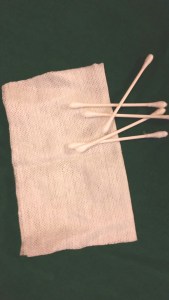
The gentle gauze of acknowledgement will better slow verbal grieving than the poky prodding of a cotton swab. (photo by Teresa TL Bruce, TealAshes.com)

The gentle gauze of acknowledgement will better slow verbal grieving than the poky prodding of a cotton-tipped swab. (photo by Teresa TL Bruce, TealAshes.com)

Sometimes the people I blurted to were sympathetic. “I’m sorry,” they’d say while looking me over carefully. (One asked, “Are you okay to drive? Do you need me to call someone for you?”) I appreciated the kindness of their sympathy and felt slightly better for the interaction. Their gentle acknowledgement acted like an embracing gauze to hold my wounded soul together.

Often people appeared embarrassed, averting their eyes as if I’d bared too much skin rather than too much of my soul. “Oh,” they’d say (if they said that much) before altogether turning away or, in the case of cashiers locked into position, turning their full attention back to the buttons at their fingertips. I left such encounters feeling the kind of social embarrassment I hadn’t experienced since my children were tiny and bled or threw up (or worse) in public places. In this case there were no surfaces to clean up and nothing to apologize for, but it felt much the same.

The harshest, most damaging interchanges happened when strangers (or much worse, people I knew) chastened me for speaking (or crying) about my husband’s death. “Stop crying,” they’d say, or “You already told me,” or “But that was last month, so why are you still crying about it?” or “Everyone has troubles, so you need to get over it and move on.” I walked away from such encounters feeling deep shame for my feelings and my inability to keep them to myself, as if I’d just offered a messy, inappropriate blood sacrifice in someone’s all-white living room.

In hindsight, with five-plus years behind me, I can forgive myself for committing such “offenses” against those whose own insecurities prompted their harsh or embarrassed responses. Looking back on the way I felt when newly bereaved, I can see how my wounded, lacerated soul and psyche bled orally. Applying pointed pressure to stanch the flow of grieving words was no more effective than holding a Q-tip to a deep cut.**

It was about a year before I managed not to blurt, “My husband died,” long after his death faded to “old news.”

For our family, though, every day we lived with the new, unwelcome reality of “firsts” without him. Time had to thicken and slow the verbal and emotional bleeding. Gentle acknowledgement of loss had to wrap around me and take hold. The raw edges of my wounded psyche had to begin their healing.

If your mourning friends seem never to stop talking about the death of their loved ones, don’t shove a poky cotton-tipped swab into their wounds. Wrap them with the consoling gauze of your acknowledgement and absorb the mess of their blurting with your acceptance and understanding.

___

Feel free to share ways you blurted — or listened.

___

*Please see these suggestions for Better Questions to Ask than “How Are You?”

**I don’t have any affiliation with (or aversion to) the Q-tip brand of cotton-tipped swabs.


Super Bowl, Super Grief

Super Bowl 50 may be a big deal to some folks out there, but for those who are grieving it may or may not matter. If you have friends who’ve lost loved ones within the last couple of years (or so), keep in mind:

  1. Invite grieving friends to watch the big game at your house with you.

    This is the most Super Bowl that gets watched at my house.

    This is the kind of Super Bowl that gets watched at my house.

  2. If you and yours don’t watch the Super Bowl, invite your grieving friends to join you in whatever you do — or don’t.
  3. If you’re having a tailgating party, invite them there.
  4. Mourning leaves people feeling bronco-bucked. They may need to immerse themselves in occasional fun to escape their pain for a while.
  5. Grieving makes your friends feel panther-mauled. They may need to curl up in their dens to recover in solitude.
  6. Living after losing a loved one is harder than you know, so cut them a bit of slack. Mourners may need a replay or do-over.
  7. Crowds storm the field after the game, but eventually the stadium empties. Well-wishers surround the bereaved up until the funeral, but eventually everyone else goes home, leaving the bereaved alone in their loss.
  8. When you’ve lost the highest-stakes championship — with death on the line — getting riled up over a football game can seem pointless.
  9. Mourners need fans to cheer them on with encouragement and support — whether they seem ahead of their game or whether they seem to be running behind.
  10. After the game, the losing team needs fan support and continued training. After the funeral, bereaved friends need ongoing support, too.
  11. If you’ve already asked mourning friends to join you but they said, “No thanks,” ask again (GENTLY). Invite them to change their minds at any time.
  12. Honoring traditions (such as pre-game parties with friends) can make the bereaved feel more connected to their departed loved ones and their living friends.
  13. Honoring those same traditions can make the bereaved feel more disconnected from their dead loved ones and their living friends.
  14. Mourners can feel happy and involved with their friends while also feeling sad and isolated from their friends at the same time in the middle of a party.
  15. Not being invited because they’ve lost loved ones makes mourners feel like they’re being unfairly punished.
  16. Just because your friends have lost loved ones doesn’t mean they can’t laugh at funny things. Sometimes mourners need to laugh.
  17. Laughing while mourning can feel so good it makes you cry.
  18. If players are sidelined due to injuries, they need medical treatment but still belong to the team; if mourners are sidelined by grief, they’re still your friends — so treat them that way.
  19. Sometimes players’ numbers are retired, never to be worn again; people sometimes see that as sad, but the team carries on with new players signed on. Mourning friends’ loved ones have gone beyond retirement, never to play or work or interact again; their family team will never, ever be the same.
  20. Super Bowl teams train and work out long before they set foot on the televised field in front of the world. Whether mourner’s have advance notice of bereavement’s demands  or they’re tackled by it without warning, grievers often feel vulnerable under spectators’ scrutiny.
  21. Mourners don’t need would-be coaches who’ve never mourned their loss telling them how to play through their grief.
  22. If you haven’t already asked your grieving friends to join you for the game, it’s not too late. (If you’re reading this after the game, it’s still not too late to get together doing something — anything — else!)
  23. Game day snacks might be the most wholesome meal your mourning friend has eaten since their loved one died. (Mourning appetites are weird.)
  24. Players sidelined with concussions are never told to get back out on the field to play again too soon. People concussed by the death of a life partner (or other loved one) should also never be told to get back out into relationship fields to play again too soon. (They’ll know when — and/or if — they’re ready again, so don’t give your input UNLESS they ask.)
  25. Tailgating means shopping ahead and prepping food before the big event; mourners may have trouble shopping or prepping food at all.
  26. Even if you don’t usually invite friends over for the Super Bowl, please invite your bereaved friends anyway. You don’t have to do anything fancy; just being there as a friend will help.
  27. Have a box of tissues nearby for commercials. Sometimes touching ads will touch off emotions of grief. Let your friends know you are okay with them expressing their feelings.
  28. Friends don’t let friends drive drunk (grieving or not). So don’t. Ever.
  29. Whether your friends lost their loved ones recently or long ago, keep in mind that annual events may strengthen and stir up traumatic losses.
  30. Last-minute invitations are better than no invitations at all. If you haven’t already done it, please, call, text, or message your grieving friends — NOW.

Whether you’re reading this hours or minutes before the big game, halfway through it, or long after, tell mourning friends you’re thinking of them. Acknowledge that even though they may feel alone, they aren’t forgotten and they don’t have to be alone all the time.

Let them know you care.

Crazy with Grief

If you want to comfort someone who is grieving, or if you’ve recently lost a loved one, here’s something you need to know:

Grief can make a person feel crazy.

Stark. Raving. Crazy.

Before I go on, please accept that I don’t use the word “crazy” lightly. I mean no offense to any individuals living with mental illnesses. On the contrary. I have a glimmer of understanding — just a little bit — about how difficult it can be to live with mental health challenges. I have relatives and friends whose diagnoses impact their day-to-day lives.

My late husband grappled with severe, life-impeding OCD. During his last two years, other mental and/or neurological symptoms (which were never adequately diagnosed) infected his thinking and behavior, bringing our home life to its own level of … no other way to put it … crazy.

After my husband’s unexpected death, I thought I was losing my mind; it didn’t work right.

  • My short-term memory stunk. I couldn’t hold simple to-do lists. I’d flit from the start of one to the middle of another. (Why am I standing in the laundry room holding my toothbrush wearing only one shoe?) For the first time in my life, I forgot to pay bills on time. When I remembered to attempt cooking, I left perishable food on the counter or in the stove or microwave until it turned on me and I had to throw it out. I had too many near-misses forgetting I’d turned on the stove or lit a candle. (NOTE: SET A NOISY, OBNOXIOUS TIMER IF YOU’RE GRIEVING AND TRYING TO COOK.)
  • I lost time. It took twice as long (or more) to do routine things like putting on clothes or brushing my teeth. Even pouring a bowl of cereal and slicing a banana took longer. More taxing tasks (like paying bills) took three to four times longer (and I didn’t do them very well).
  • Showering was a sob-fest. I fell apart every time. The solitary vulnerability allowed too much time for thinking, reflecting, and mourning. The waterworks were so bad, for a while I put off showering as long as I (and my family) could stand it.
  • Sleep was a nightmare. Literally — I had soul-waking, body-shaking nightmares. That is, when I could sleep.  For months I avoided sleeping, no matter how exhausted I became, in hopes of avoiding (or at least delaying) the nightmares.

    After my husband died, my brown eyes looked green to me. (Photo by Teresa TL Bruce/TealAshes.com

    After my husband died, my brown eyes looked green to me. (Photo by Teresa TL Bruce/TealAshes.com

  • I couldn’t look myself in the eye. My reflection looked wrong. Instead of seeing myself — the self I’d always seen before — I saw only the emptiness in my eyes. (Emptiness, that is, except for the bloodshot insomnia tinting the whites.) It was unsettling. I knew I’d lost my husband (my other half) and the mirror flaunted I’d also lost myself. I had to avert my gaze, careful not to look too closely into my soul’s windows.
  • I couldn’t stop looking at my eyes. (Yes, that sounds like a contradiction, which seems a little crazy. Which is my point …) All my life, I thought I had clear brown eyes. It may be scientifically impossible, but after my husband died, my eyes looked more green than brown. (Yes, I felt irrational green-eyed jealousy over couples who got to keep their spouses to ripe old ages, but I’m not talking about their metaphoric hue.) My irises still look more green than brown to me.
  • I couldn’t stand to be photographed, either. I remembered as a child reading in National Geographic of a tribe of people who feared that cameras somehow captured their souls. The thought of documenting the emptiness in my eyes brought panic. I still remember one person telling me to smile for the camera and when I told her no, I didn’t want my picture taken, she did it anyway. The violation chilled me, left me shaking.
  • Making business phone calls felt like mountain climbing. (No, I’ve never actually been mountain climbing, and if I could have avoided all reasons for using the phone during that period, I wouldn’t have made those necessary calls, either.) Every time I called another organization regarding the business side of my husband’s death, I felt like I’d been punched in the stomach. (And yes, thanks to a bigger-than-me-boy-bully from elementary school, I do know how that feels.)
  • Personal calls were harder. I can’t count how many well-meaning souls said, “Call me if you need anything.” I knew they were my friends. I knew they meant it, but their offer was too general, too much from a perspective of not understanding what that “anything” might have been. (I didn’t know what I needed, and besides, didn’t they know how HEAVY the phone felt?) Even as the words came out of their mouths, I knew I would not call them. Could not.* 
  • My body betrayed me. In the first weeks of widowhood, I didn’t remember I was supposed to eat. When I complied with reminders, my body wouldn’t keep food inside. (I’ll spare you the details, but it wasn’t pretty.) Eventually, it overcompensated, telling me I was hungry when I wasn’t. Of course, there was also the nightly insomnia (and the need for daytime naps to compensate). I forgot to breathe fully. And my skin went crazy, peeling and cracking as if it were dehydrated while also creating acne like I hadn’t seen since adolescence. Even my sense of smell went haywire as I perceived the presence of smells that weren’t there.
  • I followed a stranger. With my car. For a couple of blocks. I knew — KNEW — it couldn’t possibly be my husband walking down the street with his build and gait and hair color and wearing a striped shirt like his. It couldn’t be. But I had to follow until I could see the front of him. Because it looked just like him. And I knew we’d buried my husband, but what if we hadn’t? What if it was him?

In short, I felt crazy.

For all the examples above (except the eye color thing), I’ve heard other bereaved souls acknowledge similar irrational thoughts while mourning. Finding out I wasn’t alone in my mind-mush helped me cope.

But that wasn’t enough.

Before I talked myself into giving grief counseling a try, I pondered the advice of several widowed friends who’d found the process helpful.** Those who got the most out of grief counseling plunged themselves into the process without holding anything  back. They told their therapists everything. Everything.

That scared me.

There were elements of my husband’s mental illness I hadn’t shared with anyone. Some of his symptoms were obvious to those around him; others were more subtle, known only to those closest to our family; a few issues I learned only over the course of our 24 years together. I never wanted to undermine him or betray his confidence, so I spoke of them to no one. Most people had no idea of the depth of his struggles or how they impacted both of us in our shared life.

So during my first appointment with a grief counselor, I let it all out. Everything. All the grief-related craziness and all the new-widow insecurities and all the old-life abnormal-normalcy of living with my husband’s mental illness.

It helped. Telling one nonjudgmental, neutral person everything brought a balance to my grieving. More importantly, the therapist validated the life-altering impact of losing a loved one. She helped me reframe my perceptions of how to move forward in the newly-revised, work-in-progress, ongoing version of my life.

I wasn’t crazy, she assured me. I was grieving.

If you’ve thought your grieving friends were going crazy, or if you’ve thought it of yourself while mourning, I hope this has helped you feel less alone. Please feel free to share your experiences in the comments below.

___

*I believe I made only ONE middle of the night call during the first couple of years. It was to a dear friend I met through a widows network, Shelby Ketchen. Because she’d been a widow for about six months before me, I was able to trust the sincerity of her offer to call “day or night” more than I could trust myself to call upon people I’d known much longer. I knew that as a recent widow, she understood my post-midnight madness. She shared her experience, her faith, and her friendship at a time I most needed to quell the desperation I dared not show in daylight.

___

See the Mayo Clinic’s page on Complicated Grief for more information on warning signs that your friend may need professional help adjusting after a loss.

**For a related post, see Grief therapy and a friend’s counsel.