Veterans Day Thanks

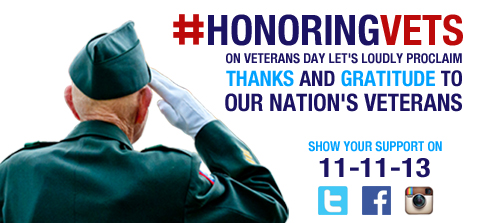
Say THANK YOU to veterans--and their families.

Say THANK YOU to veterans–and their families.

What is the purpose of Veterans Day? “A celebration to honor America’s veterans for their patriotism, love of country, and willingness to serve and sacrifice for the common good.” *

One of the best ways to honor those who have served is to say “thank you” to them — and to their families — acknowledging awareness of their service and sacrifice on behalf of their nation.

I was raised in a patriotic home by parents whose reverence for and “allegiance to the flag of the United States” was founded in acknowledgement of all the souls who perished — from the Revolutionary War to the present — in paying the price for the freedoms that bless my life. (Most patriotic songs have brought tears to my eyes since I was old enough to understand their lyrics.)

As a widow, however, my appreciation for veterans has multiplied a hundred-fold. I have a better grasp of the fragility of the time we spend with (and away from) our loved ones. I’m grateful to those whose service cost them precious days away from home and whose service-related health issues continue exacting a price.

And now, because I know the pain of losing a spouse and have met many military widows (and a few military widowers), I view the sacrifices of the fallen in a more personal way than I did before.

THANK YOU, Veterans, for leaving home and hearth to serve your country. And thank you to the loved ones who wished you well as you did so.

*quoted from “History of Veterans Day,” U.S. Department of Veterans Affairs (http://www.va.gov/opa/vetsday/vetdayhistory.asp)

Remember Your Own Pain

These flowers may not look like much, but they meant the world to me when a neighbor who'd just heard "the news" brought them from her house. Her kind gesture was incredibly helpful.

These flowers may not look like much, but they meant the world to me when a neighbor who’d just heard “the news” brought them from her house. Her kind gesture was incredibly helpful.

Grief isn’t limited to the death of a loved one, nor is its impact felt the same at each stage of our lives. If you’re old enough to read this, you’re old enough to have experienced your own loss(es) by now. Remember how you felt as you reach out to console your friends who have lost loved ones. Even if you can’t understand the depth of their pain, you can empathize by silently recalling your own — while never verbally comparing your grief to theirs).

Here are a few levels or degrees of personal grief that continue to temper my understanding as I interact with those I know:

As a kindergartner, my grief over the moving-day mishap of losing my toy kitchen felt devastating — for a while.

As an older child and teenager, my grief over the loss of each beloved pet (whether goldfish or guinea pig or dog) was devastating — for quite a while.

As a young woman in high school and college, my grief over each broken heart felt like the end of my world — for the foreseeable future.

As a young mother (not yet in my thirties), my grief over the loss of Mom was life-altering — forever. I was motherless while anticipating the renewal of my own motherhood, with our third child due in three more months. This baby would not know my wonderful mom! I leaned heavily on my husband’s strength and support at the time.

One crying-on-his-shoulder conversation stands out. He didn’t urge me to stop crying, nor did he tell me everything would be okay. He cried with me, sharing his love and grief, too. Even after Mom’s initial breast cancer diagnosis three years earlier, and even after it metastasized to her brain and spinal column, he’d assumed his much older parents would “go” before either of mine. As I thanked him for holding and hearing me, he hugged me tighter and asked that I do the same for him when the time came.

His death at 47 left me unable to reciprocate.

As a young widow (not yet midway through my forties), my grief over my husband’s death was life-shattering. It was unlike any previous experiences.

As you draw upon your own painful experiences, let them remind you of what helped — and what did not help — in similar circumstances. You may find the best help of all is to quietly “be there” beside your friend.

___

Note: For more on widowhood’s devastation, see If You Really Want to Know What Widowhood Means where I share the anonymous “Letter to a Friend” mentioned on my Helpful Grief Resources page.

I’ve Added a Resource Page

I’ve created a page of “Helpful Grief Resources” with examples of what to say when someone dies (and what not to say).  I’ll add new sources as I encounter them, so check back from time to time.

  • Have you found useful sites, books, articles–even songs–that helped you interact with the bereaved?
  • If you’ve suffered a significant loss in your life, what comments or gestures from friends were most (or least) helpful to you?

Please share your experiences in the comments below or you can contact me via

email: writeTealAshes@gmail.com

Twitter: @TealAshesTBruce

Facebook: https://www.facebook.com/TealAshesbyTeresaBruce/

Together we can ease the anxieties of those who wish to help their grieving friends — and thereby help the mourners, too.

To reach (or share) the “Helpful Grief Resources” page, click on the menu above or go directly to:

Helpful Grief Resources

Do NOT Tell the Bereaved “Life Goes On.”

Never tell a newly grieving person that “life goes on.”  Don’t.

The first time I heard that after my husband’s death, my breath whooshed away like when a fifth-grade bully punched me in the stomach. If my lungs hadn’t been empty I’d have screamed, “That’s not true!”

It wasn’t — not for my husband. His life did NOT go on.

It wasn’t true for our family, either. Death ended the life we had together. His/Our/My life did NOT “go on” physically, emotionally, financially, legally, socially. It screeched down a slope, plunged over a cliff, and shattered into flying shards.

“Life goes on?” Straightforward, everyday chores nearly undid me! When I entered the grocery store as a new widow, Halloween decorations mocked from everywhere. My heart pounded faster than my thoughts raced. “How can there still be holidays? How can people put up decorations? How dare they depict death and decay and graveyards as fun?”

I took as much offense at the onslaught of every season throughout that year of “first” annual events. Each birthday, anniversary, and holiday that “went on” without my husband scratched nails across the now excruciating chalkboard of occasions by which we had once marked our shared passage through each calendar page.

That life could “go on” normally — for everyone else — seemed cruel.

During those first shocked, raw months, I felt bruised and fettered by day-to-day evidence that — for others — “life went on” around me.

Gradually, as I worked through the motions of “going on,” I felt a brief loosening of those fetters. Sometimes they tightened again, protesting my returns toward living my own life as I faced “new firsts” without him. When I opened my first “Congratulations! Your story has been selected …” notice, I squealed and waved my arms and shouted (just a bit excited, you understand!) and then — and then I wanted to tell my husband … and my mom.

Ouch, again.

But each time I stepped forward, those fetters stretched a little more, and with each new “first” I found their restrictions looser, briefer. Eventually they began resembling bracelets more than manacles, accessories to my life story more than markings of “The End.”

I’ve learned that life does, indeed, go on, that it can be beautiful again. I, however, like every other grieving soul, had to discover it for myself — when I was ready.

When Someone Dies, Do NOT Say, “I Know How You Feel.”

Never tell a grieving person, “I know exactly how you feel”—because you don’t.

You really don’t.

Each survivor’s grief is as unique as it is personal.

Picture your coworkers, classmates, relatives. Do you relate to them identically? I don’t mean answering to the same boss, the same teacher, or the same great-grandma. Do you interact the same with everyone at work? Do your classmates get along equally? Do your siblings share identical relationships with your parents (or your children with theirs)?

Of course not.

Although every grieving parent commutes to work inside the Office Building of Loss, and each shares a suite with at least one other person, each must employ individual skills and equipment to complete assignments for their tyrannical boss.

Even though parentless children enrolled in the Boarding School of Bereavement attend classes together, all must write long-answer exam essays in the unfamiliar tongue of separation and carry their own belongings from dormitory to desk day after day.

While surviving spouses are forcibly relocated to the lonely—yet far too crowded—neighborhood of Death Did Us Part, each widow(er) must maintain sole upkeep on a once-shared mortgage, even while working within walls irreparably damaged by the move.

No matter how many coworkers, classmates, or relatives you share with the bereaved, grief is non-transferrable—one size does NOT fit all.

After my husband died, I knew that people expressing condolences intended support and comfort; I appreciated their efforts. However, each time yet another well-meaning person said, “I know what you’re going through,” I wanted to scream: No, you DON’T know (… you’ve never married, your spouse is alive, you divorced your husband, your third-cousin’s death isn’t the same as my husband’s …) because you have NOT been through THIS!

Ironically, most other widows (and widowers) did NOT say they knew how I felt! Instead, they acknowledged the uniqueness of my grief—and their inadequacy to comprehend it.

  • X and I raised our kids before he passed, so I can’t imagine what you’re going through.”
  • “I feel for you. We said our goodbyes before Y died. I can’t imagine how hard this must be for you.”
  • Z and I weren’t married as many [or as few] years as you and your husband were, so I can only guess how you’re feeling right now.”

Those who verbalized their lack of understanding made me feel best understood.