You Shouldn’t Say “You Should”

When you want to  help someone whose friend, relative, or coworker has died, avoid saying “you should” or “you shouldn’t.”

Grieving is some of the hardest work people ever undertake — perhaps the hardest. When the loss is new and raw, when bereaved parents  or widowed spouses or parentless children face the realities of never seeing loved ones again, the pain is beyond description. In the grief-laden, foggy-minded months after my husband’s death, someone told me the human brain doesn’t have the capacity to imagine that kind of pain. Though I still can’t remember the context (whether written or spoken) nor who said it, the accuracy of the assertion burned itself into my core.

Grief doesn’t affect mourners 24/7; it lurks 48 hours a day, 14 days per week. (Whether “the math” agrees or not, that is how it feels.) Grief doesn’t visit the homes or workplaces of those who have lost; without permission it becomes an unwelcome squatter inside the cells and hearts of the bereaved. It tosses beloved furnishings out onto rainy streets while arranging its own dark goods in every corner of memory and thought.

Already facing such life-altering changes, the bereaved don’t deserve to be told they “should” or “shouldn’t” … anything.

Don’t say, “You should be…” or “You shouldn’t be…”
Don’t say, “You should feel” or “You shouldn’t feel…”
Don’t say, “You should already…” or “You shouldn’t yet…”
Don’t say, “You should have…” or “You shouldn’t have…”

Instead of helping, these and other shoulds and shouldn’ts send the bereaved the message they are not grieving the “right” way, that their best efforts are inadequate, that those best efforts fall short.

Telling the bereaved what they should or shouldn’t do (unless you’re a professional whose advice they are seeking) is like whipping a horse with a broken leg because it refuses to run — pointless and cruel.

A Rude Awakening by Dog and Grief

This week I had a rude awakening– a literal rude awakening — because of  widowhood’s impact on one area of my life.

The dog whined — loudly — at 4:10 a.m. (I’d finally slipped into sleep after 12:30.) I wasn’t thrilled.

I told her it wasn’t time to get up. “Go back to bed,” I grumbled. Unfortunately, she ignored the cushy doggy bed beside mine.

My doggy woke me at 4:10 a.m., but she had a good reason.

My doggy woke me at 4:10 a.m., but she had a good reason.

I screamed when 50 pounds of unwashed mutt landed on the bed above my pillow — startling her back onto the ground and me into no-more-sleep mode.

“Maybe she really, really needs to go out,” I thought. On the way to the back door she wove between my legs — more like a cat than a dog — nearly tripping me several times.

Halfway there she blocked me from going farther. (Again, I was not thrilled.) Within seconds, the smoke alarm directly over my head chirped its shrill low battery alert, sending her into more frenzied circles around my legs.

“O-oh. That’s why you got me up. Okay, girl. I get it now.”

I let her outside to do what she needed to do, climbed a chair, and pulled down the chirping device and its housemates. Then I retrieved the batteries I’d  purchased a couple of months earlier just for these alarms.

A few minutes later the dog was back inside and the smoke alarms all had fresh batteries.

(Stay with me. There really is a point to how this relates to grief, grieving, and recovery!)

My literal “rude awakening” happened at 4:10 a.m., but the greater, figurative “rude awakening” followed as I reflected on what brought me to the top of the chair in the wee hours. In one sense I “lost” my husband twice — first to the mental illness that took his mind and then to the … whatever-it-was … that took his life.

Before he became ill, I taught emergency preparedness seminars  (emphasizing  hurricane readiness) at civic and private functions throughout our area. The woman who always, always, always urged participants to change their smoke alarm batteries when they changed their clocks for Daylight Savings Time forgot. (*See below.)

That I remembered to buy 9-volt batteries shows I’m “moving forward” again.

That I forgot to install them (after preaching preparedness for years!) shows how slow the grief recovery process can be.

That my dog reminded me of the task shows she is priceless, no matter how annoying at that hour.

(*Use and replace the foods and medicines in your emergency kit twice a year, too.)

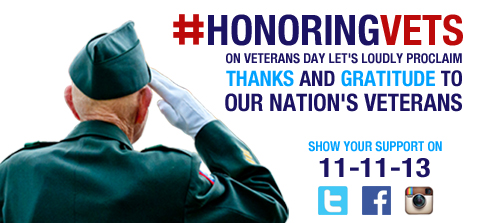
Veterans Day Thanks

Say THANK YOU to veterans--and their families.

Say THANK YOU to veterans–and their families.

What is the purpose of Veterans Day? “A celebration to honor America’s veterans for their patriotism, love of country, and willingness to serve and sacrifice for the common good.” *

One of the best ways to honor those who have served is to say “thank you” to them — and to their families — acknowledging awareness of their service and sacrifice on behalf of their nation.

I was raised in a patriotic home by parents whose reverence for and “allegiance to the flag of the United States” was founded in acknowledgement of all the souls who perished — from the Revolutionary War to the present — in paying the price for the freedoms that bless my life. (Most patriotic songs have brought tears to my eyes since I was old enough to understand their lyrics.)

As a widow, however, my appreciation for veterans has multiplied a hundred-fold. I have a better grasp of the fragility of the time we spend with (and away from) our loved ones. I’m grateful to those whose service cost them precious days away from home and whose service-related health issues continue exacting a price.

And now, because I know the pain of losing a spouse and have met many military widows (and a few military widowers), I view the sacrifices of the fallen in a more personal way than I did before.

THANK YOU, Veterans, for leaving home and hearth to serve your country. And thank you to the loved ones who wished you well as you did so.

*quoted from “History of Veterans Day,” U.S. Department of Veterans Affairs (http://www.va.gov/opa/vetsday/vetdayhistory.asp)

Remember Your Own Pain

These flowers may not look like much, but they meant the world to me when a neighbor who'd just heard "the news" brought them from her house. Her kind gesture was incredibly helpful.

These flowers may not look like much, but they meant the world to me when a neighbor who’d just heard “the news” brought them from her house. Her kind gesture was incredibly helpful.

Grief isn’t limited to the death of a loved one, nor is its impact felt the same at each stage of our lives. If you’re old enough to read this, you’re old enough to have experienced your own loss(es) by now. Remember how you felt as you reach out to console your friends who have lost loved ones. Even if you can’t understand the depth of their pain, you can empathize by silently recalling your own — while never verbally comparing your grief to theirs).

Here are a few levels or degrees of personal grief that continue to temper my understanding as I interact with those I know:

As a kindergartner, my grief over the moving-day mishap of losing my toy kitchen felt devastating — for a while.

As an older child and teenager, my grief over the loss of each beloved pet (whether goldfish or guinea pig or dog) was devastating — for quite a while.

As a young woman in high school and college, my grief over each broken heart felt like the end of my world — for the foreseeable future.

As a young mother (not yet in my thirties), my grief over the loss of Mom was life-altering — forever. I was motherless while anticipating the renewal of my own motherhood, with our third child due in three more months. This baby would not know my wonderful mom! I leaned heavily on my husband’s strength and support at the time.

One crying-on-his-shoulder conversation stands out. He didn’t urge me to stop crying, nor did he tell me everything would be okay. He cried with me, sharing his love and grief, too. Even after Mom’s initial breast cancer diagnosis three years earlier, and even after it metastasized to her brain and spinal column, he’d assumed his much older parents would “go” before either of mine. As I thanked him for holding and hearing me, he hugged me tighter and asked that I do the same for him when the time came.

His death at 47 left me unable to reciprocate.

As a young widow (not yet midway through my forties), my grief over my husband’s death was life-shattering. It was unlike any previous experiences.

As you draw upon your own painful experiences, let them remind you of what helped — and what did not help — in similar circumstances. You may find the best help of all is to quietly “be there” beside your friend.

___

Note: For more on widowhood’s devastation, see If You Really Want to Know What Widowhood Means where I share the anonymous “Letter to a Friend” mentioned on my Helpful Grief Resources page.

I’ve Added a Resource Page

I’ve created a page of “Helpful Grief Resources” with examples of what to say when someone dies (and what not to say).  I’ll add new sources as I encounter them, so check back from time to time.

  • Have you found useful sites, books, articles–even songs–that helped you interact with the bereaved?
  • If you’ve suffered a significant loss in your life, what comments or gestures from friends were most (or least) helpful to you?

Please share your experiences in the comments below or you can contact me via

email: writeTealAshes@gmail.com

Twitter: @TealAshesTBruce

Facebook: https://www.facebook.com/TealAshesbyTeresaBruce/

Together we can ease the anxieties of those who wish to help their grieving friends — and thereby help the mourners, too.

To reach (or share) the “Helpful Grief Resources” page, click on the menu above or go directly to:

Helpful Grief Resources