I’ve Added a Resource Page

I’ve created a page of “Helpful Grief Resources” with examples of what to say when someone dies (and what not to say).  I’ll add new sources as I encounter them, so check back from time to time.

  • Have you found useful sites, books, articles–even songs–that helped you interact with the bereaved?
  • If you’ve suffered a significant loss in your life, what comments or gestures from friends were most (or least) helpful to you?

Please share your experiences in the comments below or you can contact me via

email: writeTealAshes@gmail.com

Twitter: @TealAshesTBruce

Facebook: https://www.facebook.com/TealAshesbyTeresaBruce/

Together we can ease the anxieties of those who wish to help their grieving friends — and thereby help the mourners, too.

To reach (or share) the “Helpful Grief Resources” page, click on the menu above or go directly to:

Helpful Grief Resources

Better Questions than “How Are You?” Part 3 — What to Keep Asking

After the initial shock of my loss lessened, I began adjusting to life as a widow. Far from being “over” my grief, I faced ongoing challenges.

These are questions I found particularly helpful as time went by.

  • How are you sleeping?
    Grief wreaks havoc with sleep cycles, causing some to sleep much longer than “normal” and others — like me — much, much, much less. (Would another “much” be too repetitive?) Asking won’t restore the mourner’s pre-grief sleep, but it will show you’re aware of the struggle. In grieving families with young children, ask if you can take the kids for a few hours so the parent(s) can rest.
  • Do you need help with [be specific in naming possible errands] that you’ve been afraid or reluctant to ask for?
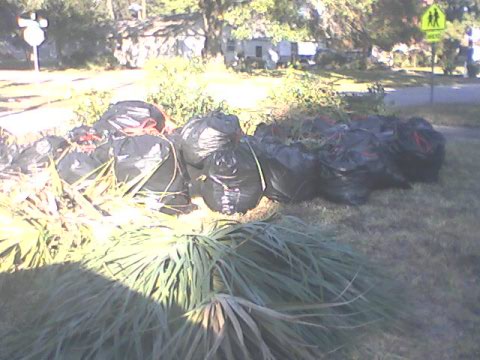
    This is only a portion of the debris cleared away by the men from church that day. The "bushes" behind the trash bags are piled limbs hauled out to the street. (Sorry for the poor lighting!)

    This is a portion of debris cleared by the men from church that day. “Bushes” behind the yard bags are actually piles of limbs they hauled to the street. The poor photo quality reflects my scattered state of mind at the time! (photo — such as it is — by Teresa TL Bruce, TealAshes.com)

    I had trouble figuring out what I’d left undone until friends offered help with specific tasks. I needed (but too seldom sought) help transporting my daughter, remembering car maintenance, washing doggie (an ordeal requiring a minimum of five human hands), cleaning …

    One Saturday, men and boys from church gathered in my yard and hauled more than 15 Hefty bags of debris — and a huge pile of limbs — out to to the curb. I was flabbergasted. Until I saw the tremendous difference their efforts made, I hadn’t noticed the overgrown undergrowth!  (I still get teary-eyed over their labors — and the thoughtfulness behind them.)

  • What sounds appetizing? Which day can I bring you [the “appetizing” dish or another item of your suggestion], or would you rather to come to my place?
    Grief scrambles appetite as ferociously as sleep. On “bad” days, pouring cereal and milk into the same bowl felt like an accomplishment. On “good days,” removing plastic wrap from frozen pizza before heating (or not burning boxed macaroni and cheese) felt like I’d done “real” cooking again.
  • Will you come [for a walk, to the store, to the mall, to a movie, to lunch, etc.] with me [name a specific day and time]?
    Again, invitations to specific activities and times are less threatening to the bereaved than general ones.  When well-meaning friends and acquaintances invited me to “do something” in the earliest weeks after the funeral, I wasn’t ready. Overwhelmed, I asked them to check back later. (Two actually did.) I needed time and space to grieve and to focus on my daughters before I worked up courage to return to “social” activities.

Questions (and actions!) such as these acknowledge you haven’t forgotten that your friend is still grieving — “even” after months have passed.

How I Learned What to Say When Someone Dies

People die every day, but learning the right thing to say when death happens to someone you know is not an everyday skill.

Death isn’t the only devastating loss we humans experience, but it’s among the hardest to handle. Don’t get me wrong — I’ve been greatly blessed by the people in my life, and I know many who’ve experienced far more losses than I. But I’ve lost my own share to the Reaper: my grandparents, my mother, a cousin, a nephew, a brother-in-law, my father-in-law. My husband.

When I became a widow, I began noting the broad range of “right” ways others offered condolences. Some were perfect, as if Shakespeare and Freud stood on the comforters’ shoulders, whispering expertise in their ears. Their consoling compassion flowed as naturally as their breath.

A Grief Observed, CS Lewis, Pollyanna, Grieving and Recovery, Chicken Soup for the Soul, Complete Works of William Shakespeare, TeresaTLBruce

Other friends’ imperfect offerings were just as welcome, even delivered with stammering hesitation or stumbled wording. I saw (and heard) that they were anxious enough for my well-being to overcome their own discomfort, and I loved them for their awkward attempts. [See posts filed under “What to Say.”]

I even appreciated the efforts of those whose comfortless condolences fell flat. I assumed they meant well, no matter how poorly they delivered. They tried, and their ineffective cracks at compassion showed they cared, no matter how clueless they were to how their words sounded.

I also encountered undeniably wrong things to say to someone grieving a devastating loss. A few of them belonged to the “meant well” group, but others were so selfishly stated that not even Pollyanna could find anything glad about them. [See posts filed under “Don’t Say This.”]

As I’ve met with other widows and widowers and with bereaved families whose losses varied from my own, I found my experiences weren’t unique. Wonderful, caring friends, relatives, and coworkers want to uplift their friends and colleagues in their losses. Neighbors act to show kindnesses that reach beyond tangible, outward gestures, touching the troubled souls of those nearby, easing the burdens of the bereaved.

And a few well-meaning folks, perhaps like you, could use concrete advice as to what to say and do — and what NOT to say and do — for a person you know who has lost a loved one.