Merry Christmas Mourning (Death Changes Holidays)

I had a wonderful Christmas this year, the first filled with more joy than sorrow since my husband died in 2010. (Yes, I already had my Christmas celebration, and yes, I know it isn’t yet December 25.)

But last year to a small degree, and the year before more so, and the year before, and the year before, and the awful year before that … (I’m  shuddering now at the painful recollections …) What most stands out is memories not of Christmas mornings but of Christmas mourning.

THIS year I sang Christmas hymns and carols at church without crying. (Okay, I did cry when the choir sang “Let There Be Peace on Earth,” but it was because the music and the message were beautiful, not because I was too emotional with grief to tolerate the familiarity of it.)

THIS year I fell into sleep on our family’s pre-Christmas Eve without tossing and turning. (Most nights I still — five years later — have difficulty getting to sleep without my husband beside me, but this year my kids and I were so on-the-go I was tired enough to leave consciousness behind the moment my head hit the pillow — but I won’t admit to them how late even that was.)

THIS year I read every line of friends’ Christmas letters without grudging envy over their continued co-parenting. (In other years since my husband died, I couldn’t get all the way through. I’ve never considered myself jealous by nature, but reading the happy announcements of what they’d done together hurt too much as I struggled to balance grief and single parenting.)

This was our barely dressed Christmas tree (photo by Teresa TL Bruce).

This was our barely dressed Christmas tree (photo by Teresa TL Bruce).

They say time heals all wounds. In grieving, it certainly helps. But healing takes much longer than most non-grievers think, and “healing” in grief is never fully complete. In A Grief Observed, C.S. Lewis likened his wife’s death to an amputation. The surrounding tissues would stop bleeding and would close up and mend, but there would always be a scar, and “normal” life would never, ever be the same.

Part of what made this year easier for me was the way we deliberately shook up (and also broke up) our Christmas traditions: Instead of putting up a six-foot tree the day after Thanksgiving* (and decorating it with nearly 30 years of memory-rich accumulated, sentimental ornaments), we pulled a factory-lit four-footer from its box (still wearing last year’s also-boxed-up string of red beads, a star, and an angel). We usually enjoy Christmas dinner in the afternoon a few hours after opening presents in the morning; this year we ate our traditional menu one night, but we opened Christmas stockings and presents three mornings later; we sipped night-before-Christmas cocoa at the end of our Christmas day, before my out of state daughters left.

This year Old Doggie Dear's stocking stayed in the Christmas decorations box -- alongside my late husband's stocking. New Doggie Dear got her own. (Photo by Teresa TL Bruce)

This year Old Doggie Dear’s stocking stayed in the Christmas decorations box — alongside my late husband’s stocking. New Doggie Dear got her own. (Photo by Teresa TL Bruce)

Part of what made Christmas more poignant this year was buying an inexpensive stocking for our new doggie. It didn’t feel right to use Old Doggie Dear’s. My out of state daughters fell head-over-heels in love-at-first-sight with New Doggie Dear — just as much as my other daughter and I did from day one — but we all cried (at least once or twice) over Old Doggie Dear’s absence — even while loving and playing with New Doggie Dear.

And it was heartwarming but heartbreaking to again gather at Aunt Ginny’s for our Christmas meal. (Family members still own her house, so we felt blessed to be there where we invoked her memory and her zest for family get-togethers.) Like we’ve done for most of the last 20 years, my girls and I made the meal together, and everyone present held hands in a circle of prayer the way Aunt Ginny always insisted on before we ate. (But the circle felt incomplete without Aunt Ginny herself squeezing my hand with her bony but incredibly strong fingers.)

Both Aunt Ginny (a few days short of 95) and Doggie Dear (13) died in the first half of this year. So this was our first Christmas without them. It was our sixth without my husband,  our 21st without Mom.

At the holidays, even those of us whose grief isn’t “new” often agonize through moments when our losses feel as raw and as inescapable as when they were.

For those grieving recent deaths, the missing loved one’s absence often tarnishes tradition, defiles decoration, taints taste, and mars music.

This well-intended message comes across as diminishing the reality and importance of grieving a loss. (Photo by Teresa TL Bruce)

This well-intended message comes across as diminishing the reality and importance of grieving a loss. (Photo by Teresa TL Bruce)

In the first few years after my husband died, I disliked being told to have a “merry Christmas” or “happy holidays.” How could I be merry or happy at all? (Don’t think I never smiled or laughed, because there must have been good moments … but they were the exceptions.)

I knew the people who wished me such seasons greetings were at the least being polite and at the best hoping to offer cheer to my gloomy, wounded soul. Being told I was supposed to feel “merry” while grieving felt like my loss wasn’t important — didn’t matter — to them.

This year, it wasn’t until a couple of weeks before our family’s Christmas celebrations that I realized it took me six Christmases before I could accept people’s “merry Christmas” greetings at face value (and not as thoughtless reprimands).

If your friends grieve a recent loss (and by recent I mean within a couple of years, not just a couple of months!), invite them to join you in your celebrations. Let them know you are thinking of them this holiday season. Acknowledge their loss to show them it’s okay for them to be sad in the midst of holiday cheer.

If they should feel like laughing or playing reindeer games with you, so much the better, but if they need to cry or decline and be reclusive, support them in that as well. Let them know you’re okay with whatever works for them.

___

*Our first Christmas without my husband, just three months after he died, I forgot about Christmas trees, decorations, everything — until a group of church brothers knocked on my door and asked whether I already had a Christmas tree. When I said no, they stepped to the back of a pickup truck in my driveway, pulled down a fragrant pine, brought it into the house, and set it up for me.

They didn’t call to ask if they could bring it (still in shock, I’d have said no) and they didn’t say “Let us know if there’s anything we can do for you.” (I wasn’t capable of knowing what I needed, much less asking for it if I figured it out.) They thought of something they thought might help me, showed up with it, and then asked while on my doorstep.

I’ll never forget their kindness and thoughtfulness!

Trauma after Death

I’m usually calm in crises, but I couldn’t remember how to dial 9-1-1.

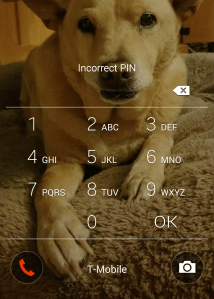
lock screen, incorrect pin, dog, emergency call

The red phone icon would have let me dial for help without keying the pin number on my locked screen … if I’d remembered. (Screenshot of photo by Teresa TL Bruce)

I’d seen items in the road and eased the car around them.

Passing the parallel-parked cars — and the things strewn on the road — I realized they weren’t things. I threw the motor into park, blocking the road. My hands shook. I jumped from the car.

On the ground, a backpack hid someone’s back; a baseball cap covered his head. His upper body jutted into the street from between two cars.

“Sir, are you okay?” He was breathing but didn’t respond. I fumbled the numbers to unlock my phone. (I forgot about the red emergency call icon.)

The man lay facedown on the road. His legs and hips hung above the ground, tangled in an upside-down bicycle between the sidewalk and the street.

Another man snaked his motorcycle around my car to see what happened. He quieted his motor and stepped close to the red pavement under the baseball cap.

I entered my unlock code, then tried keying 9-1-1. “Don’t move him!” I yelled as Mr. Motorcycle approached the unconscious man. I knew never to move anyone with possible back injuries — but this passerby didn’t.

An employee from the nearby school hurried over. Calling “9-1-1” felt more complicated than it should have been. Again I hit the wrong combination of digits.

You'd think hitting 9 once and then hitting 1 twice would be easy...

You’d think hitting 9 once and then hitting 1 twice would be easy…

Mr. Motorcycle laughed, pointing at the spilled beer can nearby. “He’s not hurt — he’s just drunk.”

I finally got through to 9-1-1.

“Sir!” I yelled again. “DON’T MOVE HIM!”

Mr. Motorcycle ignored me. He tugged and pulled the bike from between the unconscious man’s legs, lowering half his body with a thud.

The dispatcher barraged me with questions I couldn’t answer. “I don’t know. I found him like this.” How old was the person, how long had he been there, did anyone else see what happened, did the fall make him unconscious, or was it the other way around … ?

She kept asking, as if I hadn’t already answered.

Meanwhile, my car blocked the narrow street; I needed to make room for the ambulance. I told Mr. Motorcycle and the school employee to stay by the injured man (to protect him from approaching vehicles).

The dispatcher reprimanded me, telling me not to leave the scene — which I wasn’t doing! — and interrupted my disclaimers.

My hands shook as I fastened my seat belt. “I’m putting you on speaker,” I told her. She demanded I not relocate my car but rather return to make sure no one moved the man. (She’d already heard me tell Mr. Motorcycle — and that he ignored me.)

With one hand on the gearshift and one on the wheel, I jumped. Mr. Motorcycle pressed both hands against my window, talking at me through the glass.

The dispatcher fussed at me — loudly — as I lowered the window.

Mr. Motorcycle had to leave before the bank closed (it was barely three o’clock) and would be “right back.” (At least, I think that was what he said — it was hard to hear over the dispatcher’s voice.)

That was the last I saw of him.

The school employee (thank heaven for her!) “stood guard” while I drove (seven whole car-lengths away) to an empty space alongside the curb. (If you’ve never parallel parked while a 9-1-1 dispatcher berates you for making room so an emergency vehicle can reach the emergency, you can’t imagine how long that short drive was.) “I’ve parked and I’m walking back to the injured man now,” I told the dispatcher.

“Don’t give him anything to eat or drink,” she warned.

“He’s unconscious!” (I’d already told her.)

“Paramedics are on the way,” the dispatcher said, “but if he wakes before they arrive, don’t let anyone feed him or give him anything to drink.”

Between the dispatcher’s assurance of help on the way and the siren’s affirmation that it was, a gut-punching thought took my breath: These first responders were coming from that station — the station whose paramedics entered our home that night.

Please, oh, please, oh, please, oh, please, let it not be them…

I’d seen them out before — the same team — at the grocery store. I’d fallen apart, emotionally thrown back to the ground of that traumatic night.

Please oh please oh please let it not be them.

But the side of the truck bore that station number.

Please-ohplease-ohplease-not-them!

I turned and faced the prostrate man. I wouldn’t look at the paramedics’ faces.

Too many PTSD triggers of that night…

Behind me a man said, “I remember you…”

Oh, please, no!

My stomach heaved.

“Weren’t you in my radio class?”

I breathed again — How long was I holding my breath? — and turned toward the firefighter who’d taught my CERT group about the science and protocols of amateur radio back when I got my ham operator license. Way back, before the night my husband died.

It’s okay, I told myself. Not them. 

But. What if the others were on duty that night?

I blurted a summary of all I’d told the dispatcher, then asked whether I needed to stay.

“No, we’ve got him now. Thanks for helping out. Good seeing you.”

As I turned away, I heard the injured man respond to the rescue crew. I felt tremendous relief; he was conscious, but I didn’t linger. (I scurried to my car to avoid seeing other rescuers’ faces.)

Then I drove away.

Life went on, for me, anyway. I hope and assume it did for that man…

pavement, stain

“Stained pavement only seems compelling if you understand the story that soiled it. … Learning the story of another’s grief will help you understand the marks of mourning on the soul.” — Teresa TL Bruce (TealAshes.com)

It’s been a couple of weeks since that afternoon. I’ve wondered about the man whose name I don’t know. (Did he have a head injury? Did Mr. Motorcycle harm his back?) And I’ve worried. (Is that his bicycle locked against the fence near where he fell? If so, why hasn’t he come back for it?).

After two weeks in the Florida sun and rain, as of yesterday the pavement still showed stains from that day. I can’t pass the street without remembering.

It’s made me consider other marks on the roadways, discolorations I never thought twice about before. Stained pavement only seems compelling if you understand the story that soiled it.

How many of us see the behavioral or emotional “stains” in those around us and walk by — or turn our backs — without practicing emotional triage? For those who are grieving, it’s not enough (and often not a good idea) to simply ask, “Are you okay?” or “How are you?”*

Make sure your grieving friends breathe deeply. Stand guard against those who would take advantage of their vulnerability. Offer support, even if it comes in a drink of water or a bite to eat. Help them back onto their feet — physically and emotionally. Don’t ride away just because you have other things to do. Listen to their words and their tears and their assertions.

Learning the story of another’s grief will help you understand the marks of mourning on the soul.

___

*Better Questions than “How Are You?” Part 2–What to Ask When Grief Is New


Grief — It’s All in the Family

Everyone’s grief is unique. With no two people grieving in the same ways, misunderstandings can fester among family members mourning the same lost loved one.

grief, frame, family, teal, TealAshes.com, Teresa TL Bruce

Counseling reframes grief, but it doesn’t remove it, and not everyone grieves the same way. (Photo by Teresa TL Bruce, TealAshes.com)

Consider the case of adult siblings mourning the passing of their parent (or cousins mourning a grandparent). One may need time and space for quiet contemplation while another tries to talk over feelings of loss. A third sibling may seek to reminisce over memories of shared experiences with their deceased parent, or a fourth may grapple with feelings of denial by wielding humor and laughter or derision and sarcasm as a shield against more raw discussion. When such conflicting methods of coping collide, bereaved brothers and sorrowing sisters may feel their siblings’ aren’t grieving the “right” way.

Further complicating the misunderstandings between grieving family members are the unique differences in every relationship, even the “same” relationship. Each sibling’s relationship with a deceased parent was unique, as was the parent-child bond between each of a pair of grieving parents and their lost child. A mother’s loss of her adult son and her daughter-in-law’s loss of her husband are two different losses of the same person.)

One-upmanship over whose loss hurts worse never helps, and it can be difficult to repair families torn by hasty reactions of grief. Nobody wins when in-laws cut off ties or when siblings stop speaking. I’ve been grateful for in-laws who consider me and my children as much a part of the family as when my husband was alive, but I know many, many widows and widowers for whom that isn’t the case. Their children lost not only a parent but also grandparents, aunts, uncles, and cousins, compounding the tragedy in their lives.

In an ideal world, everyone who ever loved (or was loved by) someone who died should be able to reach out to give and get support from everyone else who ever loved (or was loved by) that person.

“Thought of You” Five Years Later

Five years ago my life ended.

In that same absent heartbeat, my new, alien life began.

No, I didn’t have a near-death experience, but without warning, Death got in my face, reached into my being, and ripped away my other half — my soulmate.

To say that it hurt … words don’t exist that convey the suffering of that severance. I didn’t think I could endure the agony.

I wouldn’t — couldn’t — consider ending my life to end the pain; I had three daughters who needed me. But there were times the idea was hard to squelch. More often, I daydreamed of going to sleep and never waking up.

Waking up — in that split-second flash of remembering he was dead — felt horrific, far worse than the sleepless tossing and turning that preceded it. Brief, eventual dips into nightly, exhaustion-induced, nightmare-ridden naps were never “restful.” Even within those nightmares I somehow knew that waking would bring a fresh slap in the face of the worst reality I’d ever faced: my husband was dead.

Life — as I knew it — was over. (The well-intended, misguided souls who “consoled” me that “life goes on” were wrong.)

It was

no

more.

Yet, relentlessly, without him, one unwanted sunrise after another, I “woke up and wished that I was dead, with an aching in my head . . . I thought of you and where you’d gone, and the world spins madly on.“*

I found myself drawn to communities of the widowed, and I connected more deeply with friends who’d lost children and other dear ones. In such company, the words which so frustratingly failed us when speaking with the non-bereaved weren’t necessary. Among fellow mourners, each grieving their own unique bereavement, all were fluent in the language of heart loss.

Back then, I struggled to get through a full day. The thought of enduring that degree of pain — at that intensity — for the rest of my lifetime . . . Ugh. (As I sit typing these words, even the memory of those awful months makes me shudder from shoulder to knee.)

I asked my fellow widows and widowers who seemed to have rebuilt their shattered lives, who seemed to know how to make it from one day to the next, “How long did it take? How long before you felt like yourself again? Before you felt you could cope again?”

Their responses gave me nibbles to ponder (I wasn’t yet up to food for thought), hope in future, and reasons to fight — for my own newly alien life. Their answers surprised, encouraged, and confounded me:

  • I’ll let you know if I ever feel like myself again.
  • The second year was harder than the first. I started getting my act together during the third.
  • I did what I had to do because there was no one else to do it, but I still don’t feel like myself.
  • It takes as long as it takes. Don’t listen to anybody who hasn’t walked in your shoes. There’s no set time for anything.
  • By five years I’d pulled my new self together. Give yourself time.

Five years? I thought. No way will it take me FIVE YEARS. No way I can last that long through this. No way.

From time to time since then, I’ve tried to take an objective look at where I am now compared to where I was before widowhood and where I was during the earliest months and years of widowhood. Along the way from Back Then to each new Right Now, at every self-evaluation I could see signs of progress — and of my own personal failure to thrive.

Overall, my progress has grown and my failures (for the most part) have shrunk from one stage to the next. But I always thought, It’s okay that I’m not “there” yet. I will be before five years. I am NOT gonna take that long to be okay again.

But now . . .

It has been five years.

And I am well. Not the same, but well enough. (At least, well enough for now.)

And, most of the time, I am happy again. (At least, happy enough for now.)

Among the widows and widowers I first met, someone (I wish I remember who, but too many memories from then are widow-fog obscured) shared the video clip, “Thought of You” by animator Ryan Woodward**, created the same year my husband died. The artist left the meaning open so viewers can relate their own circumstances to the story it tells. To me (and to many others who’ve lost loved ones) the animation, music, and lyrics together come close — very close — to conveying the feeling of new bereavement (which words alone can’t approach).


___

*Lyrics by The Weepies in “World Spins Madly On,”
http://www.theweepies.com/
**Ryan Woodward’s incredible site:
http://ryanwoodwardart.com/

___

(Happy angelversary in your better place, my dear.)

Remembering 9/11 can help you understand the bereaved

On September 11, 2001, life in the United States skidded to a stop when nearly 3,000 people perished because of terrorist attacks. If you were the age of a young school child or older, you remember the moment you heard the news.

Dismay.

Shock.

Denial.

Distress.

Panic.

Fury.

It was a few minutes after 9:00 a.m. when the phone rang. My friend’s voice was clipped. “Are you watching TV?”

My husband was sound asleep after his night shift. I’d taken our younger children to elementary school. Back at home I folded laundry while our oldest daughter painted on canvas. Soon we’d delve into the academic part of her seventh grade curriculum. My friend knew I homeschooled during the day, so it was odd she’d call, let alone assume the TV might be on during school hours. “No. Why?”

“Turn it on.”

“To what?”

“Anything. Any channel.”

Dismay. Shock. Denial. Distress. Panic. Fury.

I cried for those whose lives were lost. I cried harder for the loved ones who lost them.

It was a huge thing. A devastation.

A travesty. An assault.

A violation.

In the days that followed, the attacks were all anyone talked about — even when mentioning the heroics of the many, many selfless souls who stepped into the fray to help others.

None of us knew then the long-term impact of that day’s events. First responders from New York City’s police and fire departments, and others, continued losing life and health in the aftermath of the initial casualties.

(Casualties. What a calloused, indifferent word — as if any of those killed or maimed or bereaved came to that definition by casual, effortless chance.)

Families were shattered by death, disability, and despair. Businesses and livelihoods were lost along with the lives they’d once supported.

For those of us living far away, not personally knowing victims or their families, and not having our everyday routines disrupted beyond that first day’s screeching halt, we felt for them and we cried with them and we sacrificed and contributed for them. But our everyday life, for the most part, went on.

The impact of 9/11 changed us all, some more than others. Global news coverage and the scale of the tragedy made it difficult to ignore, and visible memorials and annual commemorations ensure we will never forget.

For those whose loved ones were lost, the personal impact of 9/11 is impossible to forget. Visual reminders of their absent loved ones are everywhere they look. Annual commemorations extend beyond Patriot Day on September 11 to include every holiday, birthday, anniversary, and seasonal tradition.

A decade and a half later, mourning survivors I’ve met since have “moved forward” with their lives. I won’t diminish their losses by claiming they “resumed” life in the same manner as those of us who were not personally impacted. Life, as it was Before, ended that day. Life, as they eventually learned how to live again, evolved slowly in the After.

Of course, other people died that day, too. People all around the world. One was Karl, a sweet, elderly man in my congregation at church. His death received no national fanfare. No acclaim. His kindly widow’s loss was overshadowed by the quantity of publicized loss, but Ruth’s private grief was just as real.

At the time I felt badly for her. I admired her courage and strength as she tearfully expressed her beautiful belief that her husband was needed in heaven to help soothe and greet the many souls who’d been taken from mortality that day. I prayed for her, and I told her I was praying for her, and I sent notes once in a while.

But I was clueless. I had no idea of what her loss meant to her. How could I? That was a decade before I shared the designation of widow. A decade before new bereavement taught me the private manifestations of receiving the news that another loved one was dead.

Dismay. Shock. Denial. Distress. Panic. Fury.

In the months that followed my husband’s death, coping with that was all I could think about, even though there were many selfless souls who reached out to me in compassionate gestures. But their everyday lives went on.

Now, whenever our nation pauses for a moment of silence to honor the victims and heroes of 9/11, my understanding of what they experienced remains fractional, but I am more aware than I was. I will never be able to fully understand what any of them endured. But I do know how I felt in my own dismay-shock-denial-distress-panic-fury grieving. And my empathy for them has grown.

(Ruth, I don’t know where you live now, but please know I think of you and Karl today, as I think of the thousands of others for whom September 11 has such significance.)

I remember.