Grief Talk: Blurting Nonstop about a Loved One’s Death

I blurted “my husband died” to every stranger I encountered in the earliest weeks after it happened. No matter the setting — church, the frozen foods aisle, in the pharmacy checkout line … No matter where I was, I had to say it. I hated saying it. I hated hearing it. But I had to.

It wasn’t as if I walked into any business thinking, “I’m going to announce to the world I’m a widow.” Most of my grief blurted out in unbidden bursts prompted by the piercing pressure of dull-looking (yet deceptively sharp) questions like “How are you?”*

I am grieving, that’s how I am, thank you very much. Whether a person meant the question or said it as a greeting synonymous with hello, if I was asked, I would tell. And even if I wasn’t asked, my body had to express its inexpressible sadness in tears, shallow breathing, gut-wrenching anxiety at the sight of products my husband used — no, used to use — and sometimes in words, inadequate as they were.

Perhaps my pattern of blurting was set from the first moments after the hospital doctor delivered his pronouncement, when an orderly leaned inside the doorway of the tiny waiting room. “‘Scuse me,” he said to the doctor, “the medical examiner’s office is on the phone.” He crossed the room in three steps and while extending the cordless phone toward my hand said, “How ya doin’?”

I regret to say I raised my voice at the man. “My husband just died. How do you THINK I’m doing!?” (I can only hope my outburst did some good in the long run; I hope he never, ever addressed a grieving family in that way again.)
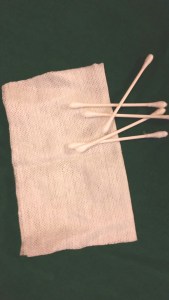
The gentle gauze of acknowledgement will better slow verbal grieving than the poky prodding of a cotton swab. (photo by Teresa TL Bruce, TealAshes.com)

The gentle gauze of acknowledgement will better slow verbal grieving than the poky prodding of a cotton-tipped swab. (photo by Teresa TL Bruce, TealAshes.com)

Sometimes the people I blurted to were sympathetic. “I’m sorry,” they’d say while looking me over carefully. (One asked, “Are you okay to drive? Do you need me to call someone for you?”) I appreciated the kindness of their sympathy and felt slightly better for the interaction. Their gentle acknowledgement acted like an embracing gauze to hold my wounded soul together.

Often people appeared embarrassed, averting their eyes as if I’d bared too much skin rather than too much of my soul. “Oh,” they’d say (if they said that much) before altogether turning away or, in the case of cashiers locked into position, turning their full attention back to the buttons at their fingertips. I left such encounters feeling the kind of social embarrassment I hadn’t experienced since my children were tiny and bled or threw up (or worse) in public places. In this case there were no surfaces to clean up and nothing to apologize for, but it felt much the same.

The harshest, most damaging interchanges happened when strangers (or much worse, people I knew) chastened me for speaking (or crying) about my husband’s death. “Stop crying,” they’d say, or “You already told me,” or “But that was last month, so why are you still crying about it?” or “Everyone has troubles, so you need to get over it and move on.” I walked away from such encounters feeling deep shame for my feelings and my inability to keep them to myself, as if I’d just offered a messy, inappropriate blood sacrifice in someone’s all-white living room.

In hindsight, with five-plus years behind me, I can forgive myself for committing such “offenses” against those whose own insecurities prompted their harsh or embarrassed responses. Looking back on the way I felt when newly bereaved, I can see how my wounded, lacerated soul and psyche bled orally. Applying pointed pressure to stanch the flow of grieving words was no more effective than holding a Q-tip to a deep cut.**

It was about a year before I managed not to blurt, “My husband died,” long after his death faded to “old news.”

For our family, though, every day we lived with the new, unwelcome reality of “firsts” without him. Time had to thicken and slow the verbal and emotional bleeding. Gentle acknowledgement of loss had to wrap around me and take hold. The raw edges of my wounded psyche had to begin their healing.

If your mourning friends seem never to stop talking about the death of their loved ones, don’t shove a poky cotton-tipped swab into their wounds. Wrap them with the consoling gauze of your acknowledgement and absorb the mess of their blurting with your acceptance and understanding.

___

Feel free to share ways you blurted — or listened.

___

*Please see these suggestions for Better Questions to Ask than “How Are You?”

**I don’t have any affiliation with (or aversion to) the Q-tip brand of cotton-tipped swabs.


Valentine Loss — A Love Story

Donna and Owen were school sweethearts, but she wanted to be a missionary before she’d settle down to marry him.

Grandpa Owen and Grandma Donna married on Valentine's Day (Teresa TL Bruce/TealAshes.com)

Grandpa Owen and Grandma Donna married on Valentine’s Day (family photo, ca. 1930, Teresa TL Bruce/TealAshes.com)

As a young woman, she left her small-town Utah home to teach (and preach) as a volunteer for The Church of Jesus Christ of Latter-day Saints. She traveled 2,000-plus miles to North Carolina, a state where few Mormons then lived. While serving the people there, Donna roomed in a home with three daughters near her age: Lala, Gertie, and Leone. At the end of her time in the South, Donna and her “Carolina sisters” half-joked that someday they’d introduce their future children to each other — and have them marry so they could become “real” family.

Donna went home and married Owen on Valentine’s Day.*

They built and ran a business together — an auto service center and motel — and brought three beloved children into the world. When their little ones were seven, five, and three, Owen went hunting in the mountains with friends and cousins for food for their families. An out-of-season blizzard stranded them. Only one returned.

Widowed Donna went back to school so she could earn a living to support her children. She taught elementary school and raised her sons and daughter. She became a principal and also worked for educational publisher Allyn & Bacon.

When her kids were grown, she taught English in Japan.

Eventually, Donna dated and married Wally, a widower with a young son — the bonus son whom she delighted in raising and claiming as her own. She later became the first woman to sit (and vote!) on her city council.

When Donna’s second son met Leone’s daughter at college, everyone later agreed it never would have worked if “the Carolina sisters” had orchestrated it as they once planned. (I’m glad it worked out for them, since Donna’s son and Leone’s daughter became my parents!)

I never knew my dad’s father, Grandpa Owen, but I liked the way Grandpa Wally spoke of him, though he never met Owen, either.

Donna and Wally had an unusual second marriage. They each had a sense of responsibility and accountability to the other’s long-dead love. They spoke of taking care of one another for the one who was absent — and also playfully “blamed” them for household mishaps (“Donna, Owen must have mislaid my book…” “Wally, Bertha must have let your dinner burn…”).

For the rest of their lives, Donna and Wally celebrated three wedding anniversaries every year: Donna and Wally’s, Wally’s and Bertha’s, and — on Valentine’s Day — Donna and Owen’s.

From her decades-later hindsight, she didn’t tell me about the hardship of losing her husband when their children were so young. She didn’t describe the loneliness of losing her mother (hit by a drunk driver) within a short time of becoming a widow. But I’d heard the stories.

In college I lived near Grandma Donna and Grandpa Wally. Whenever I mentioned going on a date, Grandma worried. “Don’t get serious with anyone until you have a way to earn your own living. You never know what’s going to happen.” However, the first time I mentioned my future husband’s name, she changed her script. “When are you bringing him to meet us?”

Whoa, I thought. Our courtship was still in early days; it gave me pause that instead of reminding me to keep my distance, Grandma Donna wanted to meet him.

Fast forward two and a half decades.

In my early days of widowhood, I yearned to ask Grandma the important things I needed to know:

Grandma, how did you get through it?

When your heart was ripped in half, how did you become the optimistic, faith-filled, compassionate person I knew and loved?

How did you raise your children to be that way, too?

Grandma, how can I get through it?

Valentine’s Day isn’t easy on anyone who has lost a loved one — to death or otherwise. Hearts ache over severed connections. When all the world (in the media, anyway) seems paired up in love, it can be easy to rename February 14 as Single Awareness Day or Sorrowing After Death Day; it can be a very SAD day.

The first few Valentine’s Days after my husband’s death hurt horribly. I did what I could to serve others who I knew were also sorrowing, but it didn’t alleviate my own sadness.

This is my sixth widowed Valentine’s Day, and I’m trying to view it more as my Grandma Donna’s wedding anniversary than as a day without my own husband.

Grandma Donna survived — and thrived — after widowhood.

Valentine's Day balloons (photo by Teresa TL Bruce, TealAshes.com)

Valentine’s Day balloons (photo by Teresa TL Bruce, TealAshes.com)

So will I.

(But I still wish I could ask how she did it.)

*For ways to help your grieving friends through this holiday (and others), please see Valentine Greetings for the Grieving.

Super Bowl, Super Grief

Super Bowl 50 may be a big deal to some folks out there, but for those who are grieving it may or may not matter. If you have friends who’ve lost loved ones within the last couple of years (or so), keep in mind:

  1. Invite grieving friends to watch the big game at your house with you.

    This is the most Super Bowl that gets watched at my house.

    This is the kind of Super Bowl that gets watched at my house.

  2. If you and yours don’t watch the Super Bowl, invite your grieving friends to join you in whatever you do — or don’t.
  3. If you’re having a tailgating party, invite them there.
  4. Mourning leaves people feeling bronco-bucked. They may need to immerse themselves in occasional fun to escape their pain for a while.
  5. Grieving makes your friends feel panther-mauled. They may need to curl up in their dens to recover in solitude.
  6. Living after losing a loved one is harder than you know, so cut them a bit of slack. Mourners may need a replay or do-over.
  7. Crowds storm the field after the game, but eventually the stadium empties. Well-wishers surround the bereaved up until the funeral, but eventually everyone else goes home, leaving the bereaved alone in their loss.
  8. When you’ve lost the highest-stakes championship — with death on the line — getting riled up over a football game can seem pointless.
  9. Mourners need fans to cheer them on with encouragement and support — whether they seem ahead of their game or whether they seem to be running behind.
  10. After the game, the losing team needs fan support and continued training. After the funeral, bereaved friends need ongoing support, too.
  11. If you’ve already asked mourning friends to join you but they said, “No thanks,” ask again (GENTLY). Invite them to change their minds at any time.
  12. Honoring traditions (such as pre-game parties with friends) can make the bereaved feel more connected to their departed loved ones and their living friends.
  13. Honoring those same traditions can make the bereaved feel more disconnected from their dead loved ones and their living friends.
  14. Mourners can feel happy and involved with their friends while also feeling sad and isolated from their friends at the same time in the middle of a party.
  15. Not being invited because they’ve lost loved ones makes mourners feel like they’re being unfairly punished.
  16. Just because your friends have lost loved ones doesn’t mean they can’t laugh at funny things. Sometimes mourners need to laugh.
  17. Laughing while mourning can feel so good it makes you cry.
  18. If players are sidelined due to injuries, they need medical treatment but still belong to the team; if mourners are sidelined by grief, they’re still your friends — so treat them that way.
  19. Sometimes players’ numbers are retired, never to be worn again; people sometimes see that as sad, but the team carries on with new players signed on. Mourning friends’ loved ones have gone beyond retirement, never to play or work or interact again; their family team will never, ever be the same.
  20. Super Bowl teams train and work out long before they set foot on the televised field in front of the world. Whether mourner’s have advance notice of bereavement’s demands  or they’re tackled by it without warning, grievers often feel vulnerable under spectators’ scrutiny.
  21. Mourners don’t need would-be coaches who’ve never mourned their loss telling them how to play through their grief.
  22. If you haven’t already asked your grieving friends to join you for the game, it’s not too late. (If you’re reading this after the game, it’s still not too late to get together doing something — anything — else!)
  23. Game day snacks might be the most wholesome meal your mourning friend has eaten since their loved one died. (Mourning appetites are weird.)
  24. Players sidelined with concussions are never told to get back out on the field to play again too soon. People concussed by the death of a life partner (or other loved one) should also never be told to get back out into relationship fields to play again too soon. (They’ll know when — and/or if — they’re ready again, so don’t give your input UNLESS they ask.)
  25. Tailgating means shopping ahead and prepping food before the big event; mourners may have trouble shopping or prepping food at all.
  26. Even if you don’t usually invite friends over for the Super Bowl, please invite your bereaved friends anyway. You don’t have to do anything fancy; just being there as a friend will help.
  27. Have a box of tissues nearby for commercials. Sometimes touching ads will touch off emotions of grief. Let your friends know you are okay with them expressing their feelings.
  28. Friends don’t let friends drive drunk (grieving or not). So don’t. Ever.
  29. Whether your friends lost their loved ones recently or long ago, keep in mind that annual events may strengthen and stir up traumatic losses.
  30. Last-minute invitations are better than no invitations at all. If you haven’t already done it, please, call, text, or message your grieving friends — NOW.

Whether you’re reading this hours or minutes before the big game, halfway through it, or long after, tell mourning friends you’re thinking of them. Acknowledge that even though they may feel alone, they aren’t forgotten and they don’t have to be alone all the time.

Let them know you care.

Forget about the “Stages of Grief,” but Remember the “Symptoms”

As a writer and editor of both fiction and nonfiction (and as a widow who has networked with thousands of other bereaved individuals) I cheered — and jeered — over one trade article’s treatment of grief.

I applaud Danny Manus for writing “Notes from the Margin: Five Stages of Grief for Your Character,” in which he urges fellow writers to infuse their characters with “fully fleshed out” emotional reactions by having “them go through the Five Stages of Grief.” Too many writers (and friends of the bereaved) appear unaware of the the life-altering impact of loss (whether that loss relates to health, relationships, employment, or other serious changes — including, of course, death).

Manus’s article and attached illustration might provide an initial working framework, but as one among many grief-related writers, I must disagree with the shape of the ribbon as well as the opening lines of the article!

The true

Although the loops acknowledge there are turns along the way to “recovering” from grief’s impediment, I disagree with the shape and “stages” of this image linked with Manus’s article at http://www.scriptmag.com/features/five-stages-of-grief-character.

“When something traumatic happens, it’s said that we all experience the five stages of grief. So as your character goes on their journey – which should be full of trauma, drama, action and emotion – it stands to reason that they should go through the same steps.” – See more at: http://www.scriptmag.com/features/five-stages-of-grief-character#sthash.jNiDqsod.dpuf%5D

I groaned — aloud — as I saw the lovely, neatly looped ribbon illustration and read the words “the five stages” and “the same steps.” 

Not again!

REAL people experience REAL grief in messier, less linear, and far less predictable ways. Every loss is different, because every relationship is unique. Realistic fictional (and nonfictional) characters should be presented accordingly — and living, (barely) breathing, grieving friends should never, ever, ever be pigeonholed into expectations of predictable, orderly patterns of grieving through “stages.”

Elizabeth Kubler-Ross herself explained that her “Five Stages” of grief applied specifically to people’s confrontations with their own impending mortality — and that they did not always line up in this neat little order. As another Elizabeth put it (though regarding the admittedly different topic of pirate laws), “They’re more like guidelines.”

A more accurate “ribbon” would show these “stages” appearing at uneven intervals and with skipped and irregular repetitions. Instead of a loosely looped U shape, the ribbon would be knotted in places, torn and shredded, and positioned in a wobbly spiral like a warped, stretched, squished Slinky.

For me (and for most of those I know who have lost loved ones, the so-called stages look more like the figure on the right:

Grief is messy. The “stages” look more like the figure on the right. (Image found at http://www.ywam-fmi.org/tl_files/ywam-fmi/images/articles/2015/Stages_of_Grief.jpg)

Consider realistically portrayed grieving television characters. Let’s look at the early guest appearances by the divorced Lorna/Lana Gardner (played by Jean Smart) on Frasier and the eight seasons of widowed Adrian Monk (played by Tony Shalhoub) on Monk.

When former high school classmate Lorna/Lana is reintroduced to Frasier, she thought she was already “over” her divorce. She’d “moved on” and was happy with her life — until her ex remarried on her birthday. The writers successfully (and comically) revealed her ups and downs along spirals of “stages” as new life circumstances forced her character to revisit past emotional reactions in her present life. In subsequent episodes, Lorna (by then called Lana) continued to carry her “anger” and “bargaining” stages with her (as parts of her personality that crept in) even as she moved along in her “meaningful life.”

In the series “Monk,” the title character was beautifully, tragically flawed. His lifetime of coping with OCD was thrown into non-coping chaos after his wife’s murder. Even though Adrian Monk managed (with heavy support from understanding though sometimes impatient and exasperated friends) to “return to meaningful life,” that life was always in flux with the “earlier stages.”

When also-widowed Natalie Teeger (played by Traylor Howard) becomes Mr. Monk’s assistant in the third season, her character has “already” returned more fully “to meaningful life” than her employer, yet throughout the remaining seasons there are moments the writers reveal the ongoing impact of grief in its recurring stages. For Adrian, the Slinky of stages remains tightly compressed as he moves forward; for Natalie the Slinky is stretched nearly — but not quite — into a straighter line.

Grieving is messy and complicated and non-linear. If you’re writing about characters whose losses have impacted their “normal” lives, be aware that realistic portrayals reflect the chaos of returning, churning emotions they thought they’d already put in the past.

If you’re supporting friends who’re mourning, please, please, please don’t tell them, “You may be depressed now, but as soon as you go through bargaining you’ll be ready for acceptance and then everything will be okay.” (Trust me on this — I’ve heard it. It doesn’t help, and unless you can bring back the dead, to the recently bereaved that will never be okay.) For many, grieving a loved one is the hardest thing they’ve ever done, and sanitizing it into simple stages implies it should be easier. They will not appreciate you minimizing their emotions.

If you’re grieving a loss of your own, I’m sorry. It hurts. Sometimes all you’ll see are the suffocating scribbles in the “My experience” illustration above. It won’t always be this hard, and in time the dark lines will fade as you work your way forward, but for now, be patient with yourself. Please.

New Year after Death

Illustration of running the gauntlet from "Spiessgasse" (Pike-alley) from the Frundsberger Kriegsbuch (war-book) of Jost Ammann, 1525. (This image is in the public domain.) Source: https://commons.wikimedia.org/wiki/File:Spiessgasse_Frundsberger_Kriegsbuch_Jost_Ammann_1525.JPG

Illustration of running the gauntlet from “Spiessgasse” (Pike-alley) from the Frundsberger Kriegsbuch (war-book) of Jost Ammann, 1525.
(This image is in the public domain.)
Source: https://commons.wikimedia.org/wiki/File:Spiessgasse_Frundsberger_Kriegsbuch_Jost_Ammann_1525.JPG

‘Twas the week after Christmas and ‘fore the New Year,
When partyers gathered to prolong good cheer.
But for mourners it marked yet another milestone
(without absent loved ones) of being alone.
— Teresa  TL Bruce

The holidays are hard for the newly bereaved. (They’re not so easy for the not-so-newly bereaved, either.) Since early fall (in the U.S.), we’ve run the grieving gauntlet of celebrations — Halloween, Veterans Day, Thanksgiving, Hanukkah, Christmas — and now we’re facing New Year’s Eve and New Year’s Day. [Please see New Year, New Grief for specifics on grief, the end of one year, and the beginning of the next.]

Sometimes, the cumulative effects of getting through event after event without deceased loved ones can seem like too much to bear. Sometimes mourners become overwhelmed with breathing — with being — in a world whose traditions and commemorations keep going while their lost loves do not.

For weeks now I’ve been reflecting on something I saw on the news the week before Thanksgiving. Former NFL New England Patriot quarterback Doug Flutie’s parents died of natural causes within hours of one another. His father had a fatal heart attack, and then his mother did, too.

It’s been said she died of a broken heart. I believe it.

My sympathies and condolences go to the Fluties’ children, grandchildren, and other extended family this holiday season and as they begin the new year without them. Losing a parent is agonizing. (I know how I felt when my mother died.) Losing a grandparent is painful and life-changing, too. (I miss all of my grandparents.)

I cannot imagine the sorrow and ache of losing both parents (or two grandparents) in a single day.

For their immediate and extended family’s sake, I am sorry. Their pain and mourning will last beyond the initial swells of sympathy and kindness they no doubt received from their friends (and from the public).

But for the sake of the couple themselves, who died within hours of each other …

Losing a spouse is heart-breaking. Literally. It wasn’t until my husband’s death that I understood how physically broken a heart could feel. But it wasn’t just my heart. I had grafted my life to my husband’s — joined in mind, heart, body, and soul. His death ripped, tore at, axed, smashed, and severed our joined mind, heart, body, and soul — my mind, my heart, my body, my soul.

We were one. And when one is halved, the fraction remaining is not whole. The surviving spouse is an off-kilter, walking wound, more a jagged hole than a functioning human.

I remember how awful the first days felt. (First weeks, months, years …) I resented rare couples, like the Fluties, who passed from this life into the next together by peaceful, natural causes.

For the sakes of that late husband and his briefly widowed wife (whose family now doubly grieves their dual absence), I reluctantly admit I held a sliver of envy. (Amid the widowed community, I know I’m not alone in this.)

I’m not the only widowed one who, on hearing of one spouse shortly following the other into death, feels … (I don’t like admitting this) … jealous.

Now, lest any of my friends, family, or readers misunderstand me, let me be very, very clear before we go on from here:  I did not ever, I do not now, and I will not ever contemplate taking any action to hasten “joining” my late husband. No. NOT gonna happen.*

But there were times I would have welcomed a passive exit of my own. There were times when grief was so ever-present, so debilitating, so excruciating, so overwhelming, so lonely … I went to bed hoping not to wake up. 

It wasn’t that I didn’t want to live, because I had three amazing daughters who needed me. I had other family and friends I needed and loved, too. But I didn’t know how to keep going One. More. Hour. — let alone another DAY — in that much pain.

Waking up to a new day was as awful as going to bed alone. (Sometimes.)

Among the newly widowed, dying together can seem preferable to surviving a spouse. (At least for a while.) Over and over I heard others say, “Why did I have to stay behind? Why do I have to keep going? How can I endure hurting this badly?”

There’s nothing you can do to remove their pain, but you can make sure they don’t endure it alone. Include them. Be with them. Validate their loss by acknowledging and accepting their sorrow.

Let them know you’ll be by their side — and not just on New Year’s Eve, but in the unbearably long 365 days that follow.

___

*If you (or anyone you know) feel so overburdened by grief or loss (or any other reason) that “not living” seems like an option, please, please seek professional help. Do it now. If not for your own sake, then for the sakes of those around you, get help now.
Visit http://www.suicidepreventionlifeline.org/ or call 1-800-273-TALK (8255) in the U.S.; outside the U.S. you may find resources listed at http://www.suicide.org/international-suicide-hotlines.html.