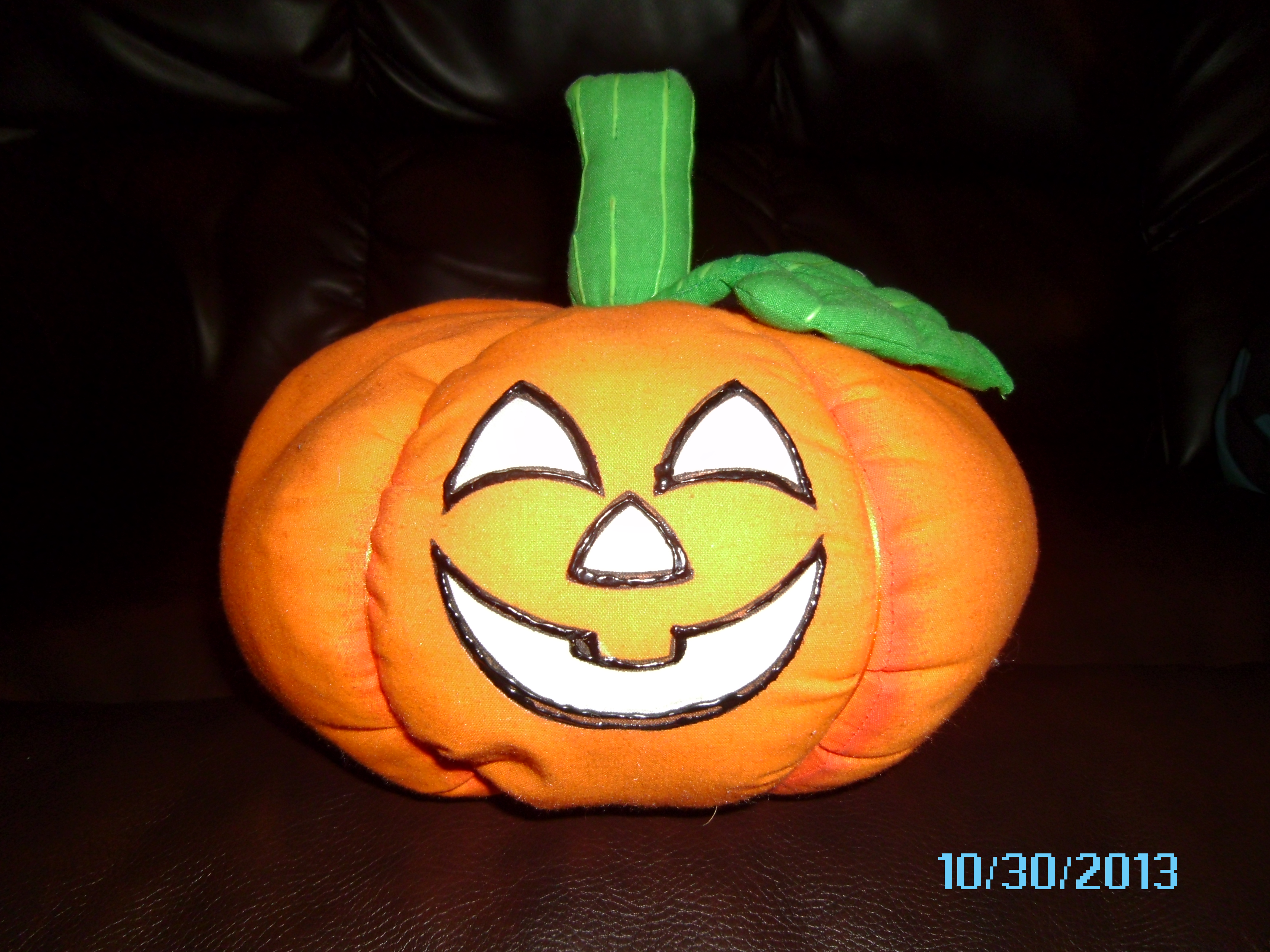
Belated Halloween Reprise

It’s Halloween night and my porch light is off. This year I didn’t pull decorations from storage bins, and the only candy I bought to share was for a social activity at church earlier in the week. I manned one of the kiddie games inside; praised the children for their cute, scary, princess-y, and clever costumes; and repeated, “Happy Halloween,” in response to their “Trunk or Treat!” greetings while chucking assorted sweets into their buckets, bags, and pillowcases.

I didn’t even dress up (beyond wearing a smoky orange Florida Writers Association T-shirt emblazoned with I love the smell of ink in the morning).

I wasn’t actively avoiding Halloween, but until a few minutes ago I hadn’t thought of why I’d ignored so much more of it this year than last year, which I wrote about in Beware of “Happy Halloween” and Other Hazardous Good Wishes.

Then I came across today’s HuffPost Healthy Living post by Megan Divine, “Halloween and Grief: When the Nightmare Is Real.”

READ IT. (Please.)

Take your grieving friends some favorite candy (or a healthier treat) to show you're thinking of them, but consider skipping the "Happy Halloween" greeting.

Take your grieving friends some favorite candy (or a healthier treat) to show you’re thinking of them, but consider skipping the “Happy Halloween” greeting.

On Scents, Memories, and Grief


Teresa TL Bruce with her late husband and his last opened bottle of aftershave.

Today the Segullah blog published my guest post “Father’s Day Non-Scents” which I wrote during the weeks leading up to this year’s Father’s Day. I hope you’ll visit and enjoy it.

http://segullah.org/daily-special/fathers-day-non-scents/

Why One Widow Won’t Watch World Cup

Once upon a lifetime ago, I was a minivan-driving, sideline-cheering soccer mom, but I haven’t watched a single World Cup match this year. Not one. Part of my avoidance is due to my late husband’s attitude toward the host country, Brazil. It’s not that he had anything against Brazil — on the contrary! He lived there as a missionary years before we met, and he appreciated the culture as much as he admired the people and their language.

(The first time he told me he loved me he said it in Portuguese. He was too shy to say it aloud — in case I didn’t feel the same — so he wrote it on a slip of paper and handed it to me. I suspected the words’ meaning, but he refused to translate them for me, so I had to find a Portuguese-English dictionary to be sure. But I digress …)

In our decades together, my husband shared his love of Portuguese with me. I understand it better than I speak it (he always made fun of my accent), but the beautiful language makes me feel saudades — an untranslatable nostalgic, homesick, loss, and beloved longing — for him. Hence, the first half of my self-imposed World Cup boycott.

We met while enrolled as students in our university’s language programs. I lived in the women’s Spanish house, a rambling old, three-story home to 17 women (including two native-speakers). He lived in the smaller men’s Portuguese house with a handful of roommates (including one from Brazil). Residents were under obligation to speak only their contracted languages while on the premises of each house (unless talking on the phone or entertaining guests in the living room). The only TV channels available (in those pre-internet days) were those broadcast by stations carrying only the languages of our houses.

The second reason for my avoidance of this World Cup is the same reason I shied away from watching the worldwide event — even before his death. Ever since the 1986 World Cup held in Mexico, back when I still lived in the Spanish House, just hearing the words “World Cup” sends shudders down my spine the way an arachnophobe  reacts to a tarantula or a coulrophobe avoids circus clowns.

It happened early in the days of that 1986 event.  With 16 roommates in my always creaking three-story house, we came and went at all hours. We seldom knew one another’s schedules, but at any given time there were usually several of us at home. One day I came home from campus to make myself lunch and do some intensive studying during that usually (relatively) quiet time of day. Even before I put my key into the lock — which was not only unlocked but slightly ajar — the sounds of cheering roared from inside the house: GOOOOAL!

A group — a very large, very rowdy group — was watching the World Cup in my living room. As I crossed the threshold, I doubted I’d manage any studying with so much noise. We had hosted 25 – 30 people in the living and dining areas before, with only the slightest sense of crowding,  but this was a much, much larger throng that left no space for my feet to step between people. I threaded, kneed, and elbowed my way toward the kitchen (getting dirty looks and derogatory comments for interrupting the wall-to-wall spectators’ views). One thing became clear: I’d never seen ANY of these people before. I checked the other rooms and floors in the house. Not one of my 16 roommates was at home. I was ALONE in a house full of strangers — and I mean full!

I didn’t know which (if any) of my roommates had  let them inside (none ever admitted to it after-the-fact, either) and I didn’t know when any of my roommates might return. I couldn’t have called any of them if I’d tried; this was before cell phones, and the house phone was out of sight in the middle of the living room hoard.

One of the strange men even followed me into the kitchen, cornered me near the sink, and begged (yes, begged) me to go out with him. He refused to take no for an answer until I shoved my engagement ring — sharp side out — in his face. (Thank goodness my then-soon-to-be-husband had already proposed!) I smacked my sandwich together and left the house through the back door — which was also unlocked.

For the rest of that World Cup, I avoided the house unless I KNEW other roommates would be there. Even when I arranged to meet one (or more) of them on campus before we headed home together, we were frequently far outnumbered when we arrived. For the most part our “guests” behaved themselves (though I recall a number of groceries disappearing from the kitchen) and at the conclusion of the matches they dispersed as suddenly as they’d appeared. Still, the three-story house never felt quite as safe as it once had (and although I know it looked different, my memories paint it looking like the establishing shot of the house outside the Bates Motel).

It was one event, nearly thirty years ago (Am I really getting that old?!?), but it still shapes my view of the world — at least of the World Cup. In the intervening years we had children together, fell in love with soccer as a sport for our daughter’s sake, and went about our merry way from year to year. But between the saudades for my husband induced by this year’s host country and the shudders induced by memories of an otherwise happy time, I’m still not planning to watch.

The loss of my husband was more than “an event,” nearing four years ago, and it will continue to shape my world–but not entirely define it. In the years ahead I will continue to grow and find new things in life to fall in love with from year to year. Even in the joys of happy times ahead, I won’t deny the occasional tempering of saudades for what once was.

Another Father’s Day–DANG IT!

Father’s Day. For three weeks I’ve written, revised, and discarded post after post, trying to decide what to say. It’s the night before, and I still don’t know …

I’m blessed and grateful that my dad is still here. He lives nearby and continues to be a rock of solid reliability. I can’t remember him ever directing an unkind gesture or a loud word my way (though when he spoke my full name in a certain tone I knew I’d crossed the line).

When I was a young, naive newlywed I remember my mother once telling me she hoped I appreciated how lucky we both were to have such good, kind men in our lives. I thought at the time that I did fully appreciate it.

Looking back now, I see how clueless I was, how little I understood. Since then I’ve seen glimpses, peeks at the hardships inflicted on many women and children because of the actions (and because of the failings) of the men in their lives.

So again I acknowledge how blessed I’ve been — how blessed I am.

And yet …

It’s another Father’s Day — DANG IT! — and my husband, the father of my children, is dead. This is our fourth without him. You’d think I’d be “used to it by now.” I thought I would, too. (It took years, but eventually I got “used to” the absence of my wonderful grandfathers. Sort of.)

But I’m not used to it. Not at all. Chances are that the widows and widowers you know, the mourning parents and the bereaved children of your acquaintance, or the grieving coworkers in your office aren’t “over it by now,” either.

Here are a few things you can do to show them your support:

  • Say something. A text, a call, a private message, or a note can be brief. “I’m thinking of you today/this weekend.”
  • Take the kids of a widower shopping so they can do something special for their daddy who’s trying to do two parents’ jobs.
  • Take a small treat to a widow (and her kids) “just because” to let them know they’re thought of on a day when they’re even more aware (if that’s possible) of their loss than on other days.
  • Let them know their loved ones aren’t forgotten — and neither are they.
  • Invite and include (with sensitivity). If the kids in the troop are doing a daddy-daughter or father-son activity, TALK TO their widowed mother. ASK if she’d like a surrogate parent or relative to “step in” for the event or if she’d like to attend with her child. (The same applies to asking widowers about activities geared toward moms.)
  • Listen. Whether the death happened recently or years ago, sometimes the bereaved need to share memories of their loved ones or feelings about their loss.
  • Ask instead of assuming.
    • “Are there ways I can help you with …?”
    • “Would you like me to …?”
    • “Would you like to talk about …?”
  • Don’t dismiss or diminish their grieving.
    NEVER say:

    • “At least …” anything. (Saying “at least” literally makes it seem as if the loss isn’t that important to the speaker, so why should it be so important to the bereaved?)
    • “You should …” OR “You shouldn’t …”
      (No one has the right to tell someone else how to go about the emotions or the business of grieving.)
    • “I know what you’re going through.” (Each loss is unique.)

You can’t “fix” your friends’ grief, but you can — and should — comfort them by letting them know you support them in it.


Honoring Memorial Day

Memorial Day was originally intended as a day of solemn remembrance.*[See the end of this post for a link to a short video about the day’s origins and evolution.] Once called Decoration Day (on which widows, orphans, and other war survivors decorated soldiers’ graves), its purpose was to honor and reflect on those who died while in service to their country.

Memorial Day, military, honor, remember, sacrifice, survivors

Memorial Day honors the sacrifices of those who died in service to their country. Please remember the loved ones they left behind, too. (This photo called “Memorial Day” is from history.com.)

Within my extended family, the day also developed a broader meaning as descendants of my great-grandparents gathered every year to honor the memories not just of all our honored military dead but of all deceased family members. In my grandmother’s hometown, kin from all over began the day at her parents’ graves, filling the weathered cemetery — for one day each year — with as many folks above- as below-ground.

My long-widowed grandmother’s features took on a different expression there. Hindsight — now having lost all my own grandparents, mother, and husband — allows me to better understand the nostalgia, the sadness, the love, and the gratitude that shone from her lined face during this annual meeting of family from afar. It was a chance for Grandma’s children, grandchildren, great-grandchildren, nieces and nephews (and all their “grands,” too) to greet and get to know (by place and by story) her long-lost grandparents, parents, siblings, husband, daughter, and — in later years before her death — grandson.

The cemetery on that day was not a place of sadness — though there were tears — but of reunion (both in the here-and-now gathering and in the looked-to-someday future).  After beginning the day with respects paid on the sacred ground there and with family news updates shared by all, we relocated to the place and time I looked forward to when I was little: the park. Nearby, the entire city park (rented by the extended family for that day every year since long before my birth) was open to exploration.

When I was a child, Memorial Day meant family reunions with buffet-style picnic foods (including as many dill pickles as I could eat from a jar that was nearly as big as I was). It meant wondering why the grownups cheered and jeered (in good fun) during their annual singles versus marrieds softball game. Close cousins and distant kin walked around wearing similar noses, foreheads, and jawlines while gesturing in mannerisms either inherited or learned in a trickle down the pyramid of  Great-grandma Inez’s and Great-grandpa Edwin’s descendants.

As a widow, my appreciation of Memorial Day has shifted. I’d always been taught to acknowledge that the price of my daily freedoms was paid for by the lives of those who served my country long before me. My parents taught me reverence for our flag, not as an item to be worshiped but as a tangible representation of the blood sacrificed by those who served. War was awful because of the lives it ended; warriors — of whatever nationality — were respected for their service to their nation(s). Although my family celebrated with fun traditions on such holidays, in a very real sense Memorial Day, Flag Day, and Independence Day were holy days, too.

Now that I’ve experienced the loss of my own husband and witnessed my children’s thus-altered lives, my appreciation for the families of fallen soldiers has increased hundred-fold. I’m not a military widow, though I have been honored by friendships with many who are.  I do not know their pain, but I have greater reverence for theirs because of my own.

How can you  honor and support such families on Memorial Day? Start with acknowledging their soldiers’ service and their families’ losses. Express appreciation. Share memories. Speak up. Such days are not for politicizing the “should”s or “should-not”s of specific military campaigns or politics. They are days of succoring, support, and solidarity.

If you have other suggestions, please share them below!

___

*See the video clip at http://www.history.com/topics/holidays/memorial-day-history