Grieving through the Holidays — A Personal Message to Mourners

Several friends and acquaintances have contacted me in recent weeks because someone they know has lost a loved one. They’re worried about how grieving friends will endure the holiday season. The purpose of my website has always focused on educating people — like my friends — in how to support the newly (and not-so-newly) bereaved.

I’ve spoken indirectly to mourners rather than addressing them here — until now:

Dear Mourning Friend of My Friend,

I’m sorry.

As a widow whose life partner perished — and as a daughter who yet mourns her mother — I share my grief with you. Not in comparison with yours but as an offering to open communication. I do not know the exact pain of your bereavement — I have not experienced it. But from within the pain of my own, I recognize your guttural groans of grief as the same life-altered language of loss I’ve learned.*

I’m so sorry.

My Friend’s Friend, if I could sit down beside you, I’d listen to you cry (and maybe probably drop a tear or two of my own) while handing you one thick, lotion-infused tissue after another. (I’d bring a new box for you each time I arrived.)

I’d nod my head (and bite my tongue) while you ranted and raved about anything and everything remotely responsible for the death of your loved one.

If you said out loud all the things you’re going to miss about your dear one, I’d listen to every one — and I’d write them if you’d like me to. If you chose to tell me funny stories about your deceased darling, I’d laugh along with you (again handing you tissues if when laughter crossed the line back to tears).

I’d hear you out — without judgement or interruption — if you chose to tell me of your faith and how it helps you cope — or how it does not. If you asked me — and only if you asked — I’d relay how my faith sustained me through the earliest days of my own grieving (and — if you asked — how, six years later, it keeps me afloat through the occasional blindsiding waves of renewed grief).

If you wanted someone at your side to attend a worship service, I’d go with you, and you wouldn’t have to explain yourself or feel like hiding your tears when the familiarity of place and ritual clashed against the unfamiliar absence of your dearly departed. I wouldn’t judge you if you needed to flee mid-hymn or mid-prayer.

Grief dehydrates through tears and stress. (Photo by Teresa TL Bruce, TealAshes.com)

Grief dehydrates through tears and stress. (Photo by Teresa TL Bruce, TealAshes.com)

I’m so sorry for the devastating loss of your loved one.

If I could sit down beside you in your grieving, I’d bring you a glass of water, I’d suggest you drink it, and I’d tell you to breathe. Yes, breathe.**

(Really. Before you read further, take a long, deep breath.) 

I would not say, “Call me if you need anything,” because I remember how confused I was while newly grieving. I didn’t know what I needed — but I knew I was as physically as emotionally incapable of picking up the phone to ask anyone for help — no matter how sincere I believed their offer.

Nor would I ask, “How are you?” because I remember how impossible it was to answer that question when half my heart felt ripped away.

But I would reassure you that, no, you’re not crazy, and yes, your grieving body is likely doing all sorts of weird things to your appetite, skin, digestion, sleep cycle, immune system, memory … I’d encourage you that — in time — much of that will resettle, but in the meantime, it wouldn’t hurt — and might help — to check in with your doctor.

I’d write things down for you, because you’re going to forget. I’d bring you an obnoxious, look-at-me-bright neon notebook for recording and storing all the death-related red tape and paperwork — everything from jotting the names, phone extensions, and times of day you speak with employees over cancelling accounts, to listing the kind ways friends and neighbors reach out, to stockpiling the government forms you have yet to fill out.

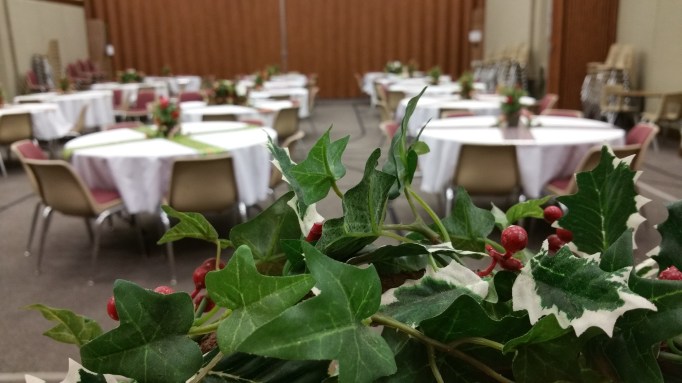
Three months after my husband died, I attended our congregation's annual Christmas pot luck social. I couldn't make myself go again until this year, the sixth after his death. (Teresa TL Bruce, TealAshes.com)

Three months after my husband died, I attended our congregation’s annual Christmas pot luck social. I couldn’t make myself go again until this year, the sixth after his death. (Teresa TL Bruce, TealAshes.com)

If I sat with you side by side, and you asked how I made it through the first (and second) holiday season after my mother died, and then after my husband died, I’d lower my eyes, thinking, Not well. Then I’d answer as positively as honesty allows, “I don’t really know. Much is a merciful blur …”

I’d pause before speaking the rest: “… but the parts I remember — hurt.”

I’d add assurances that it’s okay — even necessary — to be flexible about Christmas parties and Hanukkah traditions and holiday gatherings. I’d acknowledge they will never be the same. Only you will know which customary activities might bring you peace through their connection to your deceased loved one; only you will know which might grind salted vinegar into the raw recesses of your grieving heart. I’d give you my permission — which you don’t need — to change your mind at any time about any and all of whatever celebrations you desire to join in on. And I’d remind you that when traditions no longer bring joy, it’s okay to exchange them.

I’d ask if you’d welcome a hug, and if not, I’d graciously accept your refusal. When you’re the one grieving, you’re allowed to say what you need and want.

___

*My friend Melissa Dalton-Bradford‘s On Loss and Living Onward: Collected Voices for the Grieving and Those Who Would Mourn with Them beautifully speaks that language. Reading her poignant portrayal of working through her son’s death and studying the passages she shared from other voices helped me when I needed it.

**For specifics on why I urge you to breathe, see this post on the taboo topic of appearance.

After Castro’s Death — Grief or Relief?

When you heard the news of Fidel Castro’s death, did you feel relief or grief?

For many on the island nation, the news ushered in a state of mourning for their longtime leader.teal-thespian-faces-tealashes

For Cuban expatriates in the United States and other countries, however, in  some quarters the news ushered in celebrations at most, relief at least.

My first, widowed thought was, How sad for his family and friends who mourn him.  My second thought was, How deeply relieved his opponents and enemies must be.

Because of Fidel, many in Cuba lost their livelihood, home, country, family members, friends, and lives. Were it possible to have tried him for human rights crimes committed against his own countrymen, many I know would have signed up for jury duty.

And yet … that aged dictator’s demise cannot undo the years of separation (by sea and borders if not by death) through which those injured families have grieved.

November 26, one of my friends wrote on his personal Facebook wall (and gave me permission to quote):

Fidel Castro.

A frail old man died. No joy in that. As a Cuban who grew up listening to stories from my father about how Castro rounded up many of my dad’s friends and had them lined up in a firing squad, I am thankful for the end of this dark chapter in the history of my country and pray for better days ahead for the Cuban people.  — Manuel Fernandez*, author of the Wolf Battle series and other books

“Pray for better days ahead.” That’s good advice in the aftermath of every death — not just of public officials but of private citizens too.

Like Manuel, I hope and pray healing and reunion will step in where exile forced out.

___

*I’ve known Manuel and his family for more than twenty years — long before my youngest, now-adult child gave theirs an unauthorized haircut. 

Thanksgiving after Death

I threw out the post I penned for this Thanksgiving week.

I’d written about how giving thanks while grieving helped me heal, but those thankful acknowledgments came from within me — not from others’ admonitions to be grateful for X, Y, or Z. And I wrote about ways the post-Thanksgiving frenzy of Black Friday shopping can be a grief trigger for many.

But two events nudged me to change this post: the death of an elderly friend and the news of the school bus crash in Chattanooga.

Sunset (photo by Teresa TL Bruce, TealAshes.com)

Sunset (photo by Teresa TL Bruce, TealAshes.com)

My octogenarian friend fell, had surgery, and began recovering. After all accounts reported she was healing, Emily took ill and died within days. Two common thoughts predominated this week as I met members of the family she delighted in, as I listened to neighbors who interacted with her daily, as I spoke with others who knew her through her writing (as I did):

  • We all loved and will miss her, though in different ways.
  • In spite of her age and recent health challenges, we all felt varying degrees of shock and disbelief.

I recognized the expression of acute grief in Emily’s family members’ faces, remembering (a little too clearly) how I felt when my mother and grandmother died. My friend’s passing saddens me, and I will continue to miss her. But her family and closer friends will actively mourn her for as long as they have loved her.

Which returns me to the second event prompting this altered post.

Many hearts in Chattanooga and elsewhere will be thankful this Thanksgiving weekend as they rejoice in their little ones’ safety, but even that gratitude will be overshadowed by the knowledge of others’ suffering. My heartfelt condolences and prayers and thoughts go out to the families whose children were so abruptly taken from them.

I cannot fathom the weight of grief and mourning in that community and within the walls of those homes. I have witnessed my friends’ acute pain in mourning their  children, but I have not worn the soul-searing loss of a child, so I cannot truly understand it. I can only try, knowing nothing I do will make them feel better because nothing I do will restore their dear ones. I can’t fix their pain, but I can — I must — acknowledge it.

After any loved one’s death, Thanksgiving as a holiday and thanksgiving as a practice are never the same. The holiday — with all its traditions — now carries the dark smear of absence. The practice — though healing — may seem impossible for a time likely to stretch beyond a single season (or year).

Every life is precious. All souls deserve to be sung out of this world with love and tenderness as the sun sets on their presence. Heart-songs of mourning include gratitude for the good they did, the lives they touched, and the connections they shared. But those sweet overtones ring truest when honestly accompanied by the bitter, background disharmony of bereavement.

If your friends are mourning this holiday season, listen as they share their gratitude for their loved ones. Openly share the reasons you thank heaven for their loved ones’ influence in your life.

(But please, do not lecture or admonish grieving friends on why or whether or how they should be grateful.)


Mourning, Elections, and Choosing to Be Kind

After you study the issues and candidates, cast your vote, and learn the election results, please remember this:

Be kind.

Regardless of the outcome — win or lose, rout or run-off — the individual people in your life are more important than the people elected into community, state, and national political offices.

(You might be asking, “What does this have to do with grief and the bereaved?” Keep reading. We’ll get there.)

voted

(This sticker was from an earlier local and primary election. I’m going to the polls on Election Day. Will there be lines? Probably. But that’s okay — people-watching is always instructional.)

I don’t mean to imply that politics don’t matter. I take the opportunity to vote seriously. When I was a child, I watched my mom research the issues, attend rallies, and question candidates. This was long before the Internet allowed Google-speed searches. She invested her time — lots of it! — and her intellect in making informed choices to better our neighborhood, city, state, and nation, all the while instilling in me the responsibility to do the same.

Over some election results, Mom rejoiced; over others, she mourned — though never to extremes. No gloating, no berating. No in-your-face chanting or ranting.

I emulated her example with my children as they grew up, dragging them with me to pick up and turn in petitions, voting before or after school (so they came with me into polling places), explaining my choices beforehand and while awaiting election results.

After Mom died, when questions of politics arose, her overwhelming absence overshadowed my interest in doing as she’d taught me. I still went through the motions of researching, but the process felt hollow — as did much else without her.

However, it wasn’t until after her death that I learned how much farther her influence spread beyond what she taught me. In the first half dozen years after she died, I received phone calls — more than I counted — from people she’d met and networked with. For years, they’d sought her out during every election cycle, asking, “What do you think of so-and-so?” or “How do you interpret the meaning of such-and-such?”

She’d never told them how to vote, but she freely shared the information she had gathered and let them make up their own minds. So after she died, they called me, (rightly) assuming I did the same kind of research.

Over time, elections triggered fewer painful reminders of her absence and offered more opportunities to reflect on what a great woman she was. That became my secondary focus as I researched.

When my husband died, everything political blurred. I still cared on some level, but it was a level so far below the surface level of mourning — where I tried to survive — I may as well have been reading campaign signs without my glasses. (Reading anything without my glasses means I see only colorful, impressionistic, wordless blurs.)

Raw with shock and grief, I scarcely remembered to pay the same bills I’d managed before. I couldn’t pick out a box of cereal or loaf of bread in the grocery store without bursting into tears. Political research became a low priority. Campaign calls to my late husband’s phone, which I couldn’t yet make myself turn off, felt like daggers to my already torn heart. Contribution solicitations addressed to him made me want to stop checking the mail.

But that wasn’t the worst part.

What hurt the most as a newly grieving widow was the bitterness, rancor, mudslinging, and nastiness of political arguments. I didn’t mind honest, open-minded debate and discussion — still don’t — but I couldn’t stand the unkindness — still can’t.

Strangers attacking strangers — on social media, at rallies, over the radio. Family members fighting over philosophical disputes. Candidates calling names and contending.

Ick. Yuck. Eew.

When you’re grieving, the worst thing in the world — the death of your loved one — has already happened. Your world is upside down. The last thing you need is arguing and animosity over politics.

When you’re mourning — immersed in the hurt and anger of loss — you can’t abide meanness. You’ve been forced to acknowledge that life is too short for such negativity.

When you’re not bereaved yourself, it’s easy to forget that all around you — in person and online — there are folks in various degrees of mourning loved ones. People you know and people you don’t know, all facing their own grief over death or divorce or health …

So, please, please …

Please keep politics in perspective. There will be future elections. But many are mourning loved ones who won’t be with them in that future; they’ve got enough to handle without being surrounded by more negativity.

No matter the outcome of this election (or others), be kind.

___

For more about mourning and politics, see Taboo Topics When Someone Dies — Part 1, Politics

Grief Before and After the Storm

“Feeder bands” of grief-tinged déjà vu arrived ahead of the hurricane.

Hurricane Matthew surges toward my state after devastating the Caribbean and taking lives there. My ties to the islands are indirect — a young friend’s anxiety for the family in Haiti she hasn’t been able to contact; a daughter’s concern for students she worked with in the Dominican Republic; local friends’ worries for people within their ministries on the island of Hispaniola …

24-hours before Matthew's arrival, Central Florida grocery staples disappear (photo by Teresa TL Bruce, TealAshes.com)

Empty bread aisle 24 hours before Matthew’s arrival in Central Florida (photo by Teresa TL Bruce, TealAshes.com)

Here in Central Florida, I’m stocked up (water, food, dog food, and battery-operated fans). I’ve lowered and secured window awnings and stowed away outdoor items — I’m as ready as I can be.

Wednesday night, on the way home from a writers meeting, I stopped at a grocery store to top off my supply of stress foods (chocolate chip cookies and crunchy cheese-ish snacks). I’m glad I had already purchased the basics; as you can see by these photos, the staple aisles were depleted.

But my heart is heavy for the families of those who’ve already lost loved ones. I too clearly remember how new, raw grief felt — and I wouldn’t wish it on anyone.

48 hours before Matthew's arrival (photo by Teresa TL Bruce, TealAshes.com)

Empty water aisle 48 hours before Matthew’s arrival (photo by Teresa TL Bruce, TealAshes.com)

The advent of this monster storm also brought back memories of the years when my late husband and I weathered earlier hurricanes and tropical storms. This is the first BIG storm I’ve prepared for without him.

Six years after his death, “firsts” still punch me in the gut. Not as hard as during earlier years, but enough to make me suck in my breath, feel a moment’s panic that my wedding ring isn’t on my finger, and revisit the anger I felt so often while adjusting to widowhood.

I’m ashamed to admit this, but as I stowed away outdoor items and braved the general icky-ness of our backyard shed, I wanted to tell off my husband. (WHAT was that thing skittering past my foot? It looked like a short, striped snake with legs.) I wanted to gripe at him. “This isn’t fair. You’re supposed to be here. How dare you leave me here to get ready for this storm — and for everything else I’ve had to do — since you died.”

It’s not fair to blame him (and his absence) for this storm. It’s not reasonable to be angry with him for it. It’s not nice to wish him here in harm’s way with the rest of us.

But grief isn’t nice, or reasonable, or fair. It’s a monster that sweeps the ground out from under mourners, floods them with confusion and distress, empties them of planned-for futures, and blows over the concept of “normal.” 

Empty fruit aisle 24 hours before Hurricane Matthew (photo by Teresa TL Bruce, TealAshes.com)

Empty fruit aisle 24 hours before Hurricane Matthew (photo by Teresa TL Bruce, TealAshes.com)

After someone dies, life does not “go on” the same for the bereaved as it does for everyone else. It takes years to build what most of us call a “new-normal” life plan without the loved one who figured prominently before.

I don’t know what this (or any) hurricane will do to the physical landscape around me. I didn’t know what grieving my husband would do to the landscape of my life, either. 

If your friend or coworker or neighbor has lost a loved one in the last two years, please be patient with them as they rebuild their new normal. Stand close beside them, and let them know you are aware of their grief. Lend them your strength as they sort through the debris of dead dreams.

If you’re in the path of this storm — or others — please, please, please help each other be safe.