The Pulse of Grief, Six Months Later

Half a year ago, 49 people died without warning in an evil attack at Orlando’s Pulse Nightclub. For six months, these victims’ loved ones — parents and partners, siblings and children, other family and friends — have privately and publicly mourned their beloved ones.  Just (or should I say already?) 26 weeks ago our city — and with television and Internet coverage, the world — ground to a halt in emergency response, physical recovery, and remembering.

In the 180-some days since those horrible, early morning hours, Orlando’s outward pace has accelerated almost back to normal in a deceptive echo of the trite, insensitive dismissal — “life goes on” — some shove at the bereaved.

"You Mattered" Pulse Birds (photo by Teresa TL Bruce, TealAshes.com)

“You Mattered” Pulse Birds painted outside an Orlando business (photo by Teresa TL Bruce, TealAshes.com)

I have hope, though, that many hearts better understand the open-ended nature of grieving. Murals, T-shirts, store marquees, and hashtags all around town (#OrlandoStrong and #OrlandoUnited) display the love and pride my city’s citizens express in memory of the victims and in support of their loved ones. Surely, with such vivid visual reminders, we will keep these loved ones’ lost lives present in ways that will help their families rather than harm them.

I’m grateful for the media coverage focusing on the coming-together of disparate parts of our community. People who didn’t know any of those who were slain actively reach out to show their support for the people grieving them.

It’s important to remember, though, that most people mourning loved ones don’t have national or even local media reminding everyone of grief milestones — such as the six or twelve or eighteen or twenty-four months — since their loved ones died.

For many who grieve, such commemorations pass in lonely, heartbroken silence.  Death anniversaries — even “monthiversaries” — can be difficult. So please, reach out to those you know who have lost someone recently.


Grieving through the Holidays — A Personal Message to Mourners

Several friends and acquaintances have contacted me in recent weeks because someone they know has lost a loved one. They’re worried about how grieving friends will endure the holiday season. The purpose of my website has always focused on educating people — like my friends — in how to support the newly (and not-so-newly) bereaved.

I’ve spoken indirectly to mourners rather than addressing them here — until now:

Dear Mourning Friend of My Friend,

I’m sorry.

As a widow whose life partner perished — and as a daughter who yet mourns her mother — I share my grief with you. Not in comparison with yours but as an offering to open communication. I do not know the exact pain of your bereavement — I have not experienced it. But from within the pain of my own, I recognize your guttural groans of grief as the same life-altered language of loss I’ve learned.*

I’m so sorry.

My Friend’s Friend, if I could sit down beside you, I’d listen to you cry (and maybe probably drop a tear or two of my own) while handing you one thick, lotion-infused tissue after another. (I’d bring a new box for you each time I arrived.)

I’d nod my head (and bite my tongue) while you ranted and raved about anything and everything remotely responsible for the death of your loved one.

If you said out loud all the things you’re going to miss about your dear one, I’d listen to every one — and I’d write them if you’d like me to. If you chose to tell me funny stories about your deceased darling, I’d laugh along with you (again handing you tissues if when laughter crossed the line back to tears).

I’d hear you out — without judgement or interruption — if you chose to tell me of your faith and how it helps you cope — or how it does not. If you asked me — and only if you asked — I’d relay how my faith sustained me through the earliest days of my own grieving (and — if you asked — how, six years later, it keeps me afloat through the occasional blindsiding waves of renewed grief).

If you wanted someone at your side to attend a worship service, I’d go with you, and you wouldn’t have to explain yourself or feel like hiding your tears when the familiarity of place and ritual clashed against the unfamiliar absence of your dearly departed. I wouldn’t judge you if you needed to flee mid-hymn or mid-prayer.

Grief dehydrates through tears and stress. (Photo by Teresa TL Bruce, TealAshes.com)

Grief dehydrates through tears and stress. (Photo by Teresa TL Bruce, TealAshes.com)

I’m so sorry for the devastating loss of your loved one.

If I could sit down beside you in your grieving, I’d bring you a glass of water, I’d suggest you drink it, and I’d tell you to breathe. Yes, breathe.**

(Really. Before you read further, take a long, deep breath.) 

I would not say, “Call me if you need anything,” because I remember how confused I was while newly grieving. I didn’t know what I needed — but I knew I was as physically as emotionally incapable of picking up the phone to ask anyone for help — no matter how sincere I believed their offer.

Nor would I ask, “How are you?” because I remember how impossible it was to answer that question when half my heart felt ripped away.

But I would reassure you that, no, you’re not crazy, and yes, your grieving body is likely doing all sorts of weird things to your appetite, skin, digestion, sleep cycle, immune system, memory … I’d encourage you that — in time — much of that will resettle, but in the meantime, it wouldn’t hurt — and might help — to check in with your doctor.

I’d write things down for you, because you’re going to forget. I’d bring you an obnoxious, look-at-me-bright neon notebook for recording and storing all the death-related red tape and paperwork — everything from jotting the names, phone extensions, and times of day you speak with employees over cancelling accounts, to listing the kind ways friends and neighbors reach out, to stockpiling the government forms you have yet to fill out.

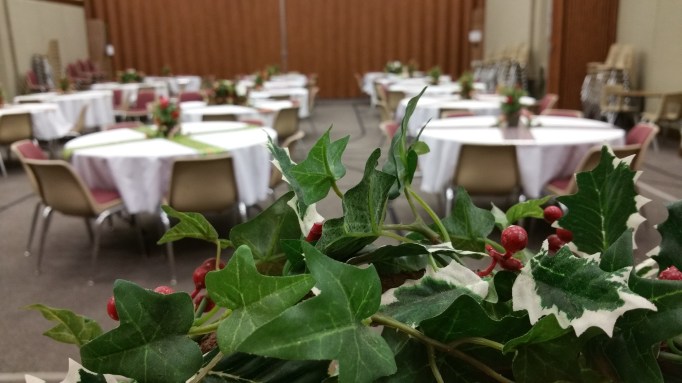
Three months after my husband died, I attended our congregation's annual Christmas pot luck social. I couldn't make myself go again until this year, the sixth after his death. (Teresa TL Bruce, TealAshes.com)

Three months after my husband died, I attended our congregation’s annual Christmas pot luck social. I couldn’t make myself go again until this year, the sixth after his death. (Teresa TL Bruce, TealAshes.com)

If I sat with you side by side, and you asked how I made it through the first (and second) holiday season after my mother died, and then after my husband died, I’d lower my eyes, thinking, Not well. Then I’d answer as positively as honesty allows, “I don’t really know. Much is a merciful blur …”

I’d pause before speaking the rest: “… but the parts I remember — hurt.”

I’d add assurances that it’s okay — even necessary — to be flexible about Christmas parties and Hanukkah traditions and holiday gatherings. I’d acknowledge they will never be the same. Only you will know which customary activities might bring you peace through their connection to your deceased loved one; only you will know which might grind salted vinegar into the raw recesses of your grieving heart. I’d give you my permission — which you don’t need — to change your mind at any time about any and all of whatever celebrations you desire to join in on. And I’d remind you that when traditions no longer bring joy, it’s okay to exchange them.

I’d ask if you’d welcome a hug, and if not, I’d graciously accept your refusal. When you’re the one grieving, you’re allowed to say what you need and want.

___

*My friend Melissa Dalton-Bradford‘s On Loss and Living Onward: Collected Voices for the Grieving and Those Who Would Mourn with Them beautifully speaks that language. Reading her poignant portrayal of working through her son’s death and studying the passages she shared from other voices helped me when I needed it.

**For specifics on why I urge you to breathe, see this post on the taboo topic of appearance.

Thanksgiving after Death

I threw out the post I penned for this Thanksgiving week.

I’d written about how giving thanks while grieving helped me heal, but those thankful acknowledgments came from within me — not from others’ admonitions to be grateful for X, Y, or Z. And I wrote about ways the post-Thanksgiving frenzy of Black Friday shopping can be a grief trigger for many.

But two events nudged me to change this post: the death of an elderly friend and the news of the school bus crash in Chattanooga.

Sunset (photo by Teresa TL Bruce, TealAshes.com)

Sunset (photo by Teresa TL Bruce, TealAshes.com)

My octogenarian friend fell, had surgery, and began recovering. After all accounts reported she was healing, Emily took ill and died within days. Two common thoughts predominated this week as I met members of the family she delighted in, as I listened to neighbors who interacted with her daily, as I spoke with others who knew her through her writing (as I did):

  • We all loved and will miss her, though in different ways.
  • In spite of her age and recent health challenges, we all felt varying degrees of shock and disbelief.

I recognized the expression of acute grief in Emily’s family members’ faces, remembering (a little too clearly) how I felt when my mother and grandmother died. My friend’s passing saddens me, and I will continue to miss her. But her family and closer friends will actively mourn her for as long as they have loved her.

Which returns me to the second event prompting this altered post.

Many hearts in Chattanooga and elsewhere will be thankful this Thanksgiving weekend as they rejoice in their little ones’ safety, but even that gratitude will be overshadowed by the knowledge of others’ suffering. My heartfelt condolences and prayers and thoughts go out to the families whose children were so abruptly taken from them.

I cannot fathom the weight of grief and mourning in that community and within the walls of those homes. I have witnessed my friends’ acute pain in mourning their  children, but I have not worn the soul-searing loss of a child, so I cannot truly understand it. I can only try, knowing nothing I do will make them feel better because nothing I do will restore their dear ones. I can’t fix their pain, but I can — I must — acknowledge it.

After any loved one’s death, Thanksgiving as a holiday and thanksgiving as a practice are never the same. The holiday — with all its traditions — now carries the dark smear of absence. The practice — though healing — may seem impossible for a time likely to stretch beyond a single season (or year).

Every life is precious. All souls deserve to be sung out of this world with love and tenderness as the sun sets on their presence. Heart-songs of mourning include gratitude for the good they did, the lives they touched, and the connections they shared. But those sweet overtones ring truest when honestly accompanied by the bitter, background disharmony of bereavement.

If your friends are mourning this holiday season, listen as they share their gratitude for their loved ones. Openly share the reasons you thank heaven for their loved ones’ influence in your life.

(But please, do not lecture or admonish grieving friends on why or whether or how they should be grateful.)


Children’s Grief Awareness Day

I wear teal every day. Most days it’s obvious by my shirt or scarf (or both).

Teresa TL Bruce, TealAshes.com, wearing blue (with accents of teal) for Children's Grief Awareness Day

Teresa TL Bruce, TealAshes.com, wearing blue (with accents of teal) for Children’s Grief Awareness Day

When I’m walking my dog (in old jeans and older T-shirts), it’s not as easy to see. It takes searching to note that my eyeglasses frames are a dark teal, my sneakers are a brighter shade of teal, and my key chain carabiner is — you guessed it — another shade of teal. (Even my hair scrunchies alternate between patterns of flowers and Winnie the Pooh figures — against teal backgrounds.)

Children, like adults, wear their grief every day, and for them it’s also obvious to see on some days. The hues of their grieving show brightly as they’re crying when a children’s movie protagonist loses a parent (or a beloved animal) — Bambi, Mufasa, Cinderella, Nemo, Charlotte, Old Yeller … (Anyone else see a trend here?) You may see them drawing pictures of deceased loved ones. Or you may see them “acting out” in behaviors you’d rather not witness.

Children’s grief — just like their drawings and the size of their clothes and their experience in every area of life — does not always look the same as adult grief. They at times play and study and go about their daily routines (almost) as if nothing happened. Unfortunately, adults may see those healthy behaviors as signs bereaved children are “all better” and expect them henceforth to behave that way.

But love, loss, and grief weave their way into children’s lives as deeply as into adults. And where children’s lives and personalities and outlooks are still in development, those threads should not be overlooked.

For specifics on what to say (and not say) to grieving children and for helpful resources, visit this earlier post.

This gift to my then-little girls from my mother's hospice nurses retains a place on our shelves 21 years later. (photo by Teresa TL Bruce, TealAshes.com)

This gift to my then-little girls from my mother’s hospice nurses retains a place on our shelves 21 years later. (photo by Teresa TL Bruce, TealAshes.com)

When my mother died, her hospice nurses gave this book to my grieving children, because they wanted my girls to have something just for them in that difficult time. We’ve purged many kids’ books in the 21 years since, but this one will always have a home with us.


Good Grief, Halloween! (It’s Not All Good)

For anyone mourning recent losses, Halloween can be painful. Good, clean, costumed, candy-consuming fun too often fades behind gruesome, in-your-face depictions of morbid, glorified, sinister portrayals.

(photo by Teresa TL Bruce, TealAshes.com)

Pumpkin (Teresa TL Bruce, TealAshes.com)

Halloween was the first store-pushed celebration after my husband’s death. With newly widowed eyes, my gut clenched at the fake tombstones, skeleton parts, and decayed zombie costumes shouting from store shelves and “decorating” — but certainly not enhancing — my neighborhood.

Don’t these people know my husband died?

Of course they didn’t know (except when I blurted it to store clerks who’d made the mistake of greeting me with rushed variations of “how’re-you-today” which they’d not really meant to ask). The whole world, it seemed, went back to normal after his funeral — the whole world except for me and my grieving household.

If your friends have just buried a loved one, they aren’t likely to nominate your plastic cemetery and zombie yard decorations for lawn-of-the-month. If they’re mourning loved ones who died by violent means, they will not thank or applaud you for costumes and makeup which call injuries to mind.

I once met a couple whose entire home — outside and inside, every room — could have furnished the gift shop inventory for a haunted house, spook alley, or nightmare on any street. From my new, widowed perspective, I couldn’t help wondering what one of them will someday think when surviving the other and walking through their once-shared front door. What will their prominently displayed tombstones and bones and coffins and skeletons mean then? Perhaps they will offer continuity and connection to items once loved by their departed beloved. But perhaps not …

Everyone reacts differently to bereavement. Children, for example, often cling to continuity after a loved one dies. The same activity, such as trick-or-treating, which agonizes one family member may act as a bridge between bereaved upheaval and tradition’s normalcy for another.

Instead of wishing your grieving friends a “happy Halloween,” invite them into your life. Invite their children to go trick-or-treating along with yours (especially if the adults aren’t up to it). Invite teenagers to costume parties. Invite the adults, too.

If  they turn you down, don’t take it personally. They may not be able to abide socializing or celebrating in any way for a while yet. But they’ll appreciate that you wanted to include and acknowledge them. Try asking them again next time. And the next.

But please, at Halloween, be thoughtful about your costume and decor. And the car you park outside your door.

Words failed me when I saw this van. Perhaps its owner had good reasons for affixing a skeleton to the front and including another inside. Perhaps they had good reasons for the splashes of red paint. (Although I can't imagine what those good reasons may be ... I snapped this photo in August, long before Halloween's approach.)

Words failed me when I saw this van. Perhaps its owner had good reasons for affixing a skeleton to the front and including another inside. Perhaps they had good reasons for the splashes of red paint. Although I can’t imagine what those good reasons may be … I snapped this in August, long before Halloween’s approach. (photo by Teresa TL Bruce, TealAshes.com)

___

Beware of “Happy Halloween” and Other Hazardous Good Wishes

Halloween Grief

Belated Halloween Reprise (including a link to Megan Divine’s HuffPost Healthy Living “Halloween and Grief: When the Nightmare Is Real“)